Ancestral trauma healing: a practical UK guide

Ancestral trauma healing is the process of identifying and integrating emotional, psychological, and energetic wounds that have been passed down through family lines, so that inherited patterns no longer drive your present-day behaviour without your awareness. If you are in crisis right now, call NHS 111 or 999, or contact the Samaritans on 116 123 before doing anything else described here.
For everyone else, here is where to start:
Ground yourself first. Stand barefoot on grass or press both feet flat on the floor, breathe slowly for two minutes, and name five things you can see. Do this before any journalling or research.
Write one observation. In the next 48 hours, note one emotional pattern you recognise across at least two generations of your family. That single observation is the beginning of the work.
Find a trauma-informed practitioner. Search the Counselling Directory or the BACP register for a therapist with intergenerational or somatic training before going deeper.
Key takeaways
Ancestral trauma healing works best when nervous-system safety, evidence-informed therapy, and meaningful ritual are combined rather than treated as competing approaches.
Point | Details |
Definition and first step | Ancestral trauma is inherited emotional and physiological patterning; ground yourself before any deeper exploration. |
Epigenetics: real but limited | FKBP5 findings show epigenetic markers in trauma descendants; causation and reversibility are not yet fully established. |
Seek professional support | Use BACP or UKCP registers to find a trauma-informed UK practitioner before working with deep ancestral material. |
Uncomfortable symptoms can signal progress | Emotional surges, vivid dreams, and physical release often indicate productive integration, not deterioration. |
Paulstebles QHHT and energy healing | Paul’s sessions in South London, Bromley, Kent, and remotely combine regression hypnotherapy with energy work to access ancestral and subconscious material safely. |
Table of Contents
What is ancestral trauma and how does it travel between generations?
Ancestral trauma, often called generational or intergenerational trauma, differs from individual trauma in one key way: the original wound was not yours. It belongs to a parent, grandparent, or earlier ancestor whose nervous system was overwhelmed by war, displacement, persecution, famine, or profound loss. Because that experience was never fully processed, it continues to shape the family system.
Three main pathways carry it forward:
Epigenetics. Extreme stress can leave molecular marks on genes without altering the DNA sequence itself. Research on Holocaust survivors and their descendants identified epigenetic differences in the stress-related gene FKBP5, suggesting that severe trauma can influence how descendants regulate stress. Rachel Yehuda’s work at the Icahn School of Medicine at Mount Sinai has been central to this field, though the science remains evolving and requires cautious interpretation.
Family systems dynamics. Unacknowledged losses, secrets, or excluded members create what family-constellation practitioners describe as a systemic field: later generations unconsciously enact the unresolved stories of those who came before. Bert Hellinger’s family-constellation model and the broader family-systems literature document how these entanglements repeat across generations.
Social learning and cultural transmission. Children absorb parental fear responses, attachment styles, and cultural narratives about safety and identity long before they can articulate them. A community that experienced collective persecution often passes on hypervigilance as a survival norm, even when the original threat has long passed.
Psychotherapist Tirzah Firestone argues that many contemporary anxieties have roots in exactly these unprocessed ancestral wounds, and that conscious ancestor work can open access not only to inherited pain but also to inherited resilience and meaning.
What signs suggest ancestral trauma might be affecting you?
The signs rarely announce themselves as “inherited.” They tend to feel like personal failings or inexplicable quirks until you map them against your family history.
Common patterns worth noticing:
Disproportionate shame or guilt that has no clear personal origin
Repeating relationship dynamics across generations (abandonment, emotional unavailability, explosive conflict)
Phobias or fears that feel older than your own life experience
Persistent hypervigilance in environments that are objectively safe
Physical symptoms with no clear medical cause that mirror those of a parent or grandparent
A family legacy of silence around a particular period, place, or person
A family that fled political violence two generations ago may produce descendants who feel chronically unsafe in public spaces, not because of anything that happened to them personally, but because the nervous system learned that lesson before they were born. As CNN’s reporting on ancestral trauma notes, trauma can be understood as the residue of deeply distressing experience that overwhelms coping strategies, and healing it often surfaces as uncomfortable nervous-system sensations before it resolves.
Pro Tip: Journal these signs in the morning, not at night. Set a 10-minute timer, write without editing, and stop when the timer ends. Avoid asking relatives directly about painful history until you have a practitioner supporting you — unsupported conversations can reopen wounds without the container to hold them.
What does the research actually show?
The science of intergenerational trauma transmission is genuinely exciting and genuinely incomplete. Understanding both sides protects you from overclaiming and from dismissing real evidence.
What the studies show
Peer-reviewed research has identified epigenetic markers linked to stress exposure in descendants of traumatised populations. Yehuda’s FKBP5 findings in Holocaust survivor families are among the most cited: the gene involved in stress-hormone regulation showed measurable epigenetic differences in both survivors and their adult children compared with controls. A separate body of work suggests that stress-management practices can influence physiological stress markers, pointing toward some reversibility.
What the studies do not yet prove
Claim | What the evidence actually supports |
Trauma is directly “encoded” and passed on | Epigenetic markers are associated with stress exposure; causation is not established |
All descendants of traumatised people will be affected | Studies show population-level associations, not individual certainty |
Epigenetic changes are permanent | Some markers appear modifiable through behavioural and environmental change |
Ancestral healing reverses epigenetic marks | No controlled trials yet confirm this specific mechanism |
The honest position, as responsible reporting on this science notes, is that epigenetic findings are frequently overstated in popular writing. Markers exist; their precise transmission mechanisms and clinical implications are still being mapped.
Why therapist qualifications matter here
Because the science is evolving, the quality of the practitioner matters more than the specific modality. In the UK, look for registration with the British Association for Counselling and Psychotherapy (BACP) or the UK Council for Psychotherapy (UKCP) as a baseline. For somatic or body-based work, the Health and Care Professions Council (HCPC) registers arts therapists and some related practitioners. Trauma-specific training beyond the core qualification is worth asking about directly.
Which healing approaches are available, and how do you choose?
No single method works for everyone. The right approach depends on your current nervous-system stability, your goals, and your cultural context.
Talk therapies
EMDR (Eye Movement Desensitisation and Reprocessing) and trauma-focused CBT are the most evidence-supported options for processing traumatic memory. They work well when the material is relatively accessible to conscious narrative. Family-systems therapy adds a relational lens, helping you see how your patterns connect to the wider family field.
Somatic and energy modalities
Many people find that talk therapy alone does not reach the material stored in the body. Somatic experiencing, breathwork, and energy healing work with the nervous system directly, accessing what practitioners describe as non-narrative memory. Quantum Healing Hypnosis Technique (QHHT) works at the level of the subconscious, allowing clients to access deeper layers of experience, including past-life and ancestral material, within a safe, guided container. A nervous system reset through QHHT and energy healing can be particularly useful when the body holds what words cannot reach.

Ritual and community approaches
Daniel Foor’s ancestral healing work and family-constellation groups operate at the level of the family system and the ancestral field. Foor reports that ritual practices, including explicit acknowledgement of ancestors and the symbolic return of burdens that do not belong to the living, can produce increased clarity, confidence, and family reconciliation. Thomas Hübl, whose work focuses on collective and relational trauma, emphasises that a supportive relational container is necessary for releasing trauma that originally occurred in relationship. Ancestral plant-medicine traditions from various cultures also carry lineage-based healing frameworks; ancestral wisdom plants have featured in indigenous healing practices for centuries, though these require careful cultural and safety consideration.
When to choose which approach:
Start with talk therapy or somatic work if you are currently destabilised or in active crisis
Add ritual or constellation work once you have a stable nervous-system baseline
Use energy modalities and QHHT when you want to access material that has not responded to verbal processing
Prioritise cultural sensitivity: if you are drawing on traditions not your own, work with a credentialled cultural custodian
How to begin healing ancestral wounds: a six-step plan
This sequence is designed for UK readers starting from scratch. Move through it at your own pace; there is no fixed timeline.
Ground and stabilise. Before anything else, build a daily grounding practice: breathwork, gentle movement, or time in nature. Your nervous system needs a stable baseline before it can safely process deeper material.
Gather family history gently. Look at photographs, old letters, or census records. Note patterns in occupation, migration, loss, and silence. The Counselling Directory’s guidance on ancestral trauma suggests this gentle mapping as a practical first step. Avoid pressuring relatives; some information will come in its own time.
Start somatic micro-practices. Five minutes of body scanning each morning, noticing where tension lives without trying to fix it. This builds the interoceptive awareness that deeper work requires.
Work with a trauma-informed practitioner. This is the step most people skip and most regret skipping. Find someone registered with BACP or UKCP who has specific training in intergenerational or somatic trauma work.
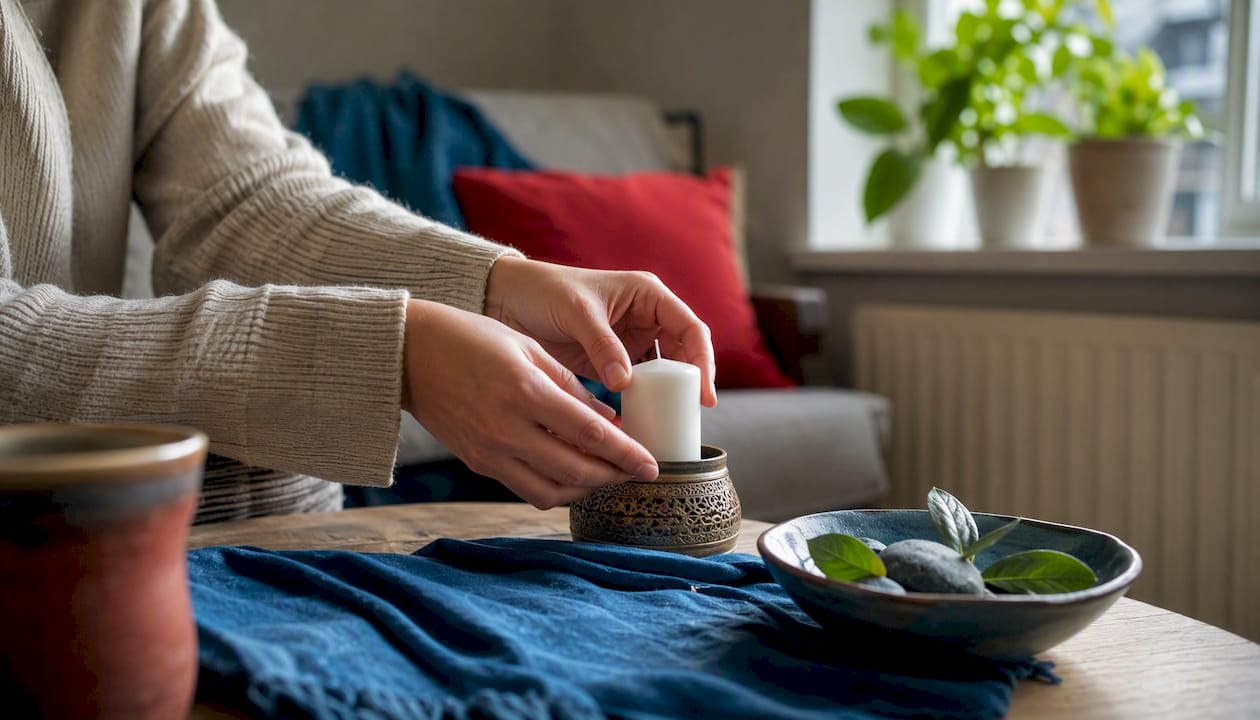
Introduce ritual or ancestor acknowledgement. Once you have professional support, consider a simple acknowledgement practice: light a candle, name an ancestor, and speak aloud what you are grateful for and what you are choosing to release. Daniel Foor’s framework of returning burdens to those they belong to can be adapted for personal use within a supported context.
Aftercare and community integration. Healing ancestral material is not a one-session event. Build an aftercare rhythm: regular check-ins with your practitioner, a journalling practice, and connection with a community, whether a family-constellation group, an online forum, or a peer circle.
Questions to ask a prospective practitioner:
Are you registered with BACP, UKCP, or HCPC?
Do you have specific training in intergenerational or somatic trauma?
What is your safeguarding policy for clients who become destabilised?
Do you have professional indemnity insurance and, for in-person UK work, a current DBS check?
Do you work with cultural material outside your own lineage, and if so, how do you approach that responsibly?
Pro Tip: Design your aftercare plan before your first deep session, not after. Write down three grounding tools you will use if you feel overwhelmed, one person you can call, and a rest window of at least two hours after any intensive session. Practical and time-bound beats vague and aspirational every time.
When should you seek professional help, and what are the red flags?
Some signs require professional support immediately, not eventually.
Seek urgent help if you notice:
Thoughts of self-harm or suicide
Overwhelming dissociation (feeling detached from your body or reality for extended periods)
Inability to function at work or in relationships due to emotional flooding
Substance use escalating as a way to manage emotional pain
If any of these apply, contact NHS 111, call 999, or reach the Samaritans on 116 123. Do not attempt deep ancestral work without professional support in place.
Credential checklist for UK practitioners:
BACP or UKCP registration (verifiable on their public registers)
Trauma-specific training named and described (not just “trauma-informed” as a general label)
Clear safeguarding and complaints procedures
Professional indemnity insurance
DBS check for in-person work with vulnerable adults
Red flags to watch for:
A practitioner who promises to “clear” your ancestral trauma in a single session
No clear safeguarding policy or complaints procedure
Pressure to commit to a long package before an initial consultation
Claims that their method is the only valid approach
Dismissal of your existing mental health support or medication
Pro Tip: Check a practitioner’s website before making contact. A credible trauma-informed practitioner will name their qualifications, their supervision arrangements, and their approach to client safety. If none of that is visible, ask directly in your first email. The quality of their response tells you a great deal.
How do you know healing is actually happening?
Progress in healing ancestral wounds rarely feels like steady improvement. More often, it feels like things getting louder before they get quieter.
Signs that can indicate productive integration:
Vivid or emotionally intense dreams that feel connected to family themes
Temporary emotional surges (grief, anger, relief) that arise and pass more quickly than before
Noticing a habitual pattern in the moment, rather than only in retrospect
A sense of grief for ancestors you never met
Physical sensations (warmth, trembling, release of held tension) during or after sessions
These are not signs that something is going wrong. They often signal that the nervous system is reorganising, processing material it previously had to suppress. As somatic practitioners describe it, healing can produce temporary discomfort as the body reintegrates previously frozen survival responses.
Timelines vary considerably. Some people notice meaningful shifts in their relationship patterns within a few months of consistent work. Deep integration of multi-generational material typically unfolds over years, not weeks. Small gains, a slightly less reactive response to a trigger, a new capacity to set a boundary, are worth tracking because they compound.
Slow down or pause if you notice:
Symptoms that are escalating rather than moving through
Increasing dissociation or emotional numbing
Inability to function in daily life
Your practitioner is unavailable or unresponsive when you need support
UK resources for ancestral trauma support
Finding good support in the UK is more straightforward than many people realise.
Professional directories:
Counselling Directory lists thousands of UK therapists with searchable specialisms; filter by “intergenerational trauma” or “family systems.”
BACP’s therapist finder (bacp.co.uk) lets you verify registration and search by location and specialism.
UKCP’s directory (psychotherapy.org.uk) covers psychotherapists with a wider range of modalities, including somatic and systemic approaches.
Community and group options:
Family-constellation groups run regularly in London, Bristol, Edinburgh, and other UK cities. Search for BACP- or UKCP-registered facilitators running these events.
Online UK-based peer circles focused on intergenerational healing have grown significantly since 2020; look for groups facilitated by a registered professional rather than purely peer-led.
Workshops by practitioners trained in the lineages of Tirzah Firestone or Daniel Foor occasionally run in the UK; check their websites for UK event listings.
Evaluating a UK event or course:
The facilitator should be registered with a recognised UK professional body or hold an equivalent international credential with named supervision.
The event description should include a safeguarding statement and a clear process for participants who become distressed.
Avoid events that promise resolution or “clearing” without acknowledging the complexity and time involved in genuine healing.
Why combining therapy and ritual is worth taking seriously
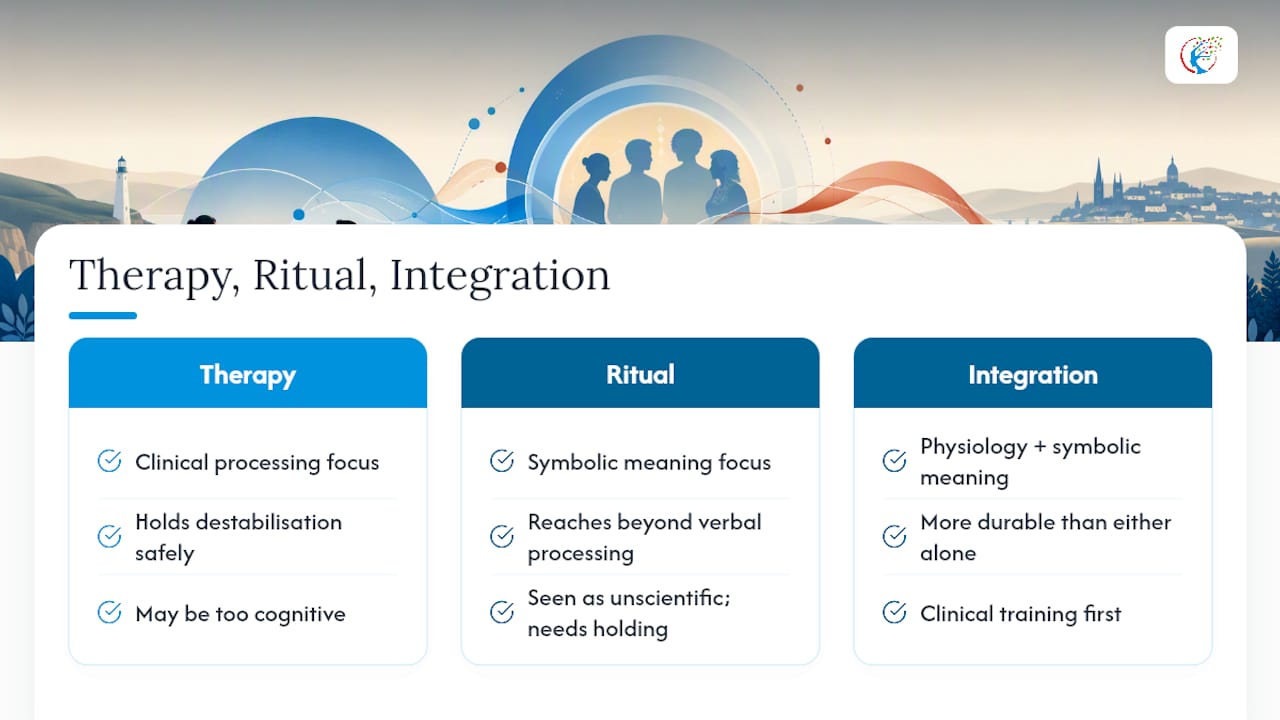
There is a tendency in both clinical and spiritual communities to dismiss the other’s tools. Therapists sometimes treat ritual as unscientific; ritual practitioners sometimes treat therapy as too cognitive to reach the deeper material. Both positions miss something real.
The nervous system does not distinguish between a somatic exercise in a therapy room and a candle-lighting ceremony at a family altar. What it responds to is safety, meaning, and relational co-regulation. When you combine a regulated nervous-system state with a meaningful symbolic act, you give the psyche two things at once: the physiological conditions for processing, and a story that makes sense of what is being released. That combination tends to be more durable than either alone.
Tirzah Firestone and Daniel Foor both trained in psychotherapy before developing their ritual practices. That sequence matters. The clinical training gives them the capacity to hold a client who becomes destabilised; the ritual arts give them tools that reach beyond what verbal processing can access. The integration is not a compromise between two approaches. It is a recognition that human beings are simultaneously nervous systems, meaning-making creatures, and members of lineages that extend far beyond their individual lives.
One caution: ritual practices drawn from Indigenous or non-Western traditions carry ethical obligations. Using them without understanding their cultural context, or without the guidance of someone from that lineage, risks both personal harm and cultural harm. Where possible, work with a practitioner who has genuine cultural custodianship of the tradition they are offering, or explore ancestral medicine frameworks that are transparent about their origins and ethics.
Ready to go deeper with QHHT and energy healing?
If you have read this far and recognise patterns in your family line that talk therapy alone has not shifted, QHHT and energy healing offer a different entry point. Paulstebles works with clients in South London, Bromley, and Kent, as well as remotely, combining regression hypnotherapy with energy healing to access subconscious and ancestral material in a safe, grounded container.
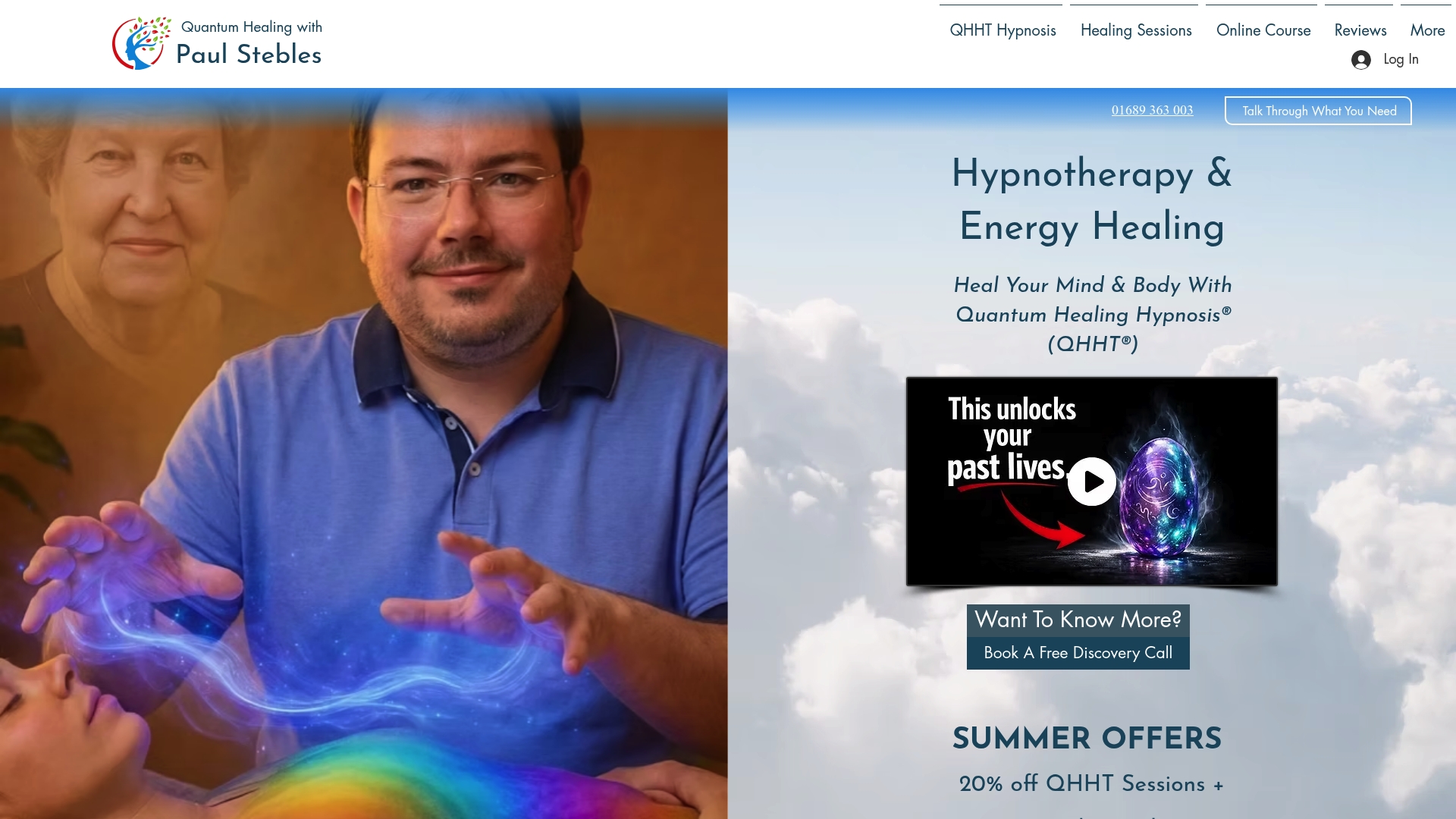
A first session typically involves a detailed consultation, a guided QHHT regression, and an integration conversation. Sessions are designed for people who are emotionally stable enough to engage with deeper material, not those currently in acute crisis (who should contact NHS services first). Paul’s practice holds professional indemnity insurance and follows clear safeguarding protocols.
If you are ready to explore what a session involves, the QHHT FAQ page answers the most common questions about what to expect. To book a consultation directly, visit the QHHT booking page.
Sources
This article provides general educational information and is not a substitute for professional psychological, medical, or therapeutic advice. If you are experiencing a mental health crisis, contact NHS 111, call 999, or reach the Samaritans on 116 123.
Recommended
Comments