Seven Day Anxiety Self Help Exercises for UK, NHS Aligned to Calm Fast


Diaphragmatic breathing, the 5-4-3-2-1 grounding technique and a 60-second somatic reset are the three anxiety self-help exercises worth learning first, because each one calms the body’s stress response within minutes and needs no equipment. They work best for mild to moderate anxiety when practised regularly, not just during a crisis, according to NHS guidance on CBT-based self-help. If your anxiety feels unmanageable right now, NHS 111 and Samaritans (116 123) are there to help immediately.
TL;DR:
The most effective immediate grounding for panic involves pressing hands on the body and focusing on physical sensations, which can reduce intensity within a minute.
Breathing techniques emphasizing longer exhalations, such as cyclic sighing or diaphragmatic breathing, activate the parasympathetic nervous system and lower physiological arousal quickly.
Regularly practicing a structured weekly routine of breathing, grounding, muscle relaxation, and thought records enhances long-term anxiety management and resilience.
Self-help exercises are most effective for mild to moderate anxiety and should be complemented by professional support if symptoms worsen or persist.
Using apps for guided breathing, journaling, and habit tracking can improve consistency and reinforce anxiety-reducing habits daily.
Table of Contents
Acute grounding: 60 to 90-second steps to stop a panic spiral
When anxiety spikes fast, you need something faster than thinking your way out. A somatic reset uses touch and breath together to interrupt the spiral before it builds.
Place both hands flat on your chest or thighs and press firmly for a slow count of five.
Breathe out for longer than you breathe in, aiming for a slow, audible exhalation.
Name one thing you can feel under your hands (fabric, warmth, your own pulse) to anchor attention in the body.
Repeat the press-and-breathe cycle three times, then check whether the intensity has dropped.
The 5-4-3-2-1 grounding technique works on the same principle but through the senses: five things you see, four you feel, three you hear, two you smell, one you taste. It is most useful early, as anxiety starts building, rather than once you are already in full panic. A detailed walk-through of this 60-second reset is worth bookmarking for the emergency steps to calm your body.
Pro Tip: Practise your grounding sequence when you are calm, not just when you are anxious. A cue you have rehearsed is far easier to recall under stress than one you are learning on the spot.

Breathing exercises that reduce physiological arousal
Slow, deep exhalation is the part that does the work. When you breathe out for longer than you breathe in, you signal to your nervous system that the threat has passed, which is why breath-based exercises are a first-line recommendation in NHS self-help materials.
Diaphragmatic breathing: breathe into your belly rather than your chest, feel it rise, then exhale slowly through pursed lips for longer than the inhale.
Box breathing: inhale for four counts, hold for four, exhale for four, hold for four, and repeat for two minutes.
4-7-8 breathing: inhale for four counts, hold for seven, exhale for eight, useful when you have a moment of quiet before a stressful event.
Cyclic sighing: take a normal breath in, top it up with a second short inhale, then release a long, slow exhale.
Research from Stanford Medicine found that breathing practices emphasising longer exhalations, such as cyclic sighing, activate the parasympathetic nervous system and can produce faster reductions in physiological arousal than other breathing styles. That single finding is a useful shortcut: whichever technique you choose, make the exhale longer than the inhale. A short daily session, even two or three minutes, trains this response so it becomes automatic when you need it under pressure.
Grounding and sensory techniques for different situations
Grounding is not one technique but a family of them, and having a few options means you can pick whatever fits where you are.
Mental grounding: count backwards from 100 in sevens, name all the red things in the room, or silently categorise objects around you by type.
Physical grounding: clench your fists tightly for five seconds then release, run cold water over your hands, or do a few slow shoulder and neck stretches.
Soothing grounding: play a familiar song, hold a textured object like a smooth stone, or spend a few minutes with a pet or outdoors.
The Cleveland Clinic notes that grounding techniques are commonly used in therapy to interrupt anxious thought spirals and work best when practised regularly rather than saved only for emergencies. Clinical experts frame grounding as a genuine therapeutic tool rather than a distraction technique, since it helps people process what they are feeling from a calmer baseline instead of avoiding it altogether. Choosing which type suits you often depends on where you are. Mental grounding works well at a desk, physical grounding suits a bathroom break, and soothing grounding fits best at home.
Progressive muscle relaxation and quick active moves
Progressive muscle relaxation (PMR) works by deliberately tensing a muscle group, holding it, then releasing and noticing the contrast. According to the Oxford Health anxiety management workbook, this sequence reduces physical tension and builds body awareness with regular practice.
Start with your feet: tense for five seconds, then release and notice the difference.
Move upward through calves, thighs, stomach, hands, arms, shoulders, and finally your face.
Hold each tense phase for around five seconds before releasing slowly.
Stop if you feel dizzy or lightheaded, and return to normal breathing.
When you do not have ten minutes for a full PMR sequence, shorter active moves help too: a few slow neck rolls, deliberate shoulder shrugs, or a short walk with attention on your footsteps. Pairing PMR with slow breathing, doing both a few times a week rather than only when anxious, tends to build the most lasting benefit.
CBT-style exercises to challenge unhelpful thoughts
Cognitive behavioural therapy techniques give you a structure for anxious thoughts rather than just a way to calm the body. NHS Every Mind Matters recommends self-help CBT techniques such as scheduled worry time, reframing unhelpful thoughts, and gradually facing feared situations.
Worry time: set aside a fixed 15-minute slot each day to write down worries, then close the notebook when the time is up.
Thought record: log the trigger, the automatic thought, the evidence for and against it, and a more balanced alternative thought.
Behavioural experiment: pick one small feared outcome, test it deliberately in a low-stakes way, and record what actually happened.
A compact way to try this: if you dread sending a certain email, write down what you predict will happen, send it, then compare the prediction to reality. Doing this a handful of times chips away at the automatic assumption that the worst outcome is the likely one. Full guidance on setting up worry time is covered in this method for stopping rumination.
Pro Tip: Keep your thought record to four columns and a single sentence each. If it takes more than five minutes to fill in, you are less likely to keep doing it.
Building a repeatable seven-day anxiety routine
A single good session rarely changes much on its own. Consistency across a week does more than any one technique practised perfectly once.
Day 1 to 2: five minutes of diaphragmatic or cyclic sighing breathing each morning.
Day 3: add a 5-4-3-2-1 grounding round in the afternoon, especially before a known trigger.
Day 4 to 5: introduce a short PMR sequence in the evening, ten minutes at most.
Day 6: add your first thought record when something bothers you during the day.
Day 7: set a 15-minute worry time slot and review what has helped most so far.
Log each attempt with a single word or a tick in a notebook or phone app: this small habit alone increases follow-through. Stack new exercises onto something you already do daily, such as brushing your teeth or making tea, and scale up slowly rather than trying everything at once. If you miss a day, simply resume the next one rather than restarting the whole plan.
When self-help is not enough: getting professional support
Self-help exercises help a great deal with mild to moderate anxiety, but some signs mean it is time to get further support.
Thoughts of suicide or self-harm at any intensity.
A marked drop in your ability to work, study, or manage daily tasks.
Panic that persists or worsens despite regular practice of the exercises above.
Adults can self-refer directly to NHS Talking Therapies without needing to see a GP first, and this route is available from age 18, or 16 in some areas. For anything urgent, NHS 111 can direct you to same-day mental health support, and Samaritans are reachable free on 116 123 at any hour. A GP visit is worthwhile if anxiety has been persistent for several weeks or is affecting sleep, appetite, or relationships.
Mindfulness meditation techniques specifically for anxiety
Mindfulness for anxiety works differently to grounding: instead of pulling attention away from anxious thoughts, it asks you to notice them without reacting. A simple version involves sitting quietly and observing each thought as it arises, labelling it gently (“that’s a worry thought”) rather than following it down a spiral.
Body scan meditation is one of the more accessible starting points: move your attention slowly from your toes to your scalp, noticing sensation without trying to change anything. Ten minutes is enough to start with. Breath-focused mindfulness, simply resting attention on the sensation of air moving in and out, works well when paired with the exhale-focused breathing covered earlier, since both calm the body while training attention to stay in the present rather than the future.

The key distinction from grounding is intention: mindfulness is about observing rather than distracting, which some people find harder at first because anxious thoughts do not disappear immediately. Regular short sessions, five to ten minutes daily, tend to build this skill more reliably than occasional longer ones. A practical guide to mindfulness exercises covers several variations worth trying if the body scan does not suit you. Background on how mindfulness fits into deeper subconscious work is also covered in this piece on mindfulness for anxiety.
Visualisation and guided imagery exercises
Visualisation works by giving your mind a specific, calming scene to focus on instead of an anxious one. The classic version is a “safe place” exercise: picture somewhere you feel completely at ease, real or imagined, and build it out with detail, what you can see, hear, and feel there.
A more targeted version rehearses a stressful event before it happens. If a work presentation or medical appointment is causing anticipatory anxiety, spend a few minutes picturing yourself walking through it calmly, from arrival in the moment it is over. This will not remove all nerves, but it gives your mind a more manageable version of the event to hold onto than a vague sense of dread.
Guided imagery recordings, often ten to twenty minutes long, talk you through a scene step by step and can be easier to follow than self-directed visualisation when you are first learning. Try one in a quiet moment rather than only reaching for it mid-panic, since like grounding, it works better once it is familiar.
Journaling exercises focused on anxiety management
Journaling gives anxious thoughts somewhere to go other than round in your head. The simplest version is a nightly brain dump: write whatever is on your mind for five minutes without editing or organising it, then close the notebook.
More structured journaling pairs well with the CBT thought record covered earlier: each entry notes the trigger, the thought, and one alternative way of seeing it. A gratitude or “three good things” entry at the end of each day works differently, shifting attention toward what went well rather than what went wrong, which some people find balances out a day spent mostly noticing threats.
Tracking patterns over a few weeks, what tends to trigger anxious spikes, what times of day feel worse, can be more useful than any single entry. Reviewing a fortnight of journal entries often reveals a pattern the reader had not consciously noticed, such as anxiety consistently worsening on Sunday evenings or after certain conversations.
Lifestyle adjustments that support these exercises
None of these exercises work in isolation from how you are sleeping, eating, and moving. Poor sleep amplifies anxious thinking, so a consistent bedtime and winding-down routine, dimmed lights, no screens, a fixed wake time, makes every other technique easier to apply. If racing thoughts at night are a specific problem, doing a short body scan or diaphragmatic breathing session in bed is often more effective than trying to reason your way to sleep.
Diet has a more indirect effect: heavy caffeine intake can mimic or worsen physical anxiety symptoms such as a racing heart, and skipping meals tends to make mood swings and irritability worse. Regular movement, even a daily walk, is one of the more consistently recommended lifestyle changes for anxiety, and the NHS notes that small, enjoyable activities done consistently outperform occasional intense exercise. None of these adjustments replace the exercises above, but they lower the baseline you are working from, making breathing, grounding, and CBT techniques noticeably easier to apply on a difficult day.
Using apps and digital tools to support your practice
A phone app will not treat anxiety on its own, but it can make consistent practice far easier than relying on memory alone. Guided breathing apps with visual pacing cues are useful for cyclic sighing or box breathing, since watching a shape expand and contract removes the need to count in your head. Meditation apps with anxiety-specific tracks work well for the mindfulness and body scan exercises covered earlier.
Journaling apps with simple prompts can replace a paper notebook if that is more likely to get used daily, and some let you tag entries by mood, which makes spotting patterns over weeks far quicker than flicking back through handwritten pages. Habit-tracking apps, even a basic tick-box calendar, support the seven-day routine outlined earlier by making missed days visible rather than easy to ignore.
Choose one tool for one purpose rather than several apps competing for attention: a single breathing app used daily beats five apps opened once each. The goal is removing friction from practice, not adding another thing to manage.
Why structured self-help is only the first layer
Breathing, grounding, and thought records are genuinely useful, and they are also where most people stop. What gets underestimated is how much anxiety sits below conscious thought, shaped by patterns formed long before the anxious habit itself took hold. Techniques that regulate the nervous system in the moment do not always address why the nervous system is on alert so often in the first place.
That gap is where I focus my work. Before any deeper exploration, I help clients build the same kind of grounding and breathing stability covered in this article, because a settled body makes subconscious work more productive, not less necessary. Once that groundwork is there, sessions such as Quantum Healing Hypnosis or energy healing give some clients a route to understanding the roots of anxiety that daily exercises alone cannot reach, and the integration afterward tends to go further when a simple routine is already in place.
— Paul
How Paul Stebles’ sessions and the Rising Higher course can help
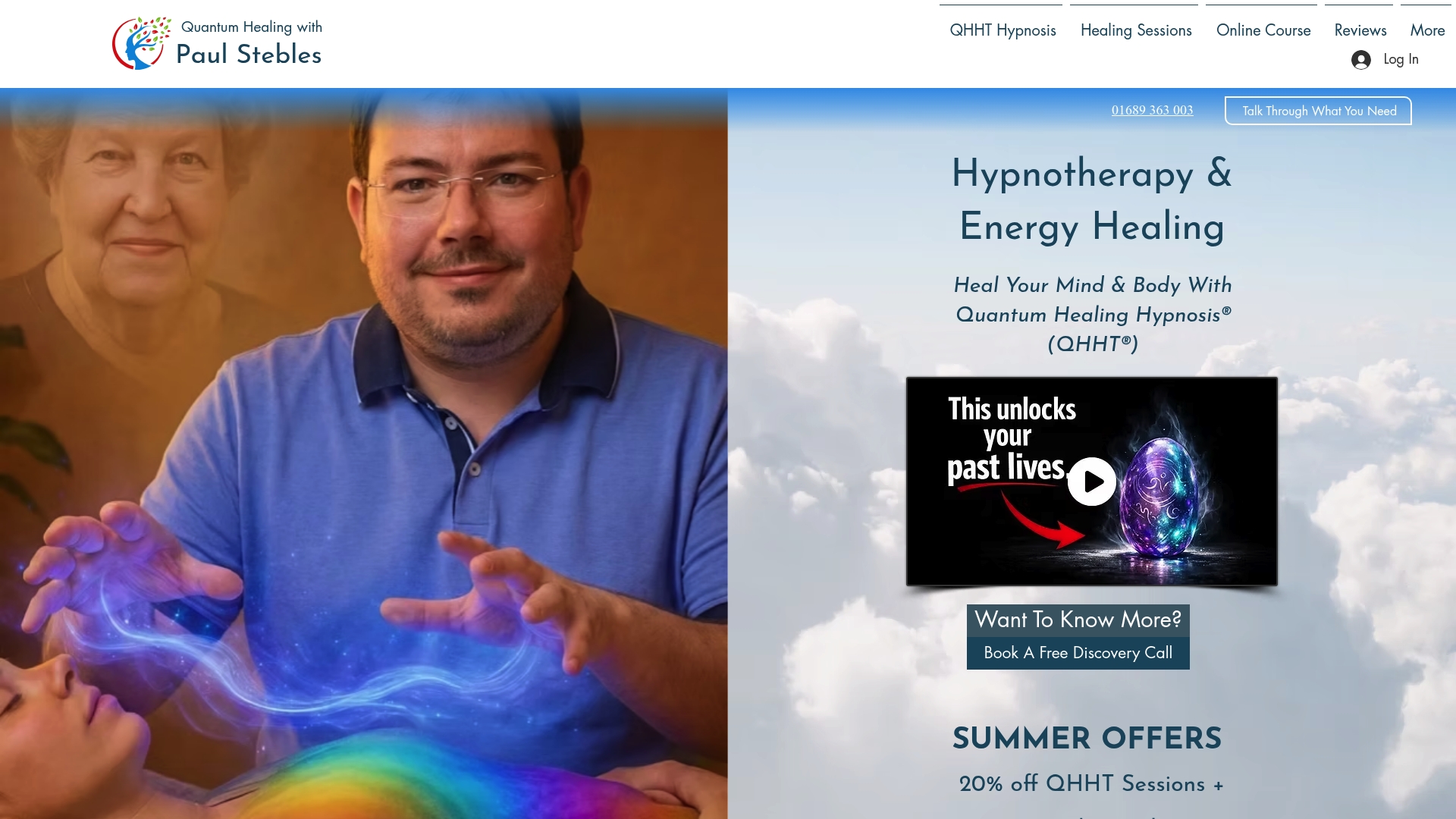
If the exercises above have helped but you want guidance tailored to what is actually driving your anxiety, that is where a session with Paul Stebles fits. The starting point for most clients is stabilising the body with tools much like the ones covered here, then moving into deeper work at whatever pace suits them.
QHHT® - Quantum Healing Hypnosis, a full regression hypnotherapy session for exploring the roots of anxious patterns.
Mobile QHHT® - Quantum Healing Hypnosis, the same session brought to your own space.
Evolve Quantum Healing and Remote Evolve Quantum Healing, combining Reiki, chakra balancing and emotional release work.
Rising Higher Online Course, a structured video course for working through anxiety and depression at your own pace.
Sessions run at a pace built around each client rather than a fixed script, with extended time built in for the work to settle. You can see availability and book a session directly when you are ready to take this further.
This article is general information, not a substitute for advice from a qualified doctor. Consult a qualified healthcare professional about your own circumstances before acting on anything here.
Sources
FAQ
How can I calm anxious thoughts quickly?
Slow your breathing so the exhale is longer than the inhale, then use a grounding technique such as 5-4-3-2-1 to bring attention back to your senses. Doing this early, as anxiety starts to build rather than once it peaks, tends to work better.
What are natural ways to reduce anxiety without medication?
Regular practice of breathing exercises, grounding techniques and progressive muscle relaxation are the main self-help tools recommended in NHS self-help guidance. Sleep, regular movement and reduced caffeine also lower baseline anxiety and make these exercises more effective.
What is the best exercise for getting rid of anxiety fast?
There is no single best exercise, but a 60-second somatic reset combining hand pressure with slow exhalation is one of the fastest to interrupt a building panic spiral. Pairing it with the 5-4-3-2-1 technique covers both body and senses at once.
What are some effective hacks for reducing anxiety day to day?
Short, repeated practice beats occasional long sessions: five minutes of breathing each morning, a grounding round when triggered, and a nightly thought record build up over a week. Logging attempts in a notebook or app, even briefly, measurably improves how consistently people actually keep doing these exercises.
When should I seek professional help instead of self-help alone?
Seek support if anxiety persists despite regular practice, if it is stopping you from working or managing daily tasks, or if you have any thoughts of self-harm. Adults can self-refer to NHS Talking Therapies directly, and NHS 111 or Samaritans on 116 123 are available for anything urgent.
Recommended
Comments