3 Daily Rituals That Heal Breakups Spiritually: UK QHHT Clinician


Spiritual healing after a breakup starts with three short daily acts: a grounding breath, a heart-centred affirmation, and one honest line in a journal. These stabilise your nervous system before you attempt anything deeper. Do them in the next ten minutes if you can. Beyond that, treat healing as a process measured in weeks and months, not a race to feel better by Friday.
TL;DR:
Micro-practices like daily grounding breath, heart affirmation, and journaling can help stabilize the nervous system during early breakup healing.
Regularly practicing cord cutting visualizations helps manage lingering attachments but requires repeated sessions for lasting effects.
Consistent heart chakra openings, through breathwork and gentle movement, facilitate emotional flow without forcing positivity.
Grounding techniques such as deep breathing and cold water taps can immediately calm intense grief spikes and prevent panic.
Focused reflection with specific journaling templates guides meaningful processing and prevents rumination from intensifying emotional loops.
Table of Contents
What does breakup healing spiritually actually involve?
Breakup healing spiritually means treating heartbreak as more than an emotional event. It’s an energetic and psychological one too, with practices drawn from meditation, energy work, and reflective ritual sitting alongside ordinary self-care. The distinction matters because most people try to think their way out of grief, when the more effective route often runs through the body and the nervous system first.
A daily rhythm that actually holds
Start each morning with a short ritual of slow breathing, a heart-centred affirmation such as “I release what no longer serves me and welcome what does,” and a single sentence of intention written down before you check your phone. This sequencing matters. Checking messages first thing puts your nervous system into reactive mode before you’ve had a chance to settle it.
Morning ritual: breathwork, one affirmation, one written intention.
Trigger response (60 to 90 seconds): when a memory or notification hits, pause, name what you’re feeling out loud, then either walk it off or write one line.
Weekly deeper work: a cord-clearing meditation, a Reiki or sound-healing session, or a small reflective ceremony (burning a written letter, lighting a candle for closure).
Micro-practices matter more than the big weekly ritual, because triggers arrive without warning. A photo resurfaces, a song plays in a shop, someone mentions their name. Rather than suppressing the spike, give it a ritualised pause: name the feeling, breathe for four counts, then choose a safe distraction (calling a friend, a short walk) instead of scrolling their profile.
Practitioners generally advise moving through grief rather than trying to bypass it. That means letting the body express what it’s holding, through movement, sound, or simply sitting with the emotion, instead of rushing to feel neutral again, according to guidance from Kripalu on healing grief after a breakup. Fighting the wave usually prolongs it.
Pro Tip: Keep your toolkit small on purpose. Pick one morning ritual and one trigger response, and repeat them for three weeks before adding anything new. Practitioners increasingly warn against what’s been called “spiritual consumerism”: collecting more techniques instead of going deeper with the few that work, according to Tiffani Walker Coaching.
What is cord cutting and does it really work?
An energetic cord, in this framework, is the lingering pull you feel towards someone after a relationship ends: the urge to check their social media, the phantom sense they’re thinking about you, the way certain rooms or songs still feel occupied by them. Cord cutting is a visualisation practice aimed at symbolically severing that ongoing attachment so your energy and attention return to you.
It won’t erase memories or grief on its own, and it isn’t a substitute for processing what happened. What it can do is give you a concrete ritual for the moment you decide, deliberately, to stop feeding the connection.
Here’s a version you can try tonight:
Sit or lie somewhere quiet and take five slow breaths.
Picture the other person standing a few feet away, and notice a cord of light connecting your chest to theirs.
Say, either aloud or silently: “I release this cord with love. I keep the lessons and return what is mine.”
Visualise the cord dissolving, or cut it with a symbolic gesture (a hand movement, a pair of imaginary scissors).
Picture the space where the cord was filling with light, then place both hands on your chest for thirty seconds.
Practitioners who work with this technique regularly describe it as recurring energetic hygiene rather than a single fix. You may need to repeat the visualisation regularly, particularly in the first weeks, according to observations from House of Cleo Devine. That’s normal, not a sign it isn’t working.
Afterwards, expect anything from calm relief to unexpected tears. Both are common. If the session leaves you shaky, drink water, ground your feet on the floor, and journal briefly rather than analysing it too hard. Book a session with a practitioner if the emotion feels disproportionate to the ritual, if old trauma surfaces you weren’t expecting, or if you find yourself repeating the exercise obsessively without relief. Reiki aftercare guidance covers what to expect in more depth if you’re new to energy work generally.
How do you open the heart chakra after heartbreak?
The heart chakra, associated with love, connection, and grief in energy-healing traditions, is where most breakup pain is said to lodge. Opening or balancing it isn’t about forcing positivity. It’s about restoring emotional flow so you can feel sadness without getting stuck in it.

A short morning or evening practice works best: sit with your hand on your chest, breathe into that space for two minutes, and repeat the mantra “YAM” softly, either aloud or internally, on each exhale. YAM is the traditional seed sound associated with the heart centre in yogic tradition. A short daily ritual of this kind practised consistently is one of the most commonly used heart chakra techniques among practitioners and shows ongoing engagement on platforms like Insight Timer’s heart chakra practice.
Pair the meditation with gentle movement:
Camel pose or a simple backbend, held for three to five breaths, to physically open the chest.
Cat-cow flow, ten rounds, to release tension held in the upper spine and shoulders.
A short visualisation holding a piece of rose quartz, or any object that symbolises self-worth, while picturing green or pink light expanding from your chest.
The crystal or object is a focus point, not the mechanism. If you find yourself needing to hold it before you can feel calm, that’s worth noticing. Real progress looks like reaching for the ritual less often over time, not depending on it more. A full heart-chakra healing guide walks through the sequence in more detail.
What grounding techniques calm acute grief spikes?
When grief spikes hard, sadness turning into panic, a racing chest, the urge to text them at 2am, your body needs a physical anchor before any meditation will land.
Feet first. Press both feet flat into the floor and name five things you can see in the room.
Paced breathing. Inhale for four counts, hold for four, exhale for six. Repeat six times.
Cold water. Run cold water over your wrists for thirty seconds; it slows the heart rate quickly.
Stand and stretch. Reach both arms overhead, then let them drop, three times.
That whole sequence takes under ninety seconds and works because it interrupts the panic loop before your thoughts catch up. Walking barefoot on grass or a hard floor for five minutes achieves something similar more slowly, and works well as an evening wind-down rather than an emergency measure. For a longer guided version of this exact sequence, Paul’s 60 second somatic grounding page walks through it step by step.
What should you write in a breakup journal?
Rumination and reflection feel similar but produce opposite results. Rumination loops the same hurt without moving anywhere. Reflection extracts something from it. Three short templates keep you on the right side of that line.
The processing page: one column for facts (what actually happened), one for feelings (what came up), one for needs (what you actually needed and didn’t get).
The lesson template: finish three prompts starting “This relationship taught me about my worth…”, “…about my boundaries…”, and “…about what I actually want next.”
The compassion letter: write a short letter to yourself as though from a wise friend, forgiving yourself for what you didn’t know then.
Pro Tip: Always follow the compassion letter with two minutes of grounding, hand on chest, slow breath. Writing self-compassion can stir up more emotion than expected, and closing the exercise properly matters as much as the writing itself. For more structured techniques on releasing what surfaces, see emotional release therapy.
When should you add therapy to spiritual healing?
Spiritual practice and professional mental health support aren’t competing options. Research on spirituality and recovery suggests the two are genuinely complementary: spiritual work tends to supply meaning and structure, while therapy addresses the parts of you that aren’t functioning day to day.
Watch for these signs that it’s time to bring in professional support alongside your rituals:
You can’t work, eat, or sleep properly for more than two weeks.
Thoughts of self-harm or suicide appear, even briefly.
Insomnia persists most nights for over a fortnight.
You feel numb rather than sad, unable to access emotion at all.
If you do see a therapist, tell them plainly what spiritual tools you’re using: cord cutting, chakra meditation, journalling prompts. A good therapist will work alongside that rather than dismiss it. For relationship patterns that keep repeating, couples counselling is worth exploring even post-breakup, particularly if you’re trying to understand your own role in the dynamic before the next relationship.
How does Paul work with clients healing from heartbreak?
Paul combines Quantum Healing Hypnosis Technique (QHHT) with energy healing, Reiki, chakra balancing, cord cutting, and belief transformation, tailored to what a client is carrying. Sessions run in person or remotely, and the format stays deliberately unhurried: extended time, a calm space, and enough room for the subconscious material to surface without being rushed.
QHHT sessions suit clients wanting to understand deeper patterns behind repeated relationship pain, sometimes tracing them to past-life or subconscious material.
Energy healing sessions (Reiki, cord cutting, chakra work) suit clients who want the somatic and energetic release without the regression component.
Both integrate naturally with the DIY practices above. Many clients start with daily rituals and book a session when they hit a plateau or need deeper cord work than solo visualisation can reach.
Professional qualifications and client testimonials are available on the booking page.
Depth over speed: why the quick fix rarely holds
Most people want breakup healing to work like a checklist: do the ritual, feel better, move on. It doesn’t work that way, and pretending otherwise sets people up to feel like they’re failing at grief.
The practitioners worth listening to on this all say roughly the same thing: stop collecting new tools and go deeper with fewer ones. Chasing the next technique often just recreates the same restlessness that made the breakup hard to sit with in the first place. If you take one thing from everything above, let it be this: pick your morning ritual, pick your grounding response, and stay with them longer than feels comfortable before adding anything new.
— Paul
Ready to go deeper than a solo ritual can take you?
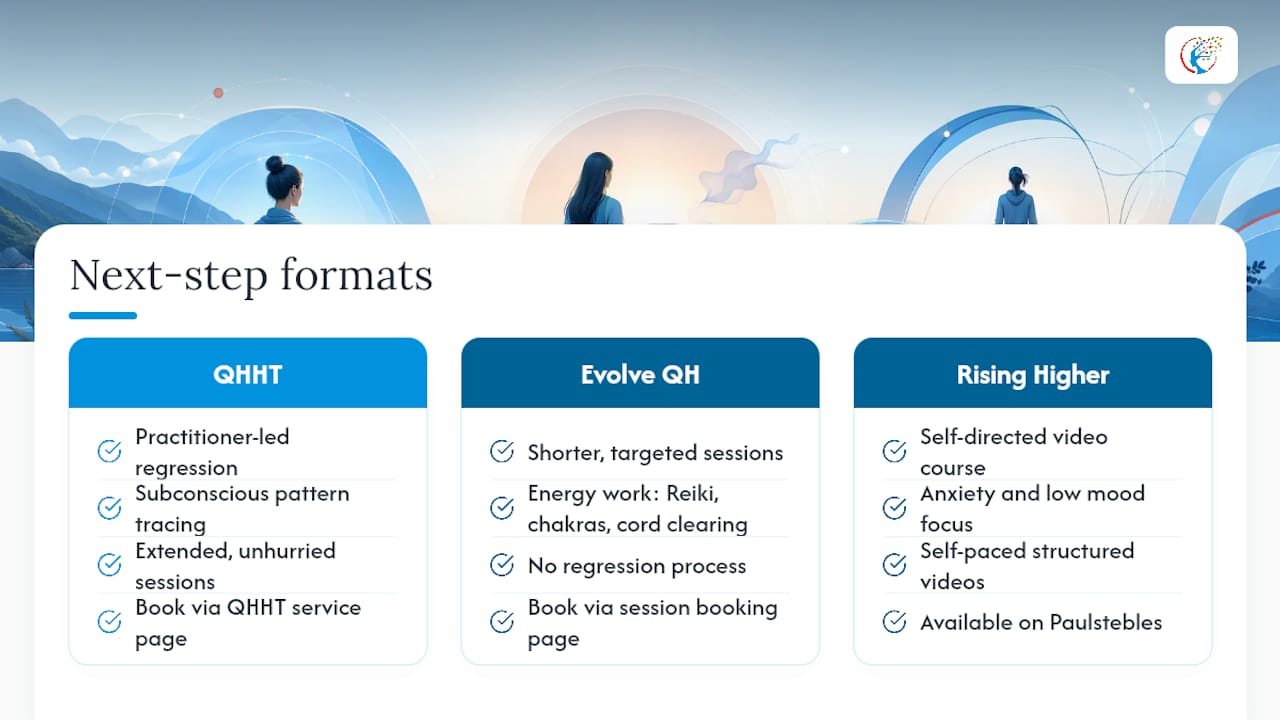
If you’ve tried the daily practices above and still feel stuck, that plateau is usually where solo visualisation reaches its limit and practitioner-led work earns its keep. Extended, unhurried sessions are offered, built around a calm, trauma-informed space where deeper cord and belief work can take place.

QHHT sessions suit anyone wanting to trace relationship patterns back to their subconscious root through guided regression. Book either through the session booking page. If you want something shorter and more targeted, Evolve Quantum Healing sessions focus specifically on energy work: Reiki, chakra balancing, and cord clearing, without the full regression process. Full service details sit on the QHHT service page.
Prefer a self-directed route first? The Rising Higher online course on Paulstebles offers structured video content for working through anxiety and low mood at your own pace, before or instead of booking a one-to-one session. Either way, the next step is simple: pick the format that matches how much support you want right now, and book it.
Sources
The claims above draw on peer-reviewed evidence and practitioner guidance: the PMC review on spirituality and recovery for clinical context, Kripalu and Tiffani Walker Coaching for grief-processing guidance, House of Cleo Devine on cord-cutting practice, and Meridian Counseling on the spiritual framing of breakups.
FAQ
How do you get over a breakup fast?
There’s no genuine shortcut, and rushing tends to backfire by pushing feelings underground rather than resolving them. What helps most is a short daily ritual (grounding breath, heart affirmation, one journal line) practised consistently rather than intensely, since research on spirituality and recovery shows steady practice supports resilience better than occasional bursts of effort.
What spiritual awakenings can occur after a breakup?
Breakups often act as catalysts for deeper self-examination, prompting people to question their values, boundaries, and sense of purpose in ways they hadn’t before. Practitioner analyses describe this as a common pattern where the ending of a relationship triggers real personal growth rather than just loss, according to Meridian Counseling.
Is anger a normal feeling after a breakup?
Yes, anger is a normal and often necessary stage of grieving a relationship, and suppressing it tends to prolong the process rather than shorten it. Practitioners generally recommend expressing it through movement or vocalisation rather than pushing it down, in line with guidance on moving through grief rather than avoiding it.
What does it mean to feel relief after breaking up?
Relief after a breakup usually means the relationship was costing you more energy or peace than you’d consciously registered, and it’s a completely valid response even alongside sadness. It doesn’t mean you didn’t care, and it often signals that some form of healing has already quietly begun.
Does cord cutting actually work, or is it just visualisation?
Cord cutting is a visualisation ritual, not a clinically tested treatment, and it works best as a tool for intentionally redirecting your energy and attention rather than a magic fix. Practitioners describe it as recurring energetic hygiene that usually needs repeating, not a one-time cure, according to House of Cleo Devine.
Recommended
Comments