Pick a UK QHHT Practitioner Who Runs 4–5 Hour In Person Sessions


Choose an in-person QHHT practitioner who follows QHHT Academy guidance, holds sessions of at least four to five hours, offers you a recording, and feels right the moment you speak to them. Contact two or three practitioners this week. Ask each one about their level, their session length, and their recording policy before you book anything.
TL;DR:
Practitioners should conduct sessions in person for at least four to five hours, with a clear policy on recording and a minimum experience level.
Level 3 practitioners, with over 125 verified sessions and additional training, generally offer more seasoned guidance, though experience isn’t the only quality indicator.
Verify practitioner credentials by asking about session length, recording policies, and response speed, and compare answers across multiple practitioners to spot inconsistencies.
Red flags include remote sessions, sessions shorter than four hours, and pressure to book multiple follow-ups; trust immediate red flags and authentic testimonials.
Prepare physically and mentally by resting, writing questions in advance, and scheduling recovery time, then listen to the recording and journal insights after the session.
Table of Contents
What to check before you choose a QHHT practitioner
Screening practitioners takes ten minutes if you know what to look for. Most people skip the checking stage entirely and book whoever appears first in a search, which is exactly how they end up disappointed.
Run through this before you hand over any money:
In-person only. QHHT was built around physical presence, and sessions should run for a minimum of four to five hours.
Level and session count. Ask what level the practitioner holds and roughly how many sessions they’ve conducted.
Recording provided. Confirm the session is recorded and that you leave with your own copy.
Communication. Notice how quickly and clearly they answer your first message. It tells you how they’ll handle you on the day.
Rapport and testimonials. Read a few genuine client accounts, but trust your own gut reaction during that first conversation too.
None of these criteria are complicated, but skipping even one of them is where things tend to go wrong. A practitioner who ticks every box on paper but makes you feel rushed on the phone is not the right fit, whatever their credentials say.
What do QHHT practitioner levels actually mean?
QHHT practitioners are graded across three tiers, and the tier tells you far more about hands-on experience than any marketing copy does. According to the QHHT Academy, the structure runs like this:
Level 1: at least 25 verified sessions completed.
Level 2: 25 or more sessions plus additional advanced training.
Level 3: 125 or more verified sessions, plus a further skills evaluation.
That gap between Level 1 and Level 3 is the difference between someone still finding their rhythm and someone who has guided over a hundred people through the same process, seen most of the ways a session can unfold, and adjusted their approach accordingly.
Higher levels don’t guarantee a better outcome for you personally, and a newer practitioner with the right manner can still give you a genuinely valuable session. Levels are a useful filter, not a certainty. Pricing sits outside this grading system entirely: practitioners work as independent sole proprietors and set their own rates, so a Level 3 practitioner in one town might charge less than a Level 1 practitioner elsewhere. Use the level as one data point among several, not the only one.
What should you ask a practitioner before booking?
A short phone call or email exchange before booking answers most of the questions that actually matter. Ask these directly:
Do you conduct sessions in person, and how long do they typically run? The answer should be yes, and several hours minimum.
Do you follow the recommendations set out by the QHHT Academy?
Is the session recorded, and will I receive a copy afterwards?
What level are you, and roughly how many sessions have you completed?
What’s your cancellation and rescheduling policy?
Do you take part in ongoing training?
How quickly do you typically respond to questions, before and after the session?
The way someone answers matters as much as the answer itself. A practitioner who dodges the recording question, or gets vague about session length, has told you something important without saying it outright.
Pro Tip: Send the same set of questions to two or three practitioners in one sitting. Comparing their replies side by side makes inconsistencies and red flags far easier to spot than judging each one in isolation.
What actually happens during a QHHT session?
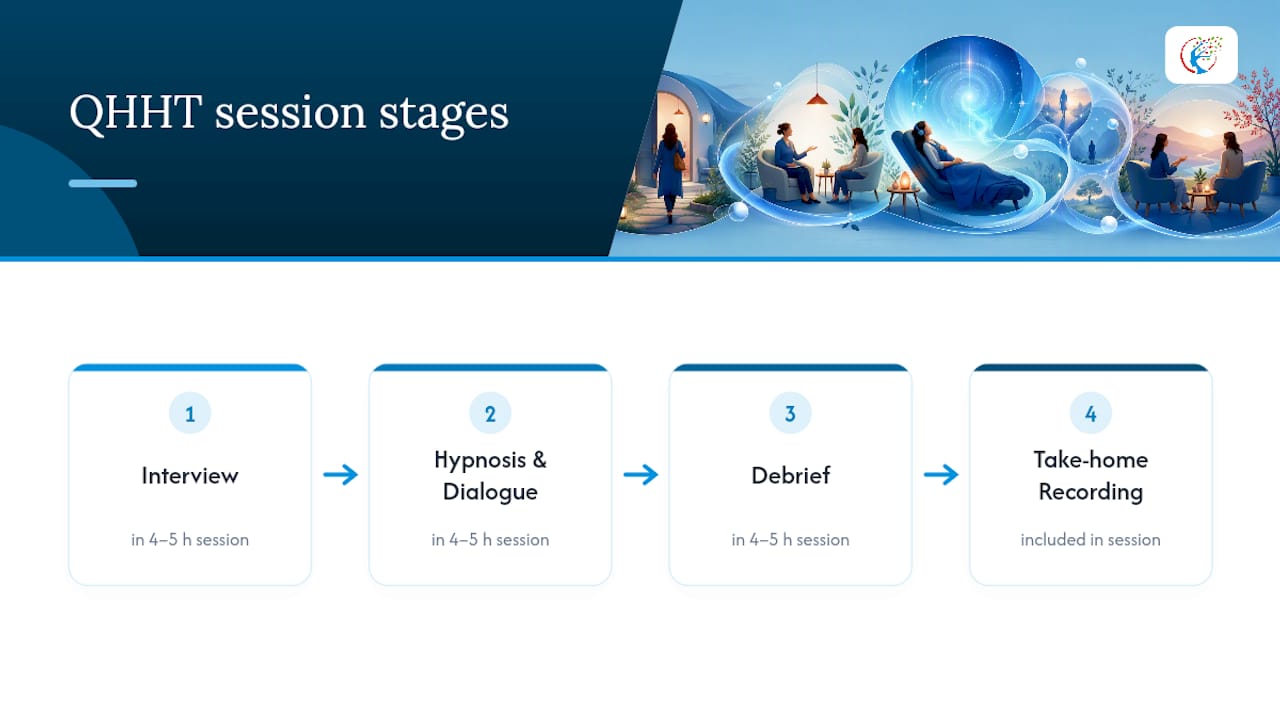
A genuine QHHT session follows a fairly consistent shape, and knowing it in advance helps you judge whether a practitioner is running things properly. Expect four stages:
A pre-session interview, usually an hour or more, where you talk through your history and the questions you want answered.
The induction and hypnosis phase, guiding you into a deeply relaxed state.
Dialogue with the higher self, the part most people associate with QHHT, where insight and healing work tends to happen.
A post-session debrief, talking through what came up while it’s still fresh.
The whole process typically runs four to five hours or longer in a single sitting, and official guidance treats QHHT as a one-time comprehensive experience rather than something you repeat weekly; for a comparable perspective on extended therapy sessions, see how therapy sessions are conducted. A properly run session is recorded throughout, and a practitioner who blends in other unrelated techniques mid-session, without explaining why beforehand, is straying from the established method.
Which warning signs should make you walk away?
Some signals are worth trusting immediately, and others are worth walking away from just as fast. Watch for these red flags:
Remote or Zoom-based “QHHT.” Physical presence is part of the method, and remote sessions don’t conform to it.
Sessions noticeably shorter than four hours.
Pressure to book repeat sessions as a standard part of the process, rather than as your own informed choice.
On the flip side, trust these:
A practitioner who states their level and session count without being asked twice.
One who offers a recording as a matter of course, not as a favour.
Testimonials you can actually trace back to real people.
A reply that lands within a day or two, not a week.
If the objective checks all pass but something feels off in conversation, believe that feeling. Experienced practitioners themselves recommend combining the two: the paperwork and your own sense of the person.
How should you prepare and what happens afterwards?
Sessions this long ask a lot of your body and mind, so a little preparation pays off. Follow these steps either side of the appointment:
Rest well the night before and skip alcohol or recreational drugs for at least 24 hours beforehand.
Write your questions down in advance so nothing gets lost once you’re in the room.
Arrange your travel and the rest of your day around a session that could run five hours or longer, plus recovery time afterwards.
Disclose relevant medical or psychiatric history to your practitioner beforehand so they can advise you properly.
Ask for the recording once the session ends and listen back within a few days, while the detail is still fresh.
Journal what came up rather than trying to hold it all in memory.
Aftercare is where a lot of the value of the session actually settles in, often more than the hours in the chair themselves.
How much should a QHHT session cost?
There’s no fixed price list for QHHT because practitioners operate as independent sole proprietors who set their own rates. That means cost varies by practitioner, location, and experience level, and a lower price does not automatically mean lower quality, nor does a higher one guarantee a better session.
What you’re paying for is a single, extended appointment, typically four to five hours or more, which already sets QHHT apart from a standard hour-long therapy slot on a cost-per-hour basis. A fair fee should cover the pre-session interview, the hypnosis and dialogue work, the debrief, and a recording you keep afterwards. If a quoted price only covers part of that, ask exactly what’s included before you compare it against another practitioner’s rate.
Be wary of pricing structures built around multiple paid sessions rather than one comprehensive appointment, since that runs against how QHHT is designed to work. A practitioner charging for a single, thorough four-to-five-hour session, recording included, is following the model as intended. One who quotes a low headline price but adds extras for the interview, the recording, or a follow-up call is effectively charging more than it first appears.
Ask for the full price in writing before booking, including what happens if the session overruns, which it sometimes does. A five-hour estimate that becomes six hours shouldn’t come with a surprise bill at the end.
How do you verify a practitioner’s reputation?
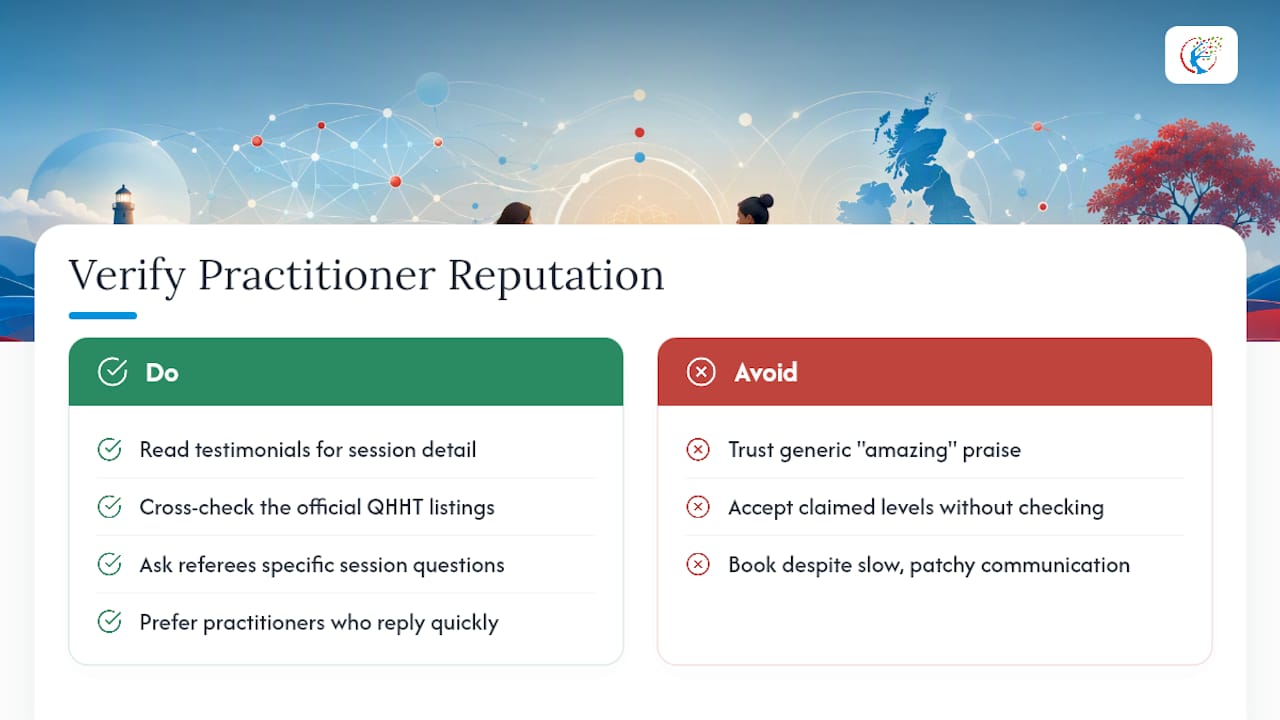
Testimonials are easy to fake and easy to cherry-pick, so read them with a critical eye rather than taking them at face value. Look for detail. A review that describes what actually happened in the session, how long it ran, whether a recording was provided, reads as far more credible than a generic line about feeling “amazing.”
Cross-check practitioners against the official QHHT listings, which let you search by location and confirm a practitioner’s active status and level. This matters more than it sounds: anyone can claim a level on their own website, but the official directory is the version you can actually verify independently.
Word of mouth still carries weight. If you know someone who has had a QHHT session, ask them directly about their practitioner, and be specific in what you ask. How long did the session run? Were they given a recording? Did the practitioner explain what was happening at each stage? Vague praise tells you little; specific answers tell you a lot.
Response time is itself a reputation signal. Practitioners who reply within a day or two (https://www.qhhtofficial.com/uncategorized/choosing-a-practitioner/) tend to be the ones running an organised, professional practice, and that same organisation usually carries through into the session itself. Slow, patchy communication before you’ve even booked rarely improves once you have.
What should you ask about a practitioner’s approach?
Every QHHT practitioner works from the same core method, but how they apply it varies more than most people expect. Ask how they structure the pre-session interview, some spend a full hour building context, others move faster, and neither approach is wrong, but you should know which one you’re getting.
Ask whether they combine QHHT with other techniques, and if so, what and when. Official guidance is cautious about blending modalities mid-session without clear explanation, so a practitioner who’s upfront about this, rather than mentioning it only after you’ve booked, is one worth trusting more.
Ask what they believe QHHT actually achieves. Some frame it primarily around past-life exploration, others emphasise the higher-self dialogue and the insight that comes from it, others focus on the physical healing potential of the energy work involved. None of these framings is more correct than another, but you should choose a philosophy that matches what you’re hoping to get from the day.
Finally, ask how they handle a session that doesn’t go the way either of you expected, someone who doesn’t reach a hypnotic state easily, for instance, or a session that surfaces something distressing. A practitioner with a clear, calm answer to that question has almost certainly handled it before.
How do you know if a practitioner is the right fit for you?
Compatibility matters more in QHHT than in most therapeutic settings, because you’re committing four or five hours in a room with one person, often exploring deeply personal territory. Notice how the first conversation feels. Do they listen properly, or talk over you? Do they explain things in language you understand, or lean on jargon that leaves you more confused than before?
Pay attention to pacing too. Some practitioners answer quickly and directly; others take longer to reply but write thorough, thoughtful responses. Neither is automatically better, but one will suit your own style more than the other, and that’s worth noticing before the day itself.
If you can, have a short call rather than relying on email alone. Tone of voice and warmth carry information that text simply doesn’t. Trust your intuition here. Guidance on choosing a practitioner consistently points to personal resonance as a genuine factor, not a soft afterthought to the practical checklist.
What are the cancellation and refund policies to expect?
Ask about cancellation terms before you book, not after you need them. A four-to-five-hour appointment is a significant block of a practitioner’s day, so most set a cancellation window, commonly somewhere between 24 and 72 hours, after which a fee may apply. Get this in writing.
Rescheduling should be straightforward if you give reasonable notice. If a practitioner’s policy reads as rigid or punitive for a simple change of date, treat that as a small warning sign about how they’ll handle other unexpected moments too.
Refunds are less standardised across the field, since QHHT is typically delivered as a single comprehensive session rather than a package. Ask directly what happens if you need to stop partway through, or if illness prevents you attending altogether. A practitioner with a clear, fair answer ready on the spot is one who has thought this through properly, rather than one improvising a response for the first time.
Publisher perspective: what a trustworthy QHHT practice looks like in person
A trustworthy QHHT practice applies a consistent standard: in-person sessions, a recording provided as standard, and clear communication before anyone commits to four or five hours together.
Fit matters as much as credentials. A practitioner can hold every qualification going and still be wrong for a particular client, because QHHT asks you to be vulnerable with a stranger for an extended stretch of time. If a first conversation leaves you reassured rather than rushed, that’s usually the clearest signal you’ll get.
— Paul
Book an in-person QHHT session with clear, upfront policies
This practice offers in-person sessions run at the four-to-five-hour standard, a recording included as a matter of course, and straightforward answers before booking. No remote substitute, no pressure toward repeat paid sessions, just one comprehensive appointment done properly.

The QHHT service page sets out how sessions are structured and what to expect on the day, while the QHHT FAQ covers the practical questions most people ask before booking, session length, what to bring, how the recording works. If you’re also weighing up combined regression work, the QHHT and regression hypnotherapy page lays out how the two connect.
Ready to move forward? Get in touch through the booking page, confirm your preferred date, and ask any outstanding questions from your own checklist before you commit.
Sources
Recommended
Comments