3 Safe Cord Cutting Methods: What It Means and UK Practitioner Aftercare


Cord cutting is a symbolic or energetic ritual for severing unhealthy emotional attachments to a person, memory, or pattern, so you can reclaim your own energy and move on. The goal isn’t to erase someone from your life or punish them. It’s release: less rumination, fewer intrusive thoughts, a felt sense of separateness where there was once tangled dependency. How you do it varies widely, but the intention behind it matters more than any prop or script.
TL;DR:
Ritual cues like visual cuts, burning, or string-snipping help the brain concretize emotional detachment, but they do not physically affect external energy.
The practice draws from diverse traditions including shamanic, Reiki, and pagan rituals, with no one version being more authentic or effective than others.
Signs you might need cord cutting include persistent rumination, emotional drain, recurring patterns, bodily tension, or intrusive dreams, but professional support is necessary for trauma.
Repeated rituals over time can reinforce release, but if attachment persists, pairing cord cutting with therapy or energy healing improves results.
There is no scientific proof that cords exist or that cutting them produces measurable change; however, ritual provides psychological benefits that can aid emotional healing.
Table of Contents
What cord cutting means: spiritual, psychological and metaphorical frames
How to perform a cord cutting ritual: three safe, step-by-step methods
Does cord cutting work? Research, ritual psychology and realistic expectations
Practitioner perspective: how Paul Stebles uses cord cutting in QHHT and energy healing
How a QHHT or energy-healing session can support persistent energetic attachments
What cord cutting means: spiritual, psychological and metaphorical frames
The word “cord” here is a metaphor, not a claim about physics. Practitioners describe an energetic cord as an invisible thread of attention, emotion, or obligation connecting you to another person, an old version of yourself, or even a place or job. Some cords are healthy, like the bond between a parent and child. Others become drains: a relationship that ended years ago but still occupies your headspace, a friendship built on guilt, a family dynamic that leaves you smaller every time you engage with it.
Psychologically, cord cutting maps quite closely onto boundary-setting and emotional detachment work that therapists already use, just dressed in different language. Where a counsellor might talk about “decatastrophising” a relationship or building “psychological distance,” a spiritual practitioner talks about severing a cord. Both are aiming at the same outcome: reducing the emotional charge an old attachment still carries.
The metaphors used in cord cutting rituals tend to fall into a few recognisable categories:
Cutting or severing — scissors, a blade of light, or a symbolic snip through string or ribbon.
Burning or dissolving — visualising the cord turning to ash or light, often paired with candle work.
Returning energy — imagining your energy flowing back to you while the other person’s returns to them.
Sealing — closing the space where the cord was, so nothing new attaches in its place.
These images help because the mind responds to concrete symbols better than abstract intentions. Saying “I want to stop thinking about this” is vague. Watching, in your mind’s eye, a glowing thread being cut and both ends healing over gives the brain something specific to latch onto.
It’s worth being clear about what cord cutting is not. It isn’t a way to control, punish, or manipulate another person’s feelings, and any method framed that way misses the point entirely. The work happens inside you. You’re not casting anything onto someone else; you’re changing your own relationship to an attachment that no longer serves you.
Where cord cutting comes from
There’s no single origin story for cord cutting, and no governing body certifies one version as the “correct” ritual. The practice draws on several distinct traditions that have blended together over the past few decades.
Shamanic traditions across various cultures have long included concepts of soul retrieval and the removal of intrusive energies, often performed by a healer on behalf of a community member. Reiki, developed in Japan and popularised in the West through the twentieth century, introduced the language of energy fields and chakras that many cord cutting scripts now borrow directly. Modern pagan and Wiccan practice added ritual structure, including candle work, circle casting, and the symbolic use of props like string or ribbon.
Contemporary spiritual teachers have folded these strands together and adapted them for people with no ritual background at all. Guides now published by wellness platforms lay out fairly standardised steps, grounding, visualisation, symbolic cutting, forgiveness, and cleansing, that owe something to shamanic practice and something to modern self-help language.
That layered history is exactly why you’ll find so many variations online. None of them is more “authentic” than another. What matters is whether the version you choose feels clear and workable to you.
Signs you might need a cord cutting
Not every difficult relationship needs a ritual. But certain patterns show up repeatedly among people who find cord cutting genuinely useful.
Rumination that won’t quit — replaying the same conversation or scenario with someone weeks or months after contact ended.
A relationship that drains you on contact — feeling exhausted, anxious, or smaller after every interaction with a specific person, even a family member you love.
Repeating the same pattern with different people — noticing you keep attracting or accepting the same dynamic, which often points to an old, unresolved attachment rather than the new person themselves.
Physical or energetic cues — some practitioners report a heaviness in the chest or stomach, tension around the throat, or a sense of being “tethered” when they think of the person in question.
Dreams or intrusive imagery involving someone you’ve consciously tried to let go of.
These are useful prompts for reflection, not diagnostic criteria. If what you’re describing looks more like persistent depression, trauma symptoms, obsessive thinking that disrupts daily function, or grief that isn’t easing over time, a ritual alone isn’t the right tool. That’s a case for a GP, a therapist, or a counsellor, and pairing professional support with ritual work, rather than substituting one for the other, tends to produce better outcomes.
How to perform a cord cutting ritual: three safe, step-by-step methods
Here’s a method you can do right now, with nothing but a few quiet minutes and your own imagination.
1. The visualisation-only method (no equipment needed)
This is the most accessible version and the one most contemporary guides recommend starting with.
Sit or lie somewhere quiet. Close your eyes and take several slow breaths until your body settles.
Ground yourself by imagining roots extending from your feet or spine down into the earth.
Picture the person or situation you’re releasing standing a short distance away from you.
Visualise a cord running between your bodies, often at the chest, stomach, or throat, wherever you feel the tension.
Imagine a clean tool, a blade of light, a pair of golden scissors, cutting the cord cleanly.
Watch both ends heal instantly, sealing over so nothing seeps out or reattaches.
Silently say something like: “I release this cord with love and without harm. My energy returns to me. Yours returns to you.”
2. The symbolic string or ribbon method
For anyone who wants something tactile rather than purely mental, tie a length of string or ribbon loosely between your wrist and a chair, or simply hold both ends. Say your intention aloud, then cut the string with scissors. Bury the pieces, throw them away, or burn them safely outdoors. Contemporary practice guides describe this exact sequence as one of the more grounding variations for beginners, since the physical snip reinforces the mental one.
3. The candle and cord method
This version uses a length of natural fibre string threaded loosely near (never through) a lit candle, letting the flame symbolically weaken the cord as it burns down. Fire safety is not optional here. Use a heatproof dish, never leave a candle unattended, keep the string well clear of the flame itself rather than in it, and have the candle on a stable, flameproof surface away from curtains or paper. If you’re at all unsure about doing this safely, the visualisation-only method achieves the same intention without any risk.

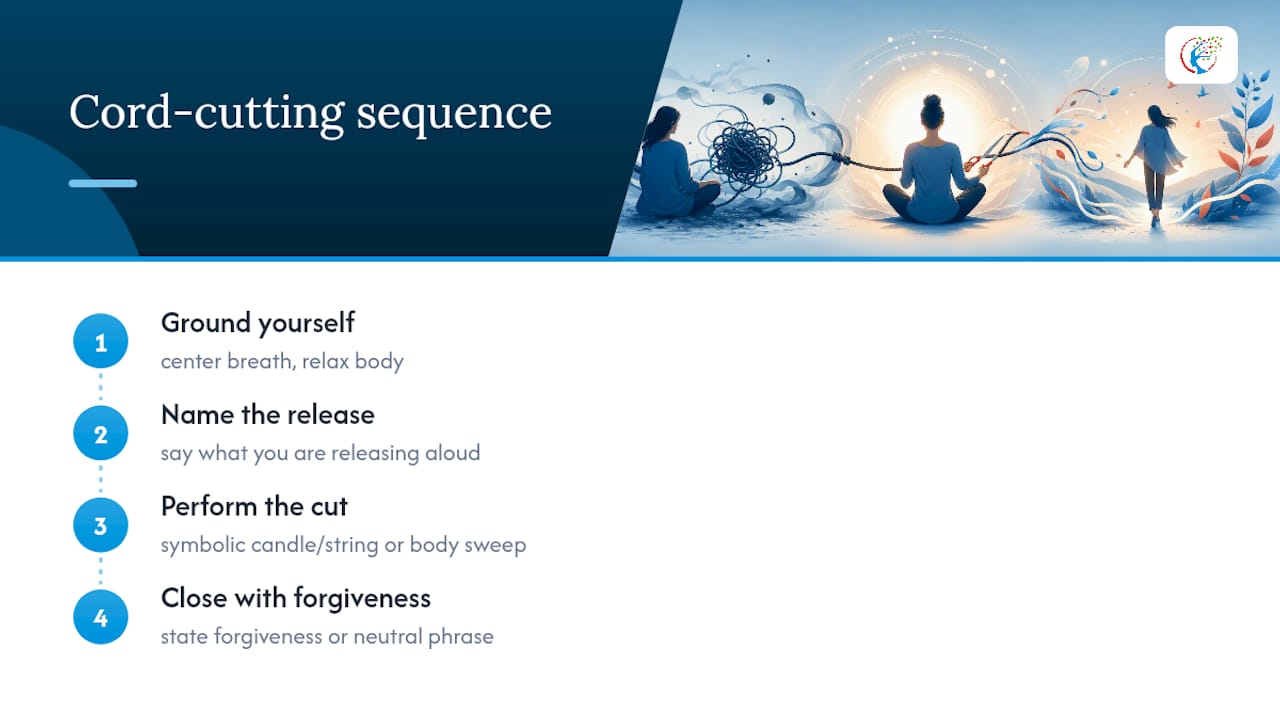
Whichever method you choose, the sequence tends to follow the same emotional arc: ground yourself, name what you’re releasing, perform the symbolic cut, and close with a statement of forgiveness or neutrality, since finishing on resentment tends to keep the attachment active rather than resolving it. Some guides also describe a body-based variant with no props at all, simply scanning your own energy field by hand and using a sweeping motion to “cut” where tension is felt, which suits people who find pure visualisation difficult to sustain.
There’s no fixed rule on frequency. Some people do a cord cutting once and feel done. Others repeat it monthly for a particularly stubborn attachment, or whenever the same intrusive thoughts resurface.
Pro Tip: Write your intention down before you start, one sentence, in plain language. “I am releasing my attachment to my ex-partner so I can stop checking his social media.” Vague intentions produce vague results; specific ones give the ritual something concrete to work with.
Aftercare and integration: making the ritual stick
The ritual itself is only half the work. What you do in the days after determines whether the release holds. Spend a few minutes journalling immediately afterwards, noting what came up and how your body feels, then set one concrete behavioural boundary that matches the intention you spoke aloud. If you cut a cord to a controlling relative, that boundary might be muting their messages for a week or declining a phone call you’d normally dread.
Expect the cord to occasionally feel like it’s reappeared. That’s normal, not a sign of failure. Old patterns are grooved habits, and a single ritual rarely erases years of neural and emotional conditioning in one pass. Many practitioners recommend repeating the ritual, sometimes weekly for a month, then tapering as the intrusive thoughts fade.
Watch for short-term signs of success: fewer unprompted thoughts about the person, less physical tension when their name comes up, an easier time saying no. If none of that shifts after several attempts, or if the underlying issue is trauma rather than attachment, pairing the ritual with talking therapy usually gets further than ritual alone.
Does cord cutting work? Research, ritual psychology and realistic expectations
There’s no clinical trial proving energetic cords exist or that cutting them physically changes anything measurable. What research does support is the power of ritual itself to change subjective experience. Research summarised by Harvard Health shows that rituals and symbolic actions shape expectation and meaning in ways that produce genuine, measurable placebo-like shifts in wellbeing, not “fake” relief, but real changes in how people feel and function.
Anthropological and psychological reporting backs this up from a different angle. Coverage explored by NPR found that rituals provide psychological structure and coping benefits even when the actions involved carry no inherent mechanical effect. Cord cutting, structured, deliberate, symbolic, ticks every box that makes ritual effective: intention, physical or imagined action, and a clear ending point.
The limit is clinical. If what you’re dealing with is trauma, an anxiety disorder, or complicated grief, ritual can sit alongside professional treatment, but it shouldn’t replace it. Used that way, alongside real boundary changes rather than instead of them, cord cutting is a genuinely useful tool.
Practitioner perspective: how Paul Stebles uses cord cutting in QHHT and energy healing
Paul Stebles works with QHHT and energy healing, and cord cutting shows up regularly inside both. In a session, it typically happens after the client is settled and grounded, once a specific attachment or pattern has surfaced, rather than as a standalone ritual bolted onto the start. Consent and clarity of intention come first every time; nothing is done to or about another person without the client’s full understanding of what’s happening and why. Paul often pairs cord cutting with timeline healing and energy sealing to reduce the chance of the same pattern resurfacing.
Pro Tip: Set your intention before the cord is even named aloud. Clarity beforehand does more for the outcome than anything that happens during the cutting itself.
When I recommend cord cutting and when I do not
I recommend cord cutting when someone is stuck on a specific person or pattern and needs a clear, symbolic way to mark an ending. I don’t recommend it as a substitute for therapy when trauma, ongoing abuse, or clinical depression is the real issue underneath. Ritual should support real change, not paper over something that needs proper treatment. Consent and non-harm guide every session I run.
— Paul
How a QHHT or energy-healing session can support persistent energetic attachments
If a cord keeps reappearing despite your own efforts, that’s usually a sign it’s tangled into something deeper, an old belief, a past pattern, a piece of unprocessed grief, that a solo ritual can’t fully reach on its own. Paulstebles works with clients on exactly that: energy-healing sessions that combine cord cutting with timeline healing and belief work, and QHHT sessions that explore what’s actually keeping the attachment alive at a subconscious level.

A first session usually starts with a conversation about what’s recurring and why previous attempts haven’t held. From there, sessions are available both in person around Bromley, Orpington and the wider Greater London area, and remotely for anyone who prefers to work from home. If you’re ready to deal with a cord that won’t stay cut, you can book a QHHT session directly through the website, or check the energy healing FAQ first if you want the details before committing.
Sources
For the psychology behind ritual, Harvard Health on placebo effects and NPR’s reporting on ritual and coping are solid starting points. For practical steps, Insight Timer’s cord cutting guide and Spirituality+Health’s explainer cover method and aftercare in more depth.
Recommended
Comments