Book a Better Distance Reiki Session: Practitioner Checklist & Evidence
- Paul Stebles

- 15 minutes ago
- 11 min read

Distance Reiki is a remote energy healing practice delivered by video call, phone, or a silently scheduled sending, where a practitioner works without being physically present. Sessions typically run for a period of time suitable to the practitioner’s and client’s preferences and suit people wanting relaxation, nervous-system support, or help processing stress and emotion. If you want interaction and feedback, choose a synchronous video or phone format; if you’d rather stay off-camera or even sleep through it scheduled silent sending is the better fit.
TL;DR:
Distance Reiki sessions often involve intention, visualization, and scheduled timing rather than actual energy transmission through physical space.
The most effective sessions follow a structured process, including intake, setting an intention, guided relaxation, healing work, and follow-up, not rushed or purely transactional.
Practitioners report variable physical and emotional sensations during sessions, with relaxation effects potentially appearing immediately or over the next 72 hours, and some studies show significant stress reduction.
Evidence for distant biofield therapies remains mixed, with small pilot studies noting improvements in stress, pain, and sleep, but broader research shows inconsistent results due to methodological differences.
Success depends heavily on the practitioner’s protocol and client’s engagement, not on metaphysical claims, and remote sessions are intended as support, not substitutes for medical diagnosis or treatment.
Table of Contents
What is distance Reiki, and how do practitioners say it works?
Distance Reiki, sometimes called remote Reiki healing or reiki healing at a distance, applies the same hands-on Reiki framework without physical proximity. Practitioners trained beyond Level 1 typically use a technique called Hon Sha Ze Sho Nen, one of several Usui symbols associated with distance work, to establish what they describe as a felt connection across space and time.
Ask a practitioner how this actually functions and most won’t claim to be firing energy through a wall like a signal. The more common explanation leans on intention and visualisation, the idea that focused attention and a settled mental state can extend care toward someone who isn’t in the room, treating separation as something the practitioner works around rather than something Reiki has to cross. Reiki frames it this way, describing the practice as a compassionate mental act rather than a mechanical transmission.
In practical terms, a session usually starts with a few preparatory steps that have nothing to do with mysticism and everything to do with focus:
The practitioner uses your name, and sometimes a photo, as a point of reference during the working.
A short invocation or intention statement marks the start of the session, similar to how an in-person session might open with a brief check-in.
Both sides agree a specific time slot in advance, even for silent sending, so the session has a clear beginning and end.
That last point matters more than it sounds. A scheduled appointment, even one where nothing visibly happens on your end, creates what practitioners often call a psychological container. It signals to your nervous system that something is starting, which seems to help people settle into a receptive state faster than an open-ended “sometime this week” arrangement would.
Common session formats: video, phone, and silent sending
Distance Reiki isn’t one fixed format. Most practitioners offer some combination of the three below, and which one you pick changes what your hour actually looks like.
Synchronous video or phone sessions. You’ll usually start with a short intake conversation covering how you’re feeling and what you’d like to focus on. The practitioner then guides you through breathwork or a brief relaxation script, before either staying connected (often muted, camera optional) or briefly stepping away from the call while the working happens. Most sessions close with a short debrief where you describe what you noticed.
Silent scheduled sending. No call at all. You and the practitioner agree a window, say 8:00 to 8:30pm, and you simply relax, nap, or go about a quiet evening while the practitioner works from their own space. Written follow-up notes usually arrive afterwards, describing anything they picked up on or worked with during the session.
Hybrid sessions. A brief live intro sets an intention and answers questions, then the practitioner switches to silent working for the bulk of the time, sometimes paired with a guided recording you can listen to. A short live outro closes things out.
Practitioner surveys conducted during the pandemic found many healers shifted toward asynchronous scheduling and simple props like photographs specifically because clients found it more convenient and, for some, more comfortable than being watched on camera. That shift has largely stuck.
What you might feel during a distance Reiki session
Expect variation. Two sessions with the same practitioner can feel completely different, and that’s normal rather than a sign something went wrong.
Physically, people commonly report:
A wave of warmth or gentle tingling, often localised rather than all over.
Changes in breathing pace, sometimes without noticing it happening.
Yawning, heaviness in the limbs, or drifting off entirely. Falling asleep mid-session is common and doesn’t mean you missed anything.
Emotionally, reactions run wider. Some people well up without an obvious trigger, others get a flash of an image or a memory, and plenty feel nothing more dramatic than a slow, pleasant unwinding. Timing varies too. Relaxation tends to hit immediately, but some of the more meaningful shifts, a change in mood, a resolved worry, better sleep that night, show up over the following 24 to 72 hours rather than during the call itself.
Statistic callout: A 2023 pilot trial of remote Reiki for frontline healthcare workers measured these effects directly. After multiple remote sessions, participants reported statistically significant reductions in stress and anxiety, and improvements in wellbeing, sleep quality, and pain on standard scales. It’s a small study, but it’s one of the more concrete data points behind a practice usually described only in anecdote.
How to prepare for a distance Reiki session
A little preparation makes a genuine difference to how much you get out of the hour, whether you’re on a video call or lying quietly at home during a scheduled sending.
Set up your space first. Find somewhere private and quiet, wear something comfortable rather than restrictive, and have a pillow or blanket within reach so you’re not adjusting mid-session.
Sort your tech before you sit down. For video or phone sessions, check your internet connection, camera, and microphone, and charge your device fully. Have a backup quiet spot in mind if your connection drops.
Decide your intention and share relevant context. A one-line focus, “help me settle before a hard week”, “support recovery after surgery”, gives the practitioner something to work with. Mention any relevant health information if it’s pertinent, and confirm the format (video, phone, or silent) with your practitioner beforehand.
Sort your household logistics. Let anyone else at home know you’ll be unavailable for the session length, and try to schedule it for a time when you can rest afterwards rather than rushing straight into something demanding.
Pro Tip: Even for a silent sending session where you won’t speak to anyone, treat the time slot as a real appointment rather than a vague “sometime today”. Blocking it out on your calendar and sitting down at the agreed time, rather than trying to fit it in around other tasks, noticeably improves how settled people feel afterwards.
Aftercare and integration after a remote healing session
What you do in the hours after a session shapes how much benefit sticks. Keep it simple rather than elaborate.
Drink water, rest where you can, and favour light movement over anything strenuous for the rest of the day.
Jot down anything you noticed, a mood shift, a specific thought, a physical sensation, even a couple of lines in a notes app helps you track patterns across sessions.
Hold off on major decisions for 24 hours if you can. Some people feel unusually clear-headed after a session, and others feel a bit foggy; neither is the moment to sign anything important.
Temporary tiredness, an emotional release that catches you off guard, or unusually vivid dreams that night are all commonly reported and generally nothing to worry about. If a reaction feels severe, persists for several days, or worries you, check in with your practitioner or, for anything physical or psychological that concerns you, your GP. Our guide to Reiki aftereffects covers this in more depth. Most practitioners will also discuss whether a single session, a short series, or an ongoing maintenance rhythm suits your situation best, worth raising before you book rather than after.
What the evidence actually shows about distance Reiki
The strongest data point available is the 2023 pilot trial already mentioned: four remote sessions, measurable drops in stress, anxiety, and pain, and gains in wellbeing and sleep, all statistically significant. It’s encouraging, but it’s a small pilot study, not a large-scale trial, and it doesn’t tell you how long the effects last.
Beyond that single trial, the wider research picture on distant biofield therapies is mixed. Reviews of randomised controlled trials note real methodological variation between studies, differences in session length, frequency, and blinding, that make it hard to draw firm conclusions across the field as a whole. Some trials report improvements on validated psychological measures; others don’t, and sample sizes are often small.
Evidence type | What it covers | Key limitation |
2023 pilot trial (healthcare workers) | Stress, anxiety, pain, wellbeing, sleep after 4 sessions | Small pilot, short follow-up |
Broader RCT reviews | Distant biofield interventions generally | Inconsistent methods across studies |
Practitioner surveys | How sessions are run day to day | Self-reported, not outcome data |
Practitioner-survey data fills a different gap: it describes protocol, not outcome. Surveys of practitioners during the pandemic describe consistent structures, an intake step, a working phase, and an evaluation or follow-up, plus common use of props like photographs when there’s no visual contact. Consumer health reporting on remote energy healing is consistent on one point worth repeating plainly: it’s a complementary practice, not a substitute for medical or mental health treatment.
How Paul runs a remote session, and what he recommends
A remote session with Paul typically follows a set sequence rather than an open-ended call:
A short pre-session intake, covering how you’re feeling and what you’d like the session to focus on.
Setting a clear intention together before the working begins.
Guided relaxation to help you settle, followed by the remote healing segment itself.
A written follow-up afterwards, plus a check-in if you’d like one, so nothing about the session gets lost once the call ends.
Consent and confidentiality are treated as standard, not optional extras, and clients are always encouraged to keep any existing medical or mental health care running alongside sessions rather than replacing it. For cost expectations and format details before booking, Paul’s FAQ on energy and quantum healing covers the practical questions people usually ask first.
Where distance Reiki falls short
Distance Reiki has real limits worth knowing before you book. It isn’t a diagnostic tool, and no reputable practitioner should present it as one. If you have an undiagnosed symptom, a worsening condition, or a mental health crisis, that needs a GP, a specialist, or emergency services first, not a remote healing slot.
It’s also not a guaranteed experience. Some people notice nothing beyond mild relaxation, and that doesn’t mean the session “failed”, it simply reflects how variable subjective responses to this kind of work are. Anyone expecting a dramatic, film-worthy reaction every time will likely be disappointed.
There are a few situations worth flagging with your practitioner beforehand rather than assuming they don’t apply. Severe trauma histories, active psychosis, or significant dissociative conditions warrant a conversation about whether remote energy work is appropriate alongside, not instead of, clinical care. Pregnancy isn’t a contraindication in most practitioner guidance, but it’s still worth mentioning at intake so the session can be tailored sensibly.
Finally, distance Reiki depends heavily on the practitioner’s training and the client’s own engagement. A rushed, ten-minute “session” squeezed between other bookings is a different experience to a properly scheduled one with a real intake conversation. If a session feels transactional rather than considered, that’s a signal to look elsewhere, not a reason to write off the practice entirely.
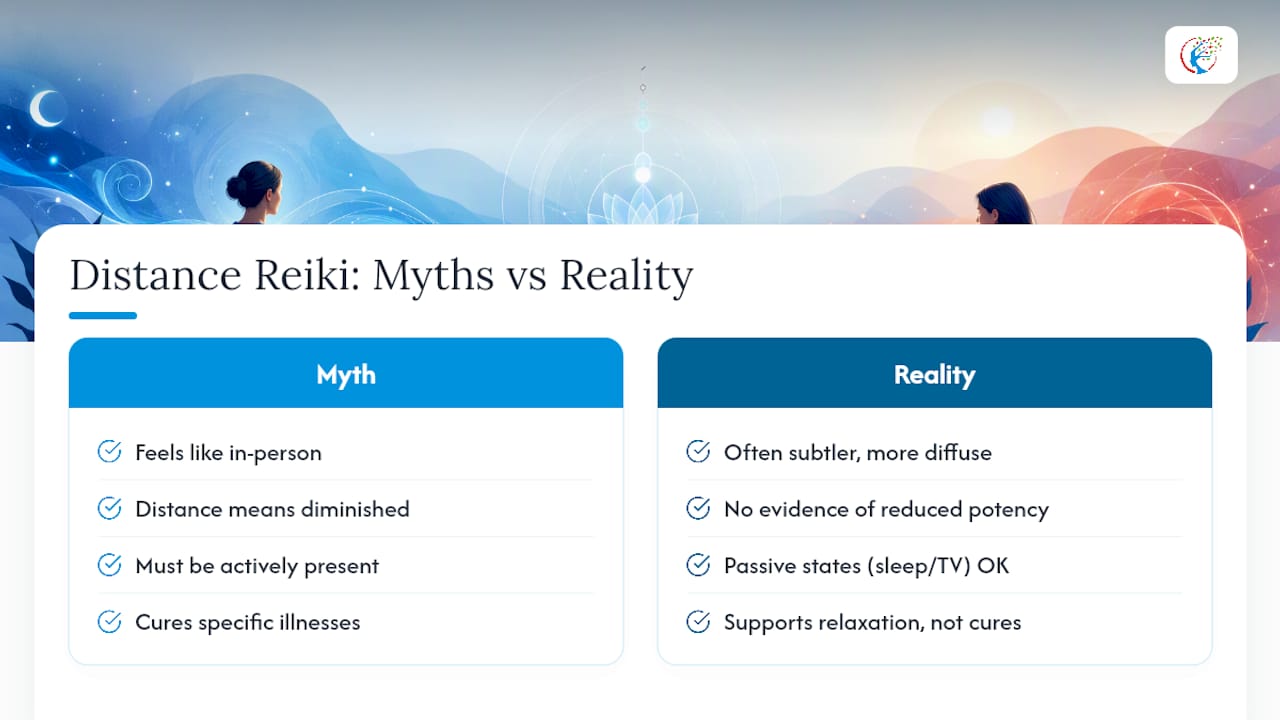
Myths about distance Reiki worth clearing up
The biggest misconception is that distance Reiki should feel identical to an in-person session, just without the hands. It doesn’t, and that’s fine. Physical touch changes the sensory experience considerably, so remote sessions often feel subtler, more diffuse, and sometimes harder to notice in the moment, even when people report benefit afterwards.
Another common myth: that distance means diminished. There’s no solid evidence that physical proximity makes energy work more “potent”, and practitioner accounts consistently describe distance sessions as just as involved, sometimes more so, since the practitioner isn’t managing hand placement and can focus entirely on intention and presence.
Some people also assume you need to be actively meditating or fully present during a scheduled sending for it to “work”. That’s not how most practitioners describe it. Falling asleep, half-watching television with the sound off, or simply going about a quiet task during the window is all commonly reported without any indication it reduces the value of the session.
Lastly, there’s a belief that distance Reiki claims to cure specific illnesses. Reputable practitioners don’t make that claim, and neither does the available research. The consistent, evidence-backed framing is support for stress, relaxation, and subjective wellbeing, alongside medical care, not instead of it.
An honest look at what distance Reiki can and can’t do
The research on distance Reiki is thinner than either its enthusiasts or its critics tend to admit. One small pilot trial with genuinely significant results doesn’t make a settled science, but it’s also not nothing, and dismissing the practice outright because the evidence base is young ignores how new this specific delivery format still is.
Where conventional advice usually falls short is the framing. Most guides either oversell the metaphysics or undersell the practical structure that actually determines whether a session feels worthwhile. What matters more than the theory behind Hon Sha Ze Sho Nen is whether the practitioner runs a proper intake, sets a clear time slot, and follows up afterwards. That structure is what separates a considered session from a rushed one, and it’s far more predictive of a good experience than any claim about energy travelling across distance.
If you’re weighing this up, prioritise the practitioner’s process over the marketing language on their booking page. Ask how they structure a session before you ask what results to expect.
— Paul
Ready to book a remote session with Paul
Remote sessions typically combine Reiki-based energy healing with a relaxed, guided structure including an intake conversation, setting a clear intention, guided relaxation, the healing segment itself, and written follow-up afterwards. First appointments often start with a short conversation about what you hope to get from the session, allowing flexibility for expectations on initial calls.
If you’re still deciding, it’s worth reading through the energy healing and quantum healing FAQ first, most preliminary questions about format, timing, and what a session involves are answered there. When you’re ready, you can book a remote energy healing session directly through Paul’s booking page. As with any complementary therapy, these sessions work alongside your existing medical or mental health care, not as a replacement for it.
Sources
The evidence and protocol claims in this guide draw mainly from the 2023 pilot trial of remote Reiki with healthcare workers, the strongest single data point on measurable outcomes, alongside practitioner surveys on distance healing during the pandemic for protocol and consent practices. Broader context on trial quality across the field comes from reviews of distant biofield intervention research, and balanced consumer framing comes from Healthline’s summary on remote energy healing.
For technique background, Reiki.org’s article on distant healing is a solid practitioner-level resource. If you want service specifics, Paul’s pages on aftercare and typical session costs cover the practical side in more detail. Readers researching structured online sessions more broadly may also find this guide to scheduling therapy sessions online useful for thinking through the logistics.
Recommended
Comments