Empath energy protection: your practical daily guide


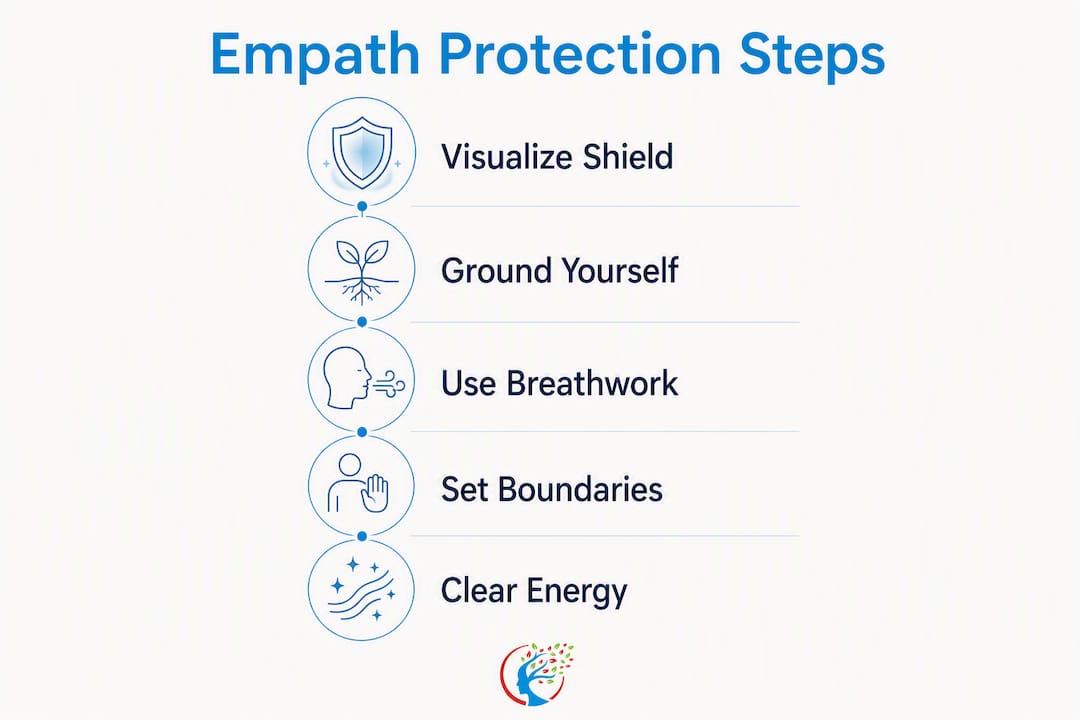
If you absorb other people’s emotions like a sponge and leave conversations feeling wrung out, you need six things right now: a quick shielding visualisation, a grounding step, a breath reset, one boundary phrase, a micro-clearing ritual, and a short recovery window. That is the whole architecture of empath energy protection, and everything in this article builds on those six moves.
Six steps to stop absorbing right now:
Shield: Close your eyes for ten seconds. Imagine a sphere of soft, golden light surrounding you. It lets your warmth out and reflects back anything that isn’t yours.
Ground: Press both feet flat on the floor. Feel the weight of your body. Say silently: “I am here. I am in my own body.”
Breath reset: Inhale for several counts, hold briefly, and exhale slowly. One round is enough to shift your nervous system out of absorption mode.
Boundary phrase: Use this in the moment: “I care about you, and I need to step away for a bit.”
Micro-clear: Wash your hands with cold water and shake them dry. Physically, it signals to your body that the interaction is over.
Recovery window: Give yourself five minutes alone before the next demand. No phone, no input.
Quick shielding script: “Only what is mine enters here. Everything else flows past.” Say it once, mean it, and move on.
Table of Contents
How shielding, grounding and breathwork protect your energy in the moment
The most common mistake empaths make with shielding is imagining a hard wall. A wall blocks everything, including your own capacity to connect, which is one of your greatest strengths. Practitioner guides teach the shield as a permeable, two-way filter: a dome that reflects back what you don’t want to absorb while still allowing genuine warmth and connection to pass through, following psychology practice storytelling techniques that enhance communication and connection. Think of it less like armour and more like a one-way mirror that you control.
Step-by-step shielding visualisation:
Sit or stand comfortably. Take one slow breath.
Visualise a sphere of golden or white light expanding from your chest outward until it surrounds your whole body, about an arm’s length in every direction.
Set the intention: this light reflects back anything that does not belong to you. Your own emotions and warmth pass freely outward.
Anchor it with a small physical cue, pressing your thumb and forefinger together, so you can re-activate the shield instantly in any situation.
Spend a short moment holding the image clearly, then open your eyes and carry on.
The physical anchor is what makes this practice reliable. Without it, the visualisation stays abstract and fades under pressure. With it, you can re-engage the shield in a crowded meeting room or on the Tube simply by pressing your fingers together.
Grounding keeps you in your own body. When you are over-absorbing, you tend to drift into other people’s emotional states because your own felt sense of self becomes vague. Three reliable grounding practices:
Feet-on-floor scan: Press your feet down, feel the texture of the floor, and name five things you can physically sense right now.
Body-scan microgrounding: Starting at the crown of your head, slowly scan downward to your feet, noticing any sensation. This takes a short time and pulls attention back into your own body.
4–7–8 breathing: Inhale for several counts, hold briefly, and exhale slowly. Research and practitioner writing consistently note that over-processing others’ emotions forces the nervous system into a conservation state. Counted breathing directly interrupts that pattern by activating the parasympathetic response.
Box breathing (four counts in, four hold, four out, four hold) works equally well and is easier to remember under stress. Two or three rounds is usually sufficient to feel a noticeable shift.
Pro Tip: Before you enter a high-drain situation, press your thumb and forefinger together and say your shielding script once under your breath. That small act primes your nervous system to stay in observer mode rather than absorption mode.

Setting emotional boundaries: scripts, limits and handling guilt
Boundaries are not walls either. Dr Riley Smith’s clinical-coaching framing describes them as a fence around your garden: you decide what comes in, you tend what is inside, and you are not responsible for every weed in the field beyond the fence. That reframe matters because most empaths were taught, often from childhood, that their sensitivity existed to serve others. Practitioner narratives link empathic overfunctioning directly to long-term patterns of caregiving and people-pleasing, which is why boundaries feel so foreign at first.
Usable boundary scripts for common situations:
Saying no to a request: “I’m not able to take that on right now, but I appreciate you thinking of me.”
Pausing a heavy conversation: “I want to give this the attention it deserves. Can we pick this up tomorrow when I’m fresher?”
Limiting call length: “I’ve got about fifteen minutes. Let’s make the most of it.”
Asking for a break mid-interaction: “I need five minutes. I’ll be right back.”
Declining emotional labour: “I hear you, and I’m not the right person to help with this one.”
None of these scripts are cold. They are honest, and honesty is a form of respect.
Signs a relationship or interaction is draining you beyond normal tiredness:
You feel physically heavy or foggy after contact, even brief contact.
You replay the conversation for hours, trying to fix or resolve the other person’s feelings.
You feel responsible for their mood before they have even said anything.
You cancel plans or avoid situations to manage your exposure.
A simple decision prompt: “Is what I’m feeling mine, or did I pick it up?” If you genuinely cannot tell, that is a signal to step back and clear before re-engaging.
Treating energy conservation as a biological necessity rather than a preference reduces the guilt response significantly. Guilt is often conditioned, not rational. The practical counter to it is behavioural: enforce the boundary anyway, let the natural consequences of the interaction play out, and notice that the relationship usually survives. Guilt diminishes with evidence.

Fast clearing rituals to use after a draining encounter
Clearing is not optional maintenance. It is the step that stops one difficult interaction from colouring the rest of your day.
Shower clearing. Stand under warm water and imagine the water carrying away everything that is not yours, down the drain. Take three slow breaths while you do it. Water is one of the fastest nervous-system resets available because the physical sensation is immediate and grounding. Cold water at the end can amplify the effect.
Salt bath. Add some Epsom salts or sea salt to a warm bath and soak for a period of time. Salt baths are best used a few times a week rather than daily, as frequent hot baths can dry skin and temporarily lower blood pressure. If you have a heart condition, kidney problems, or open skin, check with your GP first. In UK homes with poor ventilation, keep a window slightly open to prevent overheating.
Sound clearing. Strike a singing bowl, clap your hands sharply three times around your body, or hum a sustained tone. Sound breaks up stagnant energy patterns in a room and in your own field. No singing bowl? A metal spoon struck against a glass works. Clapping in the corners of a room is a traditional clearing practice used across many cultures.
Smudging and smoke clearing. Burning dried sage or palo santo is widely used for energetic clearing. A few practical notes for UK use: smudging has deep roots in Indigenous North American traditions, and using it respectfully means acknowledging that context rather than treating it as a trend. Indoors, open windows before you start. In rented properties or shared spaces, check your tenancy agreement and be considerate of neighbours and smoke alarms. White sage is legal to burn in UK homes; palo santo is also legal and has a lighter scent. Neither should be used around people with respiratory conditions, young children, or pets.
Micro-rituals after any draining interaction. Three slow breaths, a step outside, washing your hands. These small acts signal to your nervous system that the interaction is complete. They are low-friction and can be done anywhere.
Which physical tools actually help, and what their limits are
Crystals and stones are supportive aids, not primary solutions. Dr Judith Orloff, one of the most widely cited practitioners in this field, positions stones like obsidian, black tourmaline, and amethyst as part of a broader toolkit rather than standalone fixes. That framing is worth holding onto when you are browsing a crystal shop in Covent Garden or scrolling Etsy.
The three most commonly used protective stones:
Black tourmaline is the most frequently recommended stone for energetic protection. Carry it in a pocket or place it near your front door. It is relatively affordable and widely available in UK crystal shops and online.
Obsidian is used for grounding and clearing. It is a volcanic glass, so it has sharp edges in raw form. Keep it in a pouch if you carry it, and store it away from children and pets.
Amethyst is associated with calm and psychic protection. It is gentler in feel than tourmaline and works well on a desk or bedside table. Some people find it too stimulating for sleep; if that is you, move it out of the bedroom.
Practical ways to use them:
Carry a small stone in your pocket or bag during high-drain days.
Wear as jewellery (tourmaline and amethyst are both available as pendants and bracelets from UK makers).
Place on your desk or windowsill as a visual anchor for your intention.
Check for skin sensitivity before wearing any stone directly against skin for long periods.
Buying tip for UK readers: Look for sellers who can tell you where a stone was sourced. Reputable UK crystal retailers and independent market stalls will usually know. Avoid any seller making medical or diagnostic claims about stones; that crosses from supportive tool into misleading health advice.
Tool | Typical use | Ease of care | Key caveat |
Protective stone (e.g. tourmaline, obsidian) | Carry, wear, place in workspace | Rinse monthly in cool water | Sharp edges on raw obsidian; keep from children |
Aromatherapy (essential oils, diffuser) | Diffuse or apply to pulse points | Replace oils regularly | Check for pet toxicity; dilute before skin contact |
Protective jewellery (intention-set pieces) | Wear daily as a physical anchor | Clean gently; re-set intention periodically | No substitute for practised boundary skills |
How to design your day and space to reduce background drain
Environment is the variable most empaths underestimate. A single open-plan office or a noisy commute can deplete your reserves before you have had a single difficult conversation.
Immediate environmental changes worth making:
Noise-cancelling headphones at work or on public transport.
A plant or natural object on your desk as a visual grounding anchor.
A physical buffer at your workstation (face away from foot traffic where possible).
Reduced notification volume on your phone during focus periods.
A designated quiet space at home, even a corner of a room, that is yours alone.
Sample daily routine integrating protection:
Morning (5 minutes): Shielding visualisation before you check your phone. Set your anchor cue.
Mid-morning: Protect your peak-energy window. Structural enforcement works best here: calendar blocks, Do Not Disturb settings, and communicated rules (“I’m unavailable before 10 AM”) prevent your sharpest hours from being consumed by others’ demands.
After heavy interactions: Three-breath micro-ritual. Step outside if possible.
Evening: Salt bath or shower clearing. Ten minutes of silence before sleep. No emotionally heavy content in the last hour before bed.
Ultradian rhythms run in roughly ninety-minute cycles. Your peak cognitive and emotional capacity sits in the first half of each cycle. Protecting those windows is not a luxury; it is the difference between functioning well and running on empty by mid-afternoon.
Pro Tip: Schedule a five-minute recovery buffer after any emotionally heavy task or meeting. Block it in your calendar as a non-negotiable appointment. It is the single highest-return habit for preventing cumulative depletion.
When to seek professional support for empathic overwhelm
Daily techniques are enough for most empaths most of the time. But there are signs that the sensitivity has moved beyond what self-help practices can address alone.
Consider professional support if you notice:
Persistent overwhelm that does not lift after clearing rituals or rest.
Dissociation or feeling “not quite in your body” regularly.
Sleep disruption linked to absorbing others’ distress.
Inability to enact boundaries even when you know what to say.
Physical symptoms (fatigue, headaches, digestive issues) that correlate with emotionally heavy periods and have no other explanation.
Anxiety or low mood that feels like it belongs to someone else but will not shift.
Questions to ask any practitioner before booking:
What is your approach to working with highly sensitive people?
How do you handle emotional overwhelm during a session?
What aftercare do you offer?
Are you insured and registered with a relevant UK professional body?
Red flags: practitioners who make diagnostic claims, promise specific outcomes, discourage you from seeing your GP, or pressure you to book multiple sessions upfront.
How energy healing and QHHT fit into a broader plan. For empaths dealing with chronic absorption, emotional blockages, or patterns rooted in early caregiving roles, energy healing and Quantum Healing Hypnosis Technique (QHHT) can reach layers that daily practice alone does not touch. Paulstebles offers in-person and remote energy healing sessions in the UK, combining Reiki, chakra balancing, cord cutting, timeline healing, and emotional release work. QHHT sessions access the subconscious directly, which can be particularly useful for empaths whose over-absorption is tied to deep-seated beliefs about their role in others’ lives.
For guidance on choosing a practitioner safely in Kent and South East London, Paulstebles has published a practical guide covering what to look for and what to avoid.
This article is general information, not medical or psychological advice. If you are experiencing persistent mental health symptoms, please speak with your GP or a qualified mental health professional.
Key takeaways
Consistent empath energy protection requires a layered approach: a daily shielding practice, structural boundaries, fast clearing rituals after exposure, and professional support when self-help techniques are not enough.
Point | Details |
Shield first, every day | A brief visualisation with a physical anchor cue stops absorption before it starts. |
Ground to stay in your own body | Feet-on-floor, body-scan, or 4–7–8 breathing pulls you back from others’ emotional states. |
Enforce one boundary today | Use a short script; guilt fades when boundaries are practised consistently and consequences are observed. |
Clear quickly after exposure | A shower, micro-ritual, or sound clearing prevents one draining interaction from affecting the rest of your day. |
Seek help if signs persist | Persistent overwhelm, dissociation, or sleep disruption signal that professional support from a practitioner like Paulstebles may be needed. |
The part most empath guides leave out
Most articles on protecting your energy focus on techniques, and techniques matter. But the deeper issue is rarely a missing visualisation script. It is the belief, often held since childhood, that your sensitivity is a burden you owe to others rather than a capacity you steward for yourself.
That belief is what makes boundaries feel like betrayal. It is why the guilt arrives so reliably the moment you say no. And it is why some empaths practise every technique in this article faithfully and still feel depleted, because the techniques are running on top of an unexamined story about what their sensitivity is for.
The most durable shift I see in this work is not when someone learns a new shielding method. It is when they genuinely accept that their energy is finite, that protecting it is not selfishness but responsible stewardship, and that they cannot pour from an empty vessel. That acceptance changes the quality of every boundary they set afterwards.
Techniques are the scaffolding. The belief is the building. If the scaffolding keeps collapsing, it is worth looking at what is underneath.
How Paulstebles can support your energy protection work
If you have worked through the techniques in this article and still find yourself chronically depleted, absorbing emotions you cannot shake, or hitting the same patterns despite your best efforts, that is a signal worth taking seriously. Paulstebles offers in-person and remote energy healing sessions in the UK, including Reiki, chakra balancing, cord cutting, and emotional release work, designed specifically for people carrying emotional weight that daily practice alone has not shifted.
For empaths whose over-absorption runs deeper, QHHT sessions access the subconscious directly, reaching the root beliefs and early patterns that keep the absorption cycle running. Sessions are available in-person in Orpington and Bromley, and remotely for clients across the UK.
To find out which session suits your situation, visit paulstebles.com and book a session or send an enquiry through the contact page.
Useful sources and further reading
The following sources informed this article and offer practical further reading for empaths wanting to go deeper.
Source | Why it is useful |
Dr Judith Orloff: 5 protection strategies for empaths | Clinician-authored overview of environmental and tool-based strategies; one of the most cited practitioner references in this field. |
Jodi Aman: energy shield training for highly sensitive people | Step-by-step shielding scripts and the two-way mirror model; practical and accessible. |
Dr Riley Smith: energy boundaries for burnout | Clinical-coaching framing of boundaries as stewardship; useful for addressing guilt and building sustainable habits. |
Tiny Buddha: why protecting your energy isn’t selfish | Addresses conditioned guilt directly; helpful for empaths early in boundary practice. |
Genuine Empath: protecting your energy without shutting down | Practical micro-rituals and daily habits; grounded and non-woo in tone. |
UK-relevant clinical perspective on empathic vulnerability and shielding; useful for understanding the psychological dimension. | |
Paulstebles: how to choose the right energy healing practitioner | Practical UK guide to finding a safe, qualified practitioner in Kent and South East London. |
How to Think AI: energy boundaries | Structural enforcement strategies (calendar blocks, peak-hour protection) applicable to empath daily routines. |
Recommended
Comments