Energy Clearing Methods: 9 Safe Ways to Reset Yourself


Energy clearing is any practice you use to release what feels heavy, stuck or not yours, so you feel lighter and more like yourself. The methods that most people find work fastest are the simple ones: grounding, slow breathing, movement, water, and a tidy, aired space. Smoke, sound and crystals are optional extras, and they come with safety points worth knowing. This guide walks through each method, how to do it, and when a practice is not enough on its own.
TL;DR
Start with the body: grounding, slow breathing, a walk or a shower often shift how you feel within minutes.
Clear your space physically first (tidy, open a window), then add smoke, sound or light if you enjoy them.
If you burn candles, incense or herbs, ventilate the room and never leave them unattended.
Treat relief as useful information about what calms you, not proof of any one mechanism.
If anxiety, low mood or anger persists, speak to your GP or self-refer to NHS Talking Therapies. Clearing practices sit alongside care, never in place of it.
Table of Contents
What energy clearing actually means
In spiritual practice, “clearing” or “cleansing” is a broad term. One definition describes spiritual cleansing as rituals, practices and actions that create harmony between mind, body, soul and spirit. The College of Psychic Studies in London says that getting rid of negative energy can mean transmuting it, releasing it, or letting it leave by removing whatever holds it in place.
That last idea is useful. Rather than labelling energy as bad, the same College suggests it is often more constructive to see it as challenging or unhelpful, and to use those moments for healing, growth and firmer boundaries. In practice, that means clearing is less about fighting something off and more about noticing what you are carrying and putting it down.
People usually reach for clearing when they feel:
drained after being around a particular person or crowd
unable to switch off after a stressful day
flat, foggy or unsettled in their own home
emotionally “full” without knowing why
All of these are real experiences, and they respond well to the methods below.
Nine energy clearing methods to try
1. Grounding
Grounding is the best place to begin because it is simple and well supported outside the spiritual world too. NHS guidance describes grounding as a way to refocus the mind on the present moment and your immediate surroundings, which pulls attention away from distressing thoughts and feelings.
The same NHS leaflet lists practical versions: the 5-4-3-2-1 sensory scan (name five things you see, four you can touch, three you hear, two you smell, one you taste), slow relaxed breathing, and physically connecting with the ground by pressing your feet into the floor or the earth.

If you do one thing from this article, do this. Our own 60 second somatic grounding steps walk you through a quick version, and there is a longer routine in our seven day anxiety self help exercises.
2. Slow breathing and breathwork
Breath is the quickest dial you have over your nervous system. The NHS breathing exercise for stress asks you to let the breath flow deep into the belly without forcing it, breathe in through the nose and out through the mouth, and count steadily as you go. It takes a few minutes, can be done anywhere, and works best when it is part of your daily routine rather than a last resort.
In spiritual language, people describe this as releasing stagnant energy with each out-breath. You can keep that image if it helps. The practice itself is the same.
Keep it gentle. If you feel dizzy or tingly, stop and return to normal breathing. Forceful or rapid breathing styles are best learned with a qualified teacher.
3. Meditation and mindfulness
Meditation is the method most often named as the most effective by spiritual teachers. Whatever your view of that, the practical case is sound. The NHS describes mindfulness as paying attention to the present moment, your thoughts, feelings, body and surroundings, and says this can improve mental wellbeing. Formal practice means sitting quietly and noticing sounds, thoughts and the sensations of breathing.
For energy clearing, a simple pattern works: sit for five minutes, notice where you feel tension, breathe towards that area, and let your attention settle on your feet or hands. If sitting still is hard, try a guided recording. We have recorded guided meditations for emotional healing if you want somewhere to start.
4. Movement
Shaking out your arms, walking round the block, stretching, dancing in the kitchen or lifting weights all count. Movement gives stuck tension somewhere to go, and it changes your state faster than thinking your way out of a mood. A walk in daylight combines movement, fresh air and a change of scene, which is why it appears in almost every list of clearing ideas.
5. Water: shower or bath
A shower is probably the most popular clearing ritual in Britain, mostly without anyone calling it that. The College of Psychic Studies suggests imagining the shower water carrying away denser energies as you wash. Finish with a few seconds of cooler water if you can tolerate it, and picture the day running down the drain. A warm bath with the lights low does the same job more slowly.

6. Visualisation: light and the protective bubble
Visualisation is a clearing method you can use in a meeting, on the Tube or in a queue. The College describes visualising a bubble of protective light around you. Picture it forming from the ground up, strong and bright, with a surface that lets in what you choose and keeps out what is not yours.
A useful companion habit comes from sensitivity coach Julie Bjelland, who suggests asking yourself whether a feeling is yours or someone else’s. That one question is often enough to create distance. If you tend to absorb other people’s moods, our guides to energy protection for empaths and short clearing routines for empaths go deeper.
7. Clearing your living space
Most traditions agree on the first step: clean and declutter physically. Wash up, change the bedding, take out the rubbish, open the windows. Then, if you like, add something sensory.
A simple home routine:
Stand at the front door and notice how the space feels.
Open windows in each room for ten minutes to move stale air through.
Tidy the surface that bothers you most, often a desk or bedside table.
Add one sensory element: gentle music, a bell, a candle or a smoke or spray option.
Finish by saying out loud what you want the space to feel like.
The College of Psychic Studies lists clearing your living space alongside grounding and smudging as ways to deal with energy once you have identified where it comes from.
8. Sound
Bells, chimes, singing bowls, clapping in corners or simply playing music you love can all mark a change in a room. Music is also one of the easiest methods to use on yourself: choose something that makes you feel clear, not just distracted. Sound has no combustion risk, which makes it a good option for flats, shared houses and anyone with asthma.
9. Smoke, candles, oils and crystals
Smudging, incense, candles and essential oils are the most traditional tools and the ones that need the most care. Crystals carry no fire risk and many people simply keep one in a pocket as a reminder to pause. The safety notes in the next section matter most for anything you burn.
Using smoke, candles and incense safely
If you burn anything, treat it as a fire and air-quality matter first and a ritual second.
Ventilate. NICE recommends using extractor fans or opening windows when using candles, open fires or free-standing gas heaters. The same sensible approach applies to incense and herbs.
Never leave them unattended. Buckinghamshire Fire & Rescue advises never leaving burning candles, incense or oil burners alone, using suitable heat-resistant holders, and extinguishing them completely before you leave the room or go to bed.
Keep smoke away from vulnerable people. If anyone at home has asthma or other breathing difficulties, choose sound, light or fresh air instead.
Keep pets and children out of the room while anything is burning, and keep lighters and matches out of reach.
None of this makes the ritual less meaningful. A calm, safe room is exactly the state you are aiming for.
A five-minute reset you can do anywhere
When you do not have time for a full routine, combine three methods:
Feet down (1 minute). Press your feet into the floor and run the 5-4-3-2-1 scan.
Slow out-breaths (2 minutes). Breathe in through the nose, out through the mouth, counting steadily.
Light and release (2 minutes). Picture a bubble of light around you and let the tension you noticed drain down through your feet.
For a variation focused on the energy field, our aura cleansing protocol gives a 2 to 5 minute sequence.
What to expect, and what clearing cannot do
Relief after a practice is real, and it is worth paying attention to. Tarot Chats’ editorial team makes the point that feeling better does not prove a supernatural mechanism but does give you useful data about which techniques help you regulate. That is a healthy way to use these methods: try several, keep what works, drop what does not.
The same source stresses that cleansing rituals are not a cure-all for chronic issues such as burnout or trauma and should not replace professional medical or psychiatric care. We agree, and we build our own work on that basis.
Speak to someone if:
anxiety or low mood continues for more than a couple of weeks or affects sleep, work or relationships. NHS Berkshire says you can talk to a GP or healthcare professional, or self-refer to Talking Therapies.
you are having vivid memories or flashbacks of past trauma. Grounding helps you remember you are safe in the present, but trauma deserves proper support.
anger can turn violent or abusive. Mind says it is essential to seek professional treatment and support.
you notice physical symptoms that worry you. See a GP before assuming they are energetic.
If you feel overwhelmed in a way that does not lift, our guide to emotional overwhelm help sets out what works now and over time, and our piece on grounding for anxiety explains how we pair it with sessions.
Choosing a practitioner for deeper clearing
Self-clearing handles daily build-up. Some people want more: help releasing old emotional patterns, beliefs or cords to people and situations. Reiki, chakra balancing, cord cutting and hypnosis-based work are common routes.
One point to know before booking anyone: Mind notes there is no compulsory regulation for most complementary healthcare practitioners in England and Wales, and the NHS advises looking for registers accredited by the Professional Standards Authority. Ask any practitioner about their training, how they handle a distressing session, and how they work alongside your GP. Mind also observes that some people feel better after complementary approaches partly through the placebo effect, so choose a practitioner who is honest with you about what to expect.
Perspective: why we pair clearing with a safe, slow space
In our sessions, the people who benefit most are rarely the ones who have tried the most rituals. They are the ones who finally feel safe enough to stop managing everything and let something shift. That is why we work in a calm, trauma-informed way, with extended session times so nothing is rushed. Our approach combines Quantum Healing Hypnosis (QHHT) with energy healing, so we can work with the emotional layer, the deeper subconscious layer and the energetic layer in one place. Daily clearing habits are the foundation: grounding, breath, water, fresh air. When the same heaviness keeps returning, a deeper session can help you understand where it began and let it go. We see this as working alongside your usual healthcare, never instead of it. Paul
Support from us if you want to go further
We offer in-person and remote energy healing that combines Reiki, chakra balancing, cord cutting, timeline healing, belief transformation and emotional release. Evolve Quantum Healing is £99, and the remote version, Remote Evolve Quantum Healing, is also £99, so you can book from home anywhere.
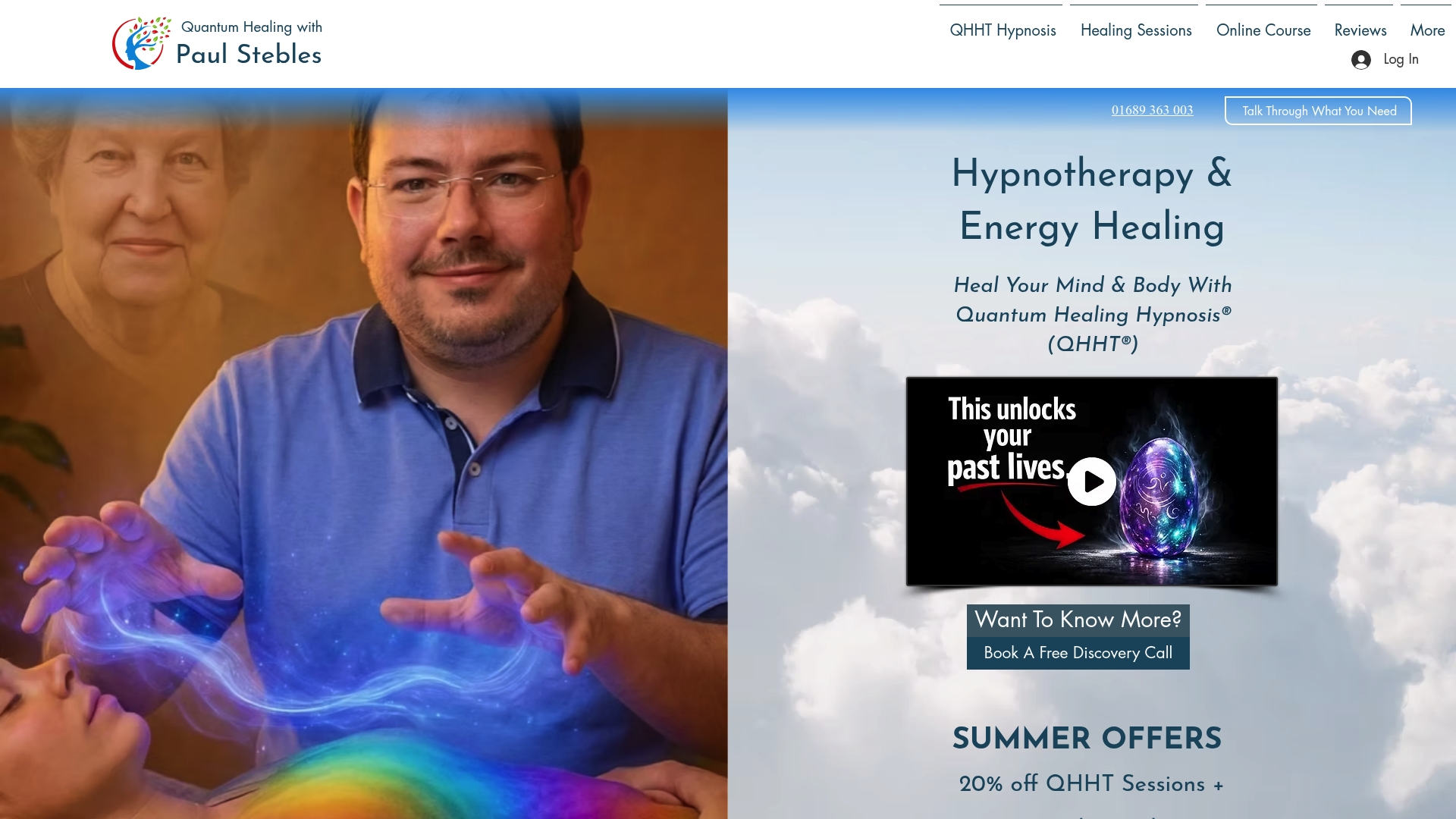
If you want to explore the subconscious mind, past lives or higher self guidance, our QHHT session is £369, and the mobile QHHT visit, where we come to you, is £399. You can see availability and book a session through the calendar. If you prefer to work at your own pace, our Rising Higher online course offers structured exercises and video content for anxiety and low mood.
FAQ
What does energy clearing mean?
It means using practices to release feelings, tension or influences that seem heavy or not your own. Spiritual traditions describe this as moving or transmuting energy. In everyday terms, many of the methods also calm the body and mind.
How do I clear my energy quickly?
Ground yourself first: press your feet into the floor and do the 5-4-3-2-1 scan. Then take a few minutes of slow breathing, or have a shower and picture the day washing away. Most people feel a shift within five to ten minutes.
What causes negative energy in a person?
People usually point to stress, tiredness, difficult relationships, crowded places and unresolved emotions. The College of Psychic Studies suggests it helps to identify the source and to see such energy as challenging rather than permanently bad. If the feeling is persistent, a GP check is a sensible first step.
Is burning sage or incense safe?
It can be, with care. Open a window or use an extractor fan, use a heat-resistant holder, never leave it unattended and put it out fully before leaving the room. If anyone in the home has asthma or breathing problems, use sound or fresh air instead.
When should I see a professional instead of clearing my energy?
See your GP or self-refer to NHS Talking Therapies if anxiety, low mood or distress lasts, affects daily life, or follows trauma. Clearing practices can sit alongside that support, but they should not replace it.
Sources
Recommended
Comments