Grounding for anxiety in QHHT and energy healing


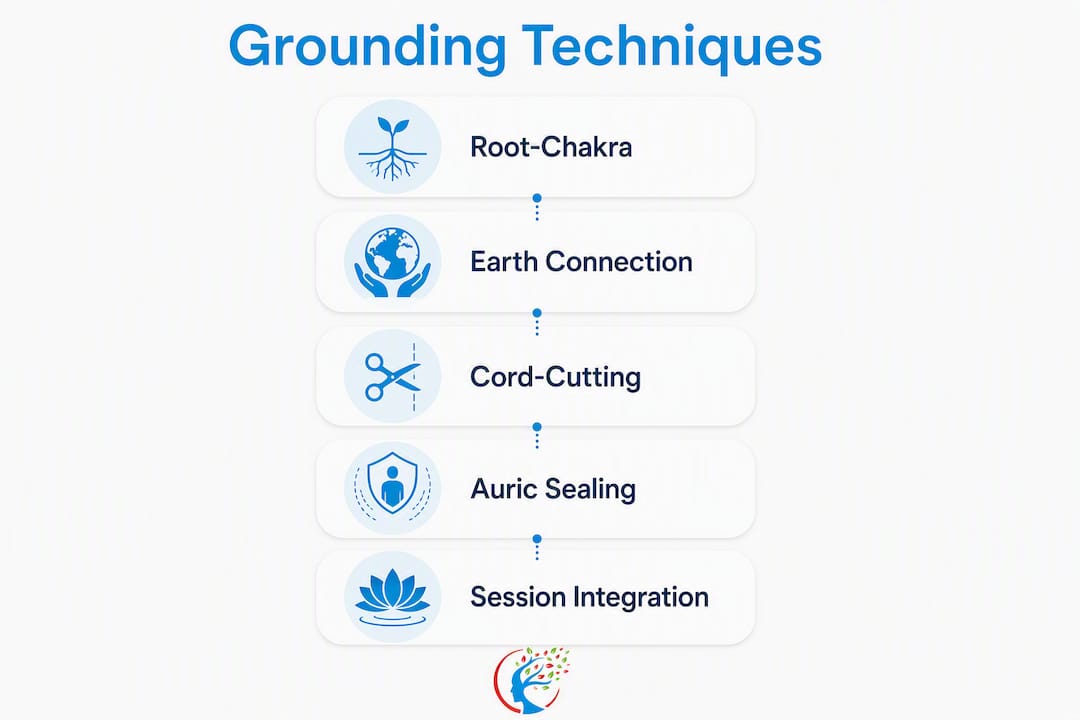
For QHHT and energy-healing clients, the most reliable grounding for anxiety combines root-chakra anchoring, earth connection, cord-cutting, and auric sealing. These four practices stabilise the nervous system before, during, and after regression work, making it possible to access deep subconscious material without becoming overwhelmed or unmoored.
“Grounding is not optional in deep regression work. The nervous system must feel secure before higher consciousness can safely expand.” Radiant You
Before you book: spend two to three days resting well, reducing stimulants, and practising a simple root-chakra visualisation each morning. That preparation alone changes what a session can reach.
Paulstebles offers QHHT and regression hypnotherapy sessions in the UK that build grounding protocols into every stage of the work.
Table of Contents
What does ‘energetic grounding’ actually mean in QHHT and energy healing?
Energetic grounding is not the same as the clinical breathing exercises or sensory techniques used in psychological anxiety management. This article is entirely about the former. In the context of Quantum Healing Hypnosis Technique (QHHT), Reiki, and related energy-healing modalities, grounding refers to a set of practices that anchor a person’s consciousness and life-force energy firmly in the physical body and the earth before, during, and after altered states.
The core components are:
Cord-cutting: — Intentionally severing unhealthy energetic attachments to people, situations, or past experiences that continue to drain energy and sustain anxiety.
“Psychic hygiene is like cleaning a window before a session — Higher Self contact is clearer and more protected when the field is already clear.” Bodhi Holistic Hub
Paul Stebles integrates all five of these within his energy healing sessions, combining Reiki, chakra balancing, cord-cutting, and auric sealing alongside QHHT regression work.
Practical energetic grounding techniques you can use before and after sessions
1. Root-chakra anchoring (visualisation and somatic)
Sit with both feet flat on the floor. Close your eyes and bring attention to the base of your spine. Visualise a deep red light at that point, warm and steady. Breathe slowly, imagining roots extending from your tailbone and feet down through the floor, through soil and rock, into the earth’s core. Hold for five to ten minutes. The somatic element matters: press your feet actively into the floor throughout. This is most useful in the 24 hours before a session and immediately after.
2. Earth connection
Barefoot contact with grass or soil, gardening, or simply sitting with your back against a tree are primary methods for root-chakra healing. None of these require equipment. Ten to twenty minutes of genuine earth contact, with attention on the physical sensation, is enough to shift the nervous system toward calm.
3. Cord-cutting ritual
Cord-cutting is often misunderstood as a single visualisation. Authentic cord-cutting requires emotional processing and a behavioural commitment, not just a symbolic gesture. The steps are: ground yourself first (use the root-chakra anchoring above), name the attachment clearly and honestly, set a firm intention to release it, visualise the cord dissolving or being cleanly severed, and then commit to a concrete behavioural change that stops re-feeding the attachment. Without that last step, the cord typically reforms.
4. Auric sealing and psychic hygiene
After any deep energetic work, visualise a luminous boundary around your entire body, sealed and intact. Some practitioners use the image of golden light, others a sphere of white. The key is intentionality. Psychic hygiene as a daily practice means checking in with your field each morning, clearing anything that feels heavy or foreign, and resealing before entering crowded or emotionally charged environments.
Pro Tip: Pace cord-cutting carefully. If you feel a surge of grief, anger, or panic during the process, pause and return to the root-chakra anchoring before continuing. Combining cord-cutting with slow somatic regulation prevents the overwhelm that comes from releasing too much at once.
Technique | Best timing | Duration | Self-practice safe? |
Root-chakra anchoring | Pre-session, post-session | 5 to 10 minutes | Yes |
Earth connection | Daily, especially post-session | 10 to 20 minutes | Yes |
Cord-cutting | Post-session, with practitioner guidance first | — | With caution |
Auric sealing | After any energy work | — | Yes |
Psychic hygiene | Daily maintenance | 5 to 10 minutes | Yes |
How grounding fits into a QHHT session from start to finish
A well-structured QHHT session moves through three distinct grounding phases. Understanding them helps you arrive prepared and integrate what surfaces.
Stage | Practitioner’s role | Client’s role | Typical duration |
Pre-session | Intake conversation, somatic orientation, psychic hygiene and auric clearing | Arrive rested, share intentions, receive grounding guidance | — |
In-session | Anchors client before regression, performs energetic clearing if needed, monitors for destabilisation | Relax into guidance, trust the process, signal discomfort | 2–4 hours |
Post-session | Gentle debrief, immediate re-grounding, integration plan and follow-up resources | Rest, hydrate, avoid rushing back to daily demands | — |
SCHH and QHHT protocols commonly begin with energy clearing, light-body repair, and auric resealing before any past-life or Higher Self work begins. This sequencing is not ceremonial; it is functional. A client whose field is cluttered with unprocessed attachments will find the Higher Self connection muddier and the regression material harder to integrate.
“Grounding in session is an active stabilising process, not a relaxation exercise. It is what allows a client to reach profound depth while remaining connected to their body and to reality.” Radiant You
Guided sessions range from focused 28-minute cord-cutting meditations to multi-hour QHHT sessions that combine past-life regression with full energetic recalibration. Most full QHHT sessions run three to four hours in total.
What to do in the 24–72 hours before your session
Sleep at least seven to eight hours for two nights before the session.
Reduce or avoid caffeine, alcohol, and cannabis from 48 hours prior.
Eat lightly on the day; avoid a heavy meal in the two hours before.
Wear loose, comfortable clothing and remove jewellery if you find it distracting.
Set your phone to silent and arrange not to be needed for the rest of the day after the session.
Spend ten minutes on earth connection (barefoot outside if possible) on the morning of the session.
For remote sessions: prepare a quiet room, a comfortable chair or mat, a glass of water nearby, and a blanket.
Write down your three main intentions or questions for the session the evening before.
Ask your practitioner in advance: what grounding practices do you use, what aftercare do you provide, and what should I do if I feel destabilised in the days following?
How to integrate and stay grounded after a session
The 72 hours after a QHHT or energy-healing session are when most of the real work happens. Insights surface, emotions shift, and the nervous system recalibrates. Rushing back to full activity too quickly is the most common integration mistake.
Timeframe | Suggested practice |
Hours 1–4 | Rest, hydrate, avoid screens and social media, eat something grounding (root vegetables, warm food) |
Day 1–2 | Short earth-connection walks, gentle journalling, no major decisions |
Day 3 and onwards | Begin somatic micro-practices (— root-chakra anchoring morning and evening), light movement |
Week 2 | Gradual re-entry to normal demands; continue journalling; note patterns in dreams and emotions |
Journal prompts for integration:
What did I learn about the root of this anxiety?
Where in my body do I still feel the old pattern?
What one behavioural change would honour what surfaced in the session?
What am I ready to release, and what do I need more time with?
Root-chakra healing is slow and relational. Gentle repetition over weeks restores bodily safety more reliably than intensity. Contact your practitioner if you experience prolonged disorientation, worsening anxiety, or emotional flooding that does not settle within 48 hours.
“Integration is not a passive process. Small, consistent somatic practices in the days after a session do more than a single dramatic ritual ever could.” Andrea Love
When do you need a trained practitioner rather than self-practice?
Self-practice is appropriate for daily maintenance: earth connection, root-chakra visualisation, auric sealing, and light psychic hygiene. Cord-cutting is manageable at home once you have done it at least once with a practitioner present.
Stop self-practice and contact a professional immediately if you notice:
Dissociation that does not resolve within an hour (feeling detached from your body or surroundings)
Worsening panic or new panic attacks following a session
Intrusive flashbacks or vivid trauma memories surfacing uncontrollably
Suicidal thoughts or a sudden sense of meaninglessness
Prolonged disorientation lasting more than 48 hours
Serious trauma often needs trauma-informed therapy alongside energy work, not instead of it. For UK clients, trauma-informed therapy online is available through MySafeTherapy if you need clinical support running in parallel.
When vetting a QHHT or energy-healing practitioner in the UK, confirm:
Formal QHHT certification (Dolores Cannon lineage or equivalent recognised training)
Explicit trauma-informed approach and clear safeguarding procedures
A structured aftercare offer: integration support, follow-up contact, and access to resources
Clear consent process before any energetic clearing or cord-cutting work
Willingness to refer to clinical services if your needs exceed their scope
Pro Tip: Ask any prospective practitioner directly: “What do you do if a client becomes destabilised during or after a session?” A confident, specific answer is the single clearest sign of professional competence.
“Responsible practitioners hold a safe container. That means knowing when to slow down, when to refer out, and how to support a client through difficult material without rushing to resolution.” Radiant You
Paulstebles: guided grounding for QHHT and energy healing in the UK
Paulstebles brings together QHHT, regression hypnotherapy, Reiki, chakra balancing, cord-cutting, and auric sealing into a single, structured session experience. Grounding is built into every stage: a thorough pre-session intake and energetic clearing, active in-session anchoring throughout the regression, and a post-session integration plan with follow-up resources.

Clients consistently describe feeling held, safe, and clear after sessions, with anxiety that had felt chronic beginning to shift. For those who want to continue the work between sessions, Paulstebles also offers an online anxiety and depression course through Udemy, giving you structured exercises and video content to support ongoing integration.
Sessions are available in person and remotely. Book your QHHT session directly, or read the QHHT FAQ if you have questions about what to expect, how to prepare, or whether QHHT is right for you.
Key takeaways
Energetic grounding is the prerequisite for safe QHHT and energy-healing work: without it, the nervous system cannot integrate what regression surfaces.
Point | Details |
Ground before every session | Root-chakra anchoring and earth connection in the 24 hours before a session prepare the nervous system for deep work. |
Psychic hygiene precedes regression | Auric clearing and cord-cutting before past-life or Higher Self work keeps the connection clear and the client protected. |
Integration takes weeks, not hours | Gentle somatic practices and journalling over the first two weeks hold insights and prevent post-session anxiety spikes. |
Red flags need professional support | Dissociation, flashbacks, or worsening panic after a session require practitioner contact, not more self-practice. |
Paulstebles offers guided grounding | Sessions with Paulstebles include pre-session clearing, in-session anchoring, and a structured integration plan with follow-up resources. |
Why grounding is the foundation, not the warm-up
Most people who come to QHHT are already carrying a significant energetic load: years of unprocessed anxiety, relational cords they have never consciously examined, and a nervous system that has learned to treat the present moment as unsafe. The instinct is to want the regression to fix all of that in one session. What I have seen, again and again, is that the sessions which go deepest are the ones where the client arrived already grounded.
The common surprise is how physical it is. People expect energetic grounding to feel abstract or mystical. What they actually experience is a settling in the body, a slowing of the breath, a sense of weight returning to their feet. That is the nervous system recognising safety. Without it, the subconscious will not open fully, because opening fully while feeling unsafe is not wisdom, it is exposure.
The other thing worth saying plainly: cord-cutting is not a quick fix for anxiety. It is a commitment. The visualisation is the beginning of the process, not the end. The real work is in the days after, when you notice the old pull and choose differently. That is where the anxiety actually shifts.
If you are considering a session and want to talk through whether you are ready, or what preparation would suit your situation, reach out before booking. A short conversation changes what the session can do.
Useful resources and next steps
QHHT & regression hypnotherapy with Paulstebles — full service overview and session format
Energy healing with Paulstebles — Reiki, chakra balancing, cord-cutting and auric sealing
QHHT FAQ — preparation, safety, and what to expect
Paulstebles blog — deeper reading on session experiences and integration
Trauma-informed therapy online UK — MySafeTherapy, for clinical support running alongside energy work
Nervous system regulation techniques — Journey Mental Health, practical somatic regulation methods
This article is general information about energetic and spiritual grounding practices. It is not a substitute for medical, psychological, or psychiatric advice. If you are experiencing acute mental health difficulties, please consult a qualified professional or contact your GP.
Recommended
Comments