Research Backed Rules to Choose Hypnosis or Meditation

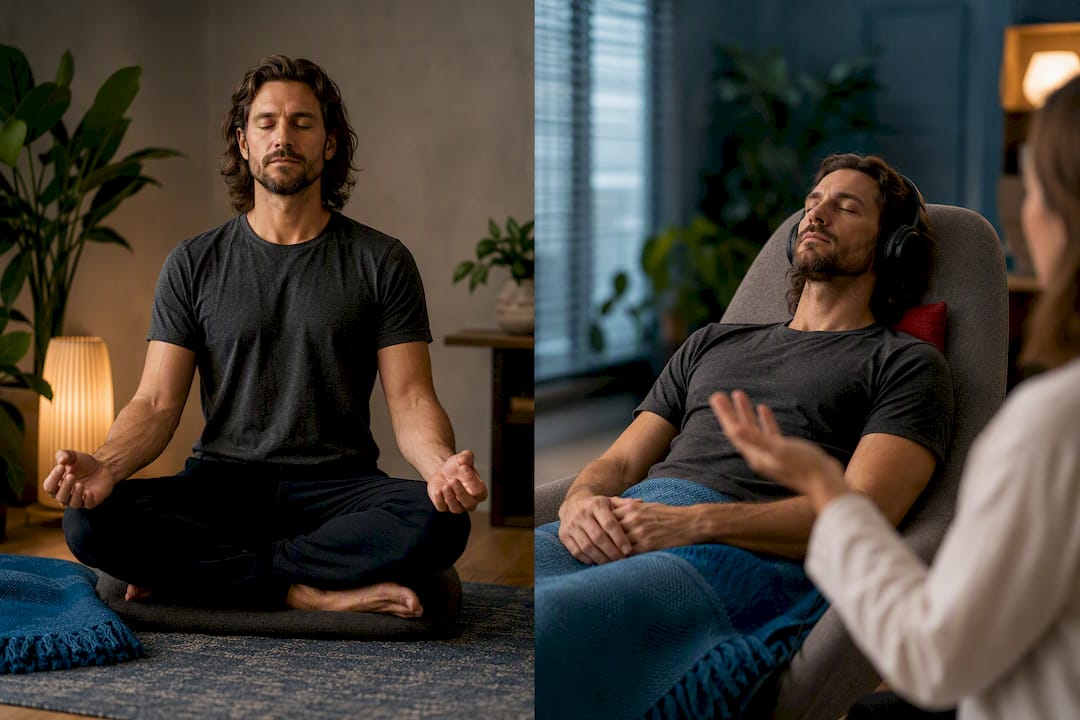
Hypnosis is a suggestion-led, goal-directed method best suited to targeted, often faster change; meditation trains open awareness and works best as a long-term practice for stress resilience. Neither replaces the other. For a specific outcome, like quitting smoking or calming pre-surgery nerves, hypnosis tends to move faster. For lasting mental fitness, meditation wins on staying power.
TL;DR:
Hypnosis delivers faster results for targeted issues like phobias, pain, or habits, especially for highly hypnotisable individuals.
Meditation builds sustained attention and long-term stress resilience, requiring consistent daily practice over weeks or months to see benefits.
Hypnosis sessions involve structured induction and suggestion, while meditation practices vary from guided to unguided without passive suggestion.
Neural evidence shows hypnosis induces broad brain network changes, whereas long-term meditation affects the default mode network and propagates lasting neural shifts.
Combining meditation to establish awareness and hypnosis to target specific behaviors can enhance overall effectiveness and deepen change.
Table of Contents
Hypnosis vs meditation: the core difference explained
Hypnosis is a state of focused attention in which a person becomes more responsive to suggestion, usually guided by a practitioner working toward a specific outcome. The Royal College of Psychiatrists describes it as goal-directed work: you go in wanting to stop biting your nails, manage a phobia, or ease chronic pain, and the session is structured around that aim.
Meditation is different in almost every respect except the surface calm it produces. It trains attention itself, rather than using that attention to plant a specific suggestion. Mindfulness meditation cultivates non-judgemental awareness of the present moment. Concentrative meditation narrows focus onto a single point, a breath or a mantra. Open monitoring styles let thoughts pass without engagement. None of these variants is chasing one outcome the way a hypnosis session does; they are building a general capacity that pays off gradually.
The clearest way to hold the distinction in your head: hypnosis is about doing, meditation is about being. Hypnosis intentionally shapes an experience or behaviour through suggestion delivered by someone else, or by a recorded script you follow. Meditation is closer to autonomous observation, watching the mind rather than instructing it.
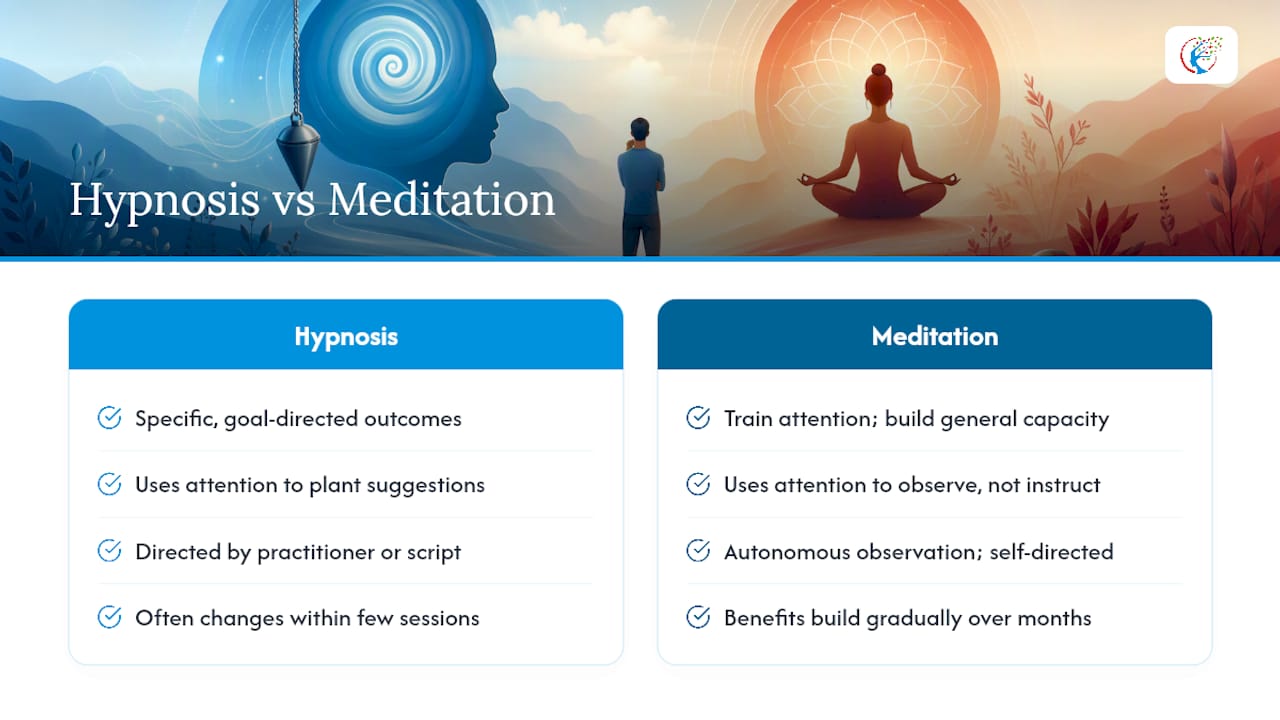
This matters because it changes what you should expect from each. Walk into a hypnosis session wanting relief from a fear of flying, and a skilled practitioner will address that fear directly, often within a handful of sessions. Sit down to meditate with the same fear in mind, and you’re not giving your mind a direct instruction. You’re building the kind of steady attention that, months later, makes the fear easier to sit with. Neither approach is “better” in the abstract. They’re built for different jobs, which is exactly why comparing them side by side is more useful than picking a winner.
What actually happens in a session
A typical hypnosis session with a trained practitioner follows a fairly predictable shape. There’s an intake conversation first, where the practitioner asks what you want to change and why. Then comes the induction, the phase most people picture when they think of hypnosis: guided imagery, progressive muscle relaxation, or a slow narrowing of attention until you’re absorbed and receptive. Suggestions follow, tailored to your goal, and the session closes with a gentle return to full alertness and a debrief.
Meditation looks nothing like that structurally, and it doesn’t need a practitioner in the room at all.
Guided audio sessions talk you through breath awareness or body scanning, often 10 to 20 minutes long.
Unguided mindfulness sits you with your own breath and thoughts, no script at all.
Mantra-based practice repeats a word or phrase to anchor attention.
Body scan meditation moves attention slowly through physical sensation, often used for sleep or pain.
The time commitment differs sharply between the two. According to Cleveland Clinic, hypnosis can produce noticeable improvement within a single session or a short course of them, particularly for people who respond well to suggestion. Meditation generally asks for 10 to 30 minutes of daily practice, and the benefits accumulate rather than arrive. This isn’t a flaw in meditation. It’s simply how attention training works: nobody develops physical fitness from one gym session, and mental fitness follows a similar curve.
There’s also a hidden variable in hypnosis that meditation doesn’t share in the same way: hypnotisability. Some people slip into a hypnotic state easily and respond strongly to suggestion; others find it takes longer or barely works at all. That variation is well documented in the research literature and helps explain why two people can have wildly different experiences of the same hypnotherapy approach, while meditation’s benefits, though slower to appear, are less dependent on any single personality trait.
Where the two overlap, and where the brain shows a real split
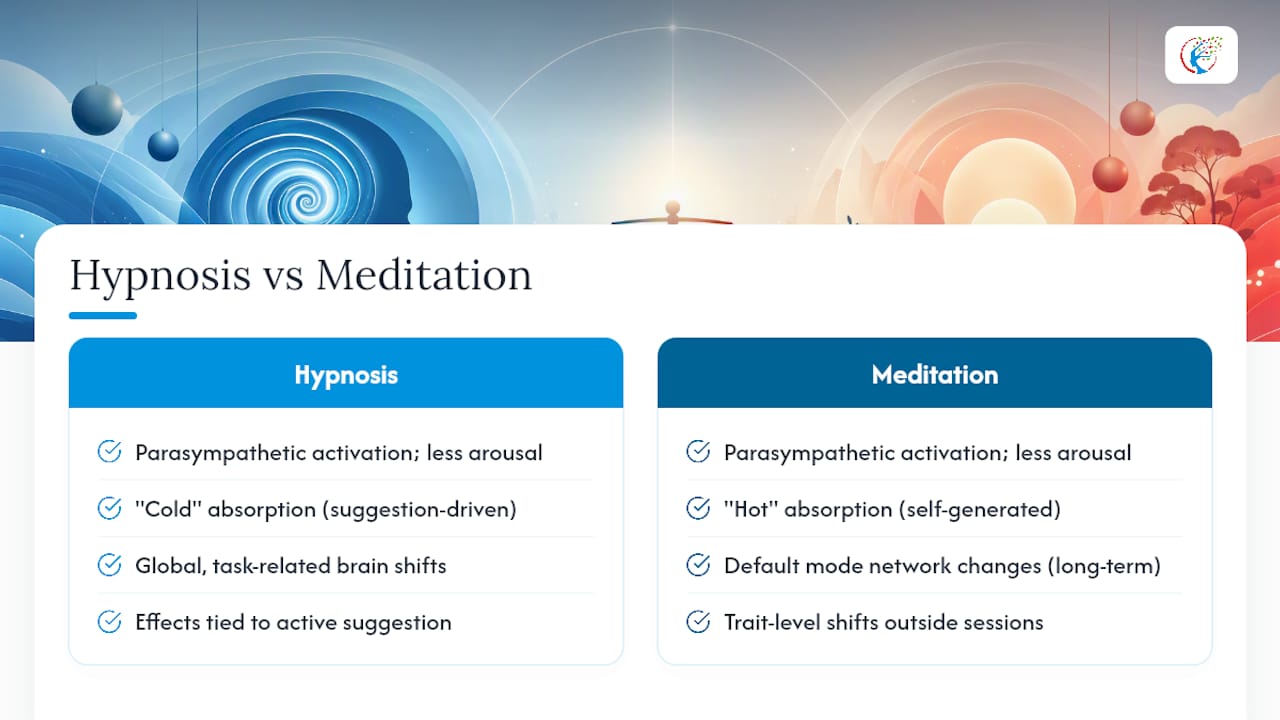
Both practices switch on the parasympathetic nervous system, the “rest and digest” branch that slows heart rate and eases blood pressure, and both tend to reduce sympathetic arousal, the fight-or-flight response. Physiological research across contemplative practices finds this pattern repeatedly, though not every study agrees on the size of the effect, and the heterogeneity of study design makes clean comparisons harder than headlines suggest.
The overlap doesn’t stop at relaxation. Both states involve a kind of absorption, a narrowing of attention that pulls you away from background noise and into the experience itself. Researchers sometimes frame this as “cold” absorption in hypnosis, driven by external suggestion, against “hot” absorption in meditation, which tends to be self-generated and sustained through effort rather than instruction.
Where the two genuinely part ways is in the brain scanner. Neuroimaging research associates hypnosis with global, task-related shifts in brain functioning, changes that show up broadly across networks while a person is actively engaged in suggestion. Meditation tells a different story, particularly in people with years of practice behind them. Long-term meditators show measurable changes in the default mode network, the brain system active during mind-wandering and self-referential thought, along with trait-level shifts that persist outside the meditation session itself. Hypnosis doesn’t typically leave that kind of lasting neural signature between sessions; its effects are more tied to the suggestion actively at work.
There’s also a subtler experiential difference worth knowing before you try either. Hypnosis can produce a sense of dissociated volition, a feeling that your actions or responses are happening somewhat outside your usual sense of control, according to the mini-review on direct comparisons between hypnosis and meditation. Meditation aims for the opposite: sharper metacognitive awareness, a stronger sense of watching your own mind at work. That contrast has practical safety implications, which matters more than it sounds.
What the research actually says when you compare them directly
Head-to-head studies of hypnosis and meditation are rarer than you’d expect given how often the two get compared informally. The 2022 Frontiers in Psychology mini-review is the most useful single source on this, and its conclusion is refreshingly honest: the two practices share phenomenological and neurophysiological features, but they are not the same thing, and direct experimental contrasts remain limited. Some studies lean toward highlighting overlap; others emphasise distinct mechanisms. No firm consensus exists yet.
That uncertainty isn’t a weakness in the science so much as a reflection of how messy the underlying categories are.
“Meditation” covers dozens of distinct techniques, from Vipassana to transcendental meditation to simple breath awareness, and lumping them together in a study blurs real differences.
Hypnotisability varies enormously between individuals, which means a hypnosis trial with a mixed-response sample will show weaker average effects than one enrolling highly responsive participants.
Most comparison studies run on small samples, often a few dozen participants, which limits how confidently anyone can generalise the findings.
Clinical bodies tend to describe the two in more practical terms than researchers do. The Royal College of Psychiatrists frames hypnosis as suggestion-based and goal-directed, delivered in a clinical or therapeutic context. Cleveland Clinic frames meditation as broadly accessible, low-risk, and self-directed, which is precisely why public health messaging leans on it so heavily; the CDC has documented a marked rise in adult meditation practice as a stress-management tool. Hypnosis, by contrast, usually needs a trained facilitator, which limits how casually people can pick it up compared with a free meditation app.
None of this means either method is unproven. It means readers should treat strong claims about superiority, in either direction, with a healthy dose of scepticism, because the evidence base simply isn’t built for that kind of verdict yet.
Which conditions each approach actually helps with
Hypnosis has a fairly consistent track record for specific, targeted problems: pain control, smoking cessation, needle phobia and other procedural anxiety, and behavioural habits people want to break quickly. Its effectiveness leans heavily on individual responsiveness to suggestion, so someone highly hypnotisable may see dramatic results where someone less responsive sees very little.
Meditation’s evidence base points in a different direction: general stress reduction, mood support, sleep quality and sustained attention training. The therapeutic benefits documented in recovery settings show how meditation gets used as a long-term adjunct rather than a quick fix, which lines up with its slower, cumulative nature. Readers exploring mindfulness for anxiety will find the same pattern: steady practice over weeks, not an overnight switch.
A few practical notes worth taking seriously:
Hypnosis for pain and procedural anxiety tends to work best as an adjunct alongside standard medical care, not a replacement for it.
Meditation’s benefits for anxiety and mood typically take several weeks of consistent practice before they become noticeable.
Anyone with a history of psychosis, dissociative disorders, or severe untreated mental illness should consult a qualified clinician before trying either practice, since altered attention states can occasionally interact badly with certain conditions.
Those with performance-related anxiety, on stage, in exams, or before a big presentation, often ask which method suits that specific pressure. A closer look at hypnosis for performance anxiety covers that particular use case in more depth.
How to decide which one to try first
Start with the goal, not the method. A specific, well-defined problem, quitting a habit, easing one particular fear, managing pain before a procedure, points toward hypnosis. A general wish for more calm, better sleep, or improved focus over the coming months points toward meditation.
Run through this checklist before committing time or money to either:
Define the goal precisely. “I want to stop smoking within six weeks” is workable; “I want to feel better” is too vague for either method to target well.
Check your time budget. If you can’t commit to 10 to 30 minutes daily, meditation will struggle to deliver. If you can find one hour for a single focused session, hypnosis becomes viable.
Assess your openness to suggestion. People who find it easy to get absorbed in a film, a book, or daydreaming often respond well to hypnosis. If that sounds nothing like you, meditation may suit your temperament better.
Find a trained practitioner if going the hypnosis route. Self-guided hypnosis apps exist, but a qualified therapist can tailor suggestions far more precisely than a generic recording.
Run a short trial and measure it. Give meditation one to two weeks of daily practice, or book one to two hypnotherapy sessions, then check your outcome against a simple metric: sleep hours, pain rating, cigarettes smoked, anxiety score, whatever fits your original goal.
Pro Tip: If you’re not sure how hypnotisable you are, try a simple test: close your eyes and imagine your outstretched arm as light as a balloon, letting it rise slightly on its own. A clear, involuntary lift suggests you’re likely to respond well to hypnosis. If nothing happens after a few honest attempts, meditation’s gradual approach may suit you better, and that’s a completely normal result, not a failure.
Combining the two for a fuller approach
Plenty of people don’t have to pick one. A common and sensible sequence: build a baseline of present-moment awareness through a few weeks of regular meditation, then bring in hypnosis to target one specific behaviour or fear once that foundation of calm is in place. The meditation groundwork tends to make people more receptive to focused suggestion later, since they’ve already practised sitting with discomfort instead of resisting it.
Therapeutic settings increasingly reflect this blend. A practitioner might open a hypnotherapy session with a brief mindfulness induction, easing a client into a relaxed, absorbed state before layering in targeted suggestion work, a technique noted in clinical guidance on hypnosis. It borrows the accessibility of meditation to smooth the entry point into hypnosis.
Picture someone dealing with chronic pain alongside generalised anxiety. Weeks of daily breath-focused meditation build a steadier baseline mood and better tolerance for physical discomfort. A course of hypnotherapy then targets the pain response directly, using suggestion to change how the brain interprets and reacts to the sensation. Neither piece replaces the other; each does a different part of the job. For readers curious about related integrative techniques, emotional release therapy covers another angle on combining approaches for deeper healing.
A practitioner’s view on where hypnosis fits
Meditation and hypnosis get lumped together constantly, and that habit does both a disservice. Meditation builds the quiet, observant mind that makes suggestion work land properly. Without that groundwork, some clients arrive at hypnotherapy carrying so much surface tension that the induction takes far longer than it should.
Quantum Healing Hypnosis Technique sits at the more intensive end of hypnotherapy, less about quick behavioural tweaks and more about deep subconscious exploration, sometimes touching on past-life material or a client’s sense of higher purpose. That depth of work suits people who’ve often already tried lighter approaches, meditation apps, standard talking therapy, and want to go further. The clients who benefit most tend to present with a mix of emotional blockages, unexplained physical tension, or a persistent sense that something unresolved sits beneath the surface. Regression hypnotherapy offers a more targeted route for those who want focused change without the full QHHT depth. Either way, the goal stays the same: give the subconscious room to speak once the noise of everyday thinking settles.
— Paul
Ready to explore hypnosis for yourself?
If meditation has taken you as far as steady daily practice can, and you’re still carrying something unresolved, structured hypnosis often reaches deeper in a fraction of the time. A practitioner may work with clients across various locations in South East London, offering Quantum Healing Hypnosis Technique, regression hypnotherapy, and energy healing sessions tailored to individual goals.

A first session starts with an unhurried conversation about what’s actually going on, no rushing into an induction before there’s real trust in the room. From there, sessions are tailored: some clients want targeted regression work on a specific fear or block, others want the fuller QHHT exploration of subconscious material and higher self guidance. Full details on what to expect, including how QHHT sessions are structured, sit on the QHHT FAQ page. For anyone managing a diagnosed mental health condition, checking in with a GP or psychiatrist alongside any hypnotherapy work is a sensible precaution, not an either/or choice.
Ready to book? Visit the QHHT session booking page to check availability and reserve a time that works for you.
This article is general information, not a substitute for advice from a qualified doctor. Consult a qualified healthcare professional about your own circumstances before acting on anything here.
Sources
FAQ
What are the downsides of hypnosis?
Hypnosis depends heavily on individual hypnotisability, so results vary widely between people, and it isn’t well suited to conditions like psychosis or certain dissociative disorders without careful clinical screening.
What are three things hypnosis cannot do?
Hypnosis cannot force someone to act against their core values, cannot guarantee memory recall is perfectly accurate, and cannot work reliably on someone who resists or is not genuinely responsive to suggestion.
Is 20 minutes of meditation equivalent to 4 hours of sleep?
No. That claim isn’t supported by the research summarised here; meditation can improve alertness and reduce stress, but nothing replaces sleep’s distinct physiological restoration processes.
What do psychologists think of hypnosis?
Clinical bodies including the Royal College of Psychiatrists recognise hypnosis as a legitimate, suggestion-based therapeutic tool for goal-directed change, while noting that outcomes depend on individual responsiveness and practitioner skill.
Should I try meditation or hypnosis first?
Choose meditation for general stress management and long-term mental fitness, and choose hypnosis, ideally with a qualified regression hypnotherapy practitioner, when you have one specific, well-defined change you want to make.
Recommended
Comments