When Intense Love Masks Abuse: Karmic Relationship Signs, Therapy and QHHT


If you keep asking whether what you’re in is love or something more chaotic, it’s usually the latter. A karmic relationship is an intense, cyclical bond that acts as a catalyst rather than a stable partnership, built on unresolved patterns pulling you into highs, crashes and repetition. Some can transform into something healthier, but that only happens when both people do real, sustained work. The signs below will tell you which situation you’re facing.
TL;DR:
Karmic relationships often escalate quickly, with partners discussing long-term commitments within weeks based on superficial compatibility.
They tend to involve unresolved conflicts, obsessive thinking, boundary erosion, and dramatic swings between idealization and disillusionment.
Repeated red flags such as control, intimidation, or fear indicate a safe response should be prioritizing safety before trying to heal or end the bond.
These patterns usually stem from childhood wounds or past traumas activating old unresolved wounds rather than genuine compatibility.
Breaking the cycle requires deliberate boundary setting, safety measures, professional support, and reflection on personal patterns, not just emotional detachment.
Table of Contents
Karmic relationship signs: the checklist to run against your own relationship
The pattern tends to announce itself early and then keep announcing itself in the same shape for months or years.
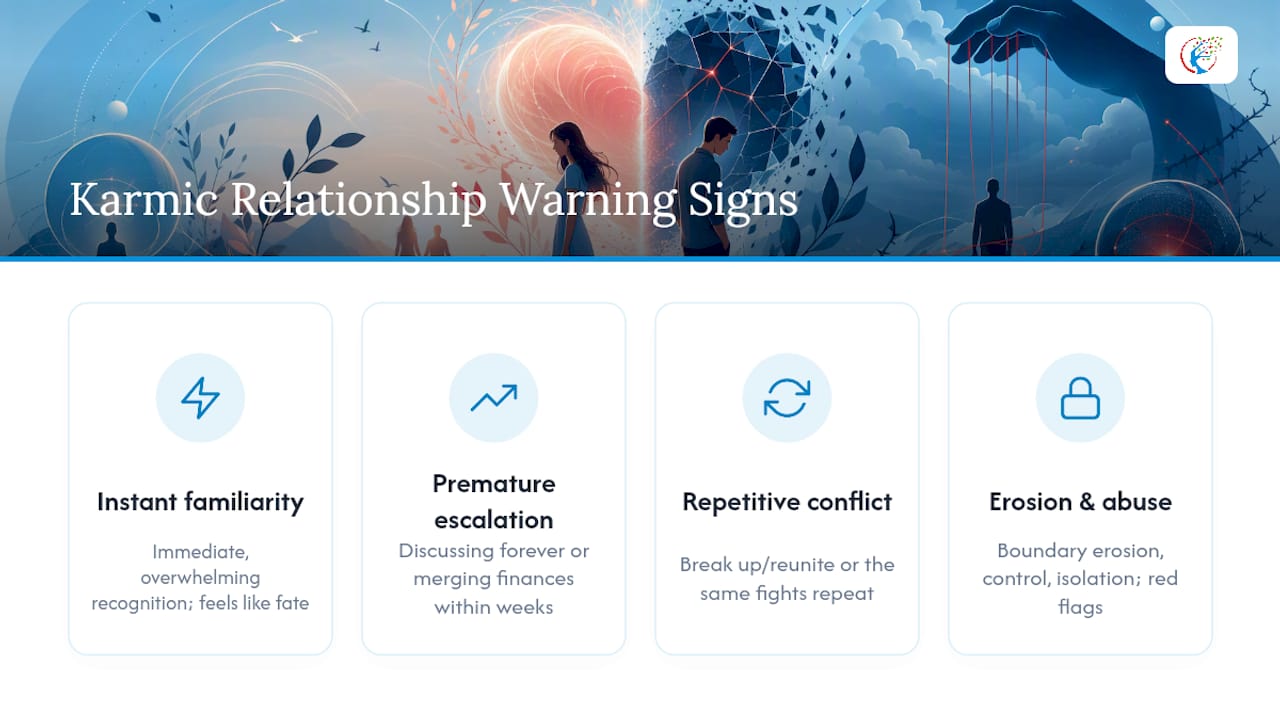
Immediate, overwhelming recognition. You met and felt like you already knew them, sometimes described as instant familiarity or a jolt of fate. That intensity feels romantic in the moment, but it’s also the first warning sign, because real compatibility is usually built, not summoned.
Escalation that outpaces the relationship’s foundation. Within weeks, you’re discussing forever, moving in, or merging finances, long before you’ve actually learned who this person is day to day.
Push and pull that never resolves. You break up and reunite, or you fight about the same three things every few weeks without ever landing on a solution. Cleveland Clinic lists this repetitive, unresolved conflict as one of the clearest markers of a karmic dynamic, alongside the burnout that follows it.
Obsessive thinking and trauma bonding. You find yourself checking your phone constantly, replaying arguments, or feeling withdrawal symptoms when they pull away. That isn’t longing; it’s closer to dependency.
Codependency and boundary erosion. Your routines, friendships and even opinions start reshaping themselves around this one person, and saying no to them feels disproportionately frightening.
Idealisation followed by sudden crashes. One week they’re your soulmate, the next they’re the source of every problem in your life. That swing, rather than steady warmth, is the tell.
Explaining away what you’d never accept from anyone else. You find yourself justifying behaviour to friends or to yourself that you’d immediately flag as a problem in someone else’s relationship.
Genuine red flags for abuse. Intimidation, isolation from friends and family, controlling behaviour, or fear of how they’ll react are not karmic quirks. Clinicians are explicit that these dynamics can resemble abusive patterns, and when they do, Psych Central’s clinical overview recommends treating safety, not soul lessons, as the priority.
Pro Tip: If you’re ticking off five or more of these, stop asking “is this karmic” and start asking “is this safe.” The label matters far less than your wellbeing.
Not every intense relationship is karmic, and not every karmic relationship is doomed. But this particular combination of speed, repetition and self-erosion is what separates a demanding but healthy bond from one that’s quietly running you down.
Why karmic relationship patterns happen in the first place
These dynamics tend to trace back to something older than the relationship itself. Relational mirroring is the psychological explanation: your partner activates unresolved wounds from childhood, an earlier relationship, or a pattern you’ve never actually examined. You’re not falling for who they are so much as reacting to what they represent.
There’s also a straightforward reinforcement loop at work. The highs feel enormous because the lows were so painful, and your brain starts treating relief from anxiety as though it were love. Verywell Mind frames this as emotional addiction rather than depth of connection, which is a more useful lens than “we’re just passionate.”
The spiritual framing, karma as an unfinished lesson or a soul contract, works as an interpretive tool for some people rather than a literal fact everyone must accept. Either way, the practical takeaway is the same.
Dr Caroline Madden describes the relationship as functioning like a mirror. The goal isn’t to fix your partner. It’s to use what the dynamic reveals about you.
Most karmic bonds are short-term by nature. Medical News Today notes they typically act as catalysts that become toxic if the cycle repeats unchecked, and they only shift into something sustainable when both people do visible, ongoing work, not just apologise and repeat.
How to end or heal a karmic relationship
Start with safety, always. If there’s intimidation, control, isolation or fear of your partner’s reactions, contact a recognised domestic abuse helpline like The Hotline before attempting any of the steps below. Boundary work only helps once you’re actually safe to set boundaries.
From there, a workable sequence looks like this:
Name the pattern out loud. Write down, in plain language, what keeps repeating. Naming it removes some of its power.
Set one boundary at a time. Something concrete: “I won’t discuss this after 11pm,” or “I’m not available for a third reconciliation this month.” Practise saying it before you need it.
Bring in professional support. Individual therapy, particularly trauma-informed counselling, helps you separate the addictive pull from genuine compatibility. Prism Counseling’s podcast on recovering from emotional and verbal abuse is a useful starting point if you’re processing that kind of harm.
Use grounding and journalling daily. Even ten minutes of writing or breathing exercises rebuilds the perspective the relationship has been eroding.
Consider energy work as an adjunct, not a substitute. Practices like cord-cutting or QHHT can help some people gain distance from a trauma bond, but they work best alongside therapy, not instead of it.
Integrate slowly. Expect old feelings to resurface for weeks. That’s not failure, it’s aftercare.
Pro Tip: Rebuild a life outside the relationship before you try to leave it. Hobbies, friendships and routines you control give you somewhere to land.
Karmic chaos versus a genuinely healthy partner
A karmic dynamic runs on intensity; a durable relationship runs on consistency. Watch for the difference rather than the drama.
Respect that doesn’t fluctuate with mood, rather than warmth one day and contempt the next.
Shared values on the big things, money, family, how conflict gets handled, not just chemistry.
Conflict that actually resolves, with both people adjusting behaviour afterwards.
Change you can observe, not just promises repeated after every reconciliation.
If a partner says they’ll change and nothing in their actual behaviour shifts within weeks, that’s your answer regardless of how the relationship started.
Growing from a karmic relationship instead of just surviving it
Ending or fixing the relationship isn’t the only outcome worth aiming for. Some of the most useful growth happens while you’re still untangling what the dynamic taught you.
Start by treating the relationship as information rather than a verdict on your worth. What did you tolerate that you wouldn’t tolerate now? What need were you trying to meet through someone who couldn’t reliably meet it? Those questions, asked honestly, often reveal a pattern that predates this particular partner entirely, an old belief about being unworthy of steady love, or a habit of confusing intensity with intimacy.
Journalling the relationship’s timeline, not just the feelings but the actual sequence of events, tends to expose the mechanics of the cycle more clearly than replaying it emotionally ever does. Many people only see the push and pull pattern once they’ve written it down chronologically.
There’s also a quieter form of growth in simply widening your tolerance for calm. If chaos has felt like passion for years, steadiness can initially feel like something is missing. Learning to sit with that, rather than manufacturing drama to feel “alive,” is one of the more overlooked skills that comes out of these relationships.
Consider it a rehearsal for the boundaries and self-trust you’ll bring into whatever comes next, rather than a wound to be forgotten.
Breaking the cycle when karmic patterns repeat with different people
If this isn’t your first version of this exact relationship, the common thread is you, not bad luck. Karmic patterns tend to repeat across different partners until the underlying cycle is actually interrupted rather than just outlasted.
The cycle usually runs: intense attraction, escalating closeness, a triggering event, conflict, temporary resolution, calm, then a new trigger. Reconciliation without new behaviour just resets the clock rather than breaking it. As practitioner guidance on breaking karmic cycles points out, transformation depends on both partners producing observable behavioural evidence, not repeated promises.
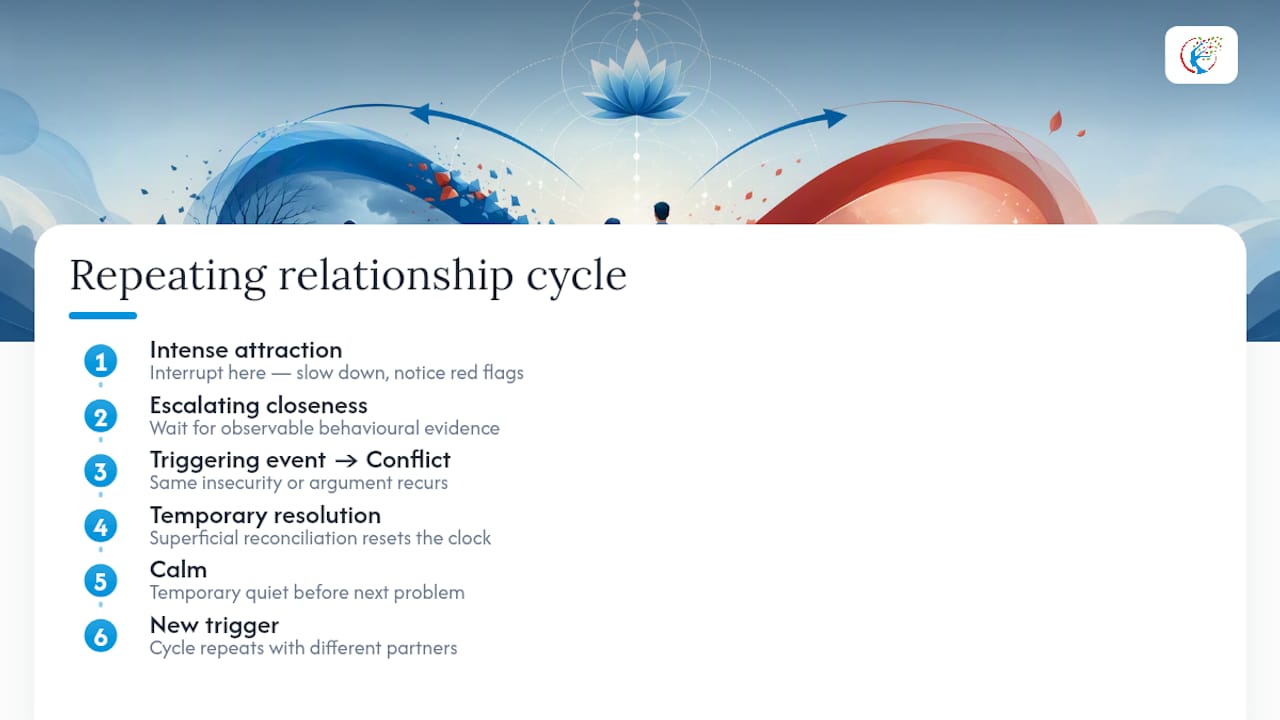
Breaking it usually means interrupting the cycle at its earliest, most containable point, the initial intensity, rather than waiting until you’re deep into the conflict phase to intervene. That means slowing down deliberately in the first weeks of a new connection, noticing if you’re already justifying red flags, and treating “I’ve never felt like this before” as a prompt for caution rather than reassurance.
It also helps to look for the common denominator across your past relationships. If three different partners have all triggered the same insecurity or the same argument, the lesson isn’t about them. Working through that root pattern, often with a therapist, sometimes alongside deeper regression work, is what actually stops the cycle rather than just changing its cast.
Practitioner perspective: how QHHT and energy healing are used alongside therapy
Quantum Healing Hypnosis Technique guides someone into a deeply relaxed state to explore the subconscious, sometimes surfacing past-life material that mirrors a current relational pattern with unusual clarity. Combined with energy clearing or chakra work, it can help someone integrate what therapy has already identified intellectually but hasn’t yet resolved emotionally. During a session, expect stillness and gentle guidance rather than performance; afterwards, trauma-informed aftercare matters as much as the session itself, since old material can resurface gradually over the following days. This kind of work sits alongside talking therapy, never instead of it. You can read more on past life patterns and soulmates for a closer look at how regression work addresses repeating relational themes.
— Paul
Where practitioner-led healing fits into your next step
A practitioner may work with people untangling repeating relational patterns, offering a slower, more personal alternative to a generic energy-healing directory or a standard therapy referral. If you recognise yourself in the signs above, Quantum Healing Hypnosis (£369) explores where the pattern originates at a subconscious level, while Evolve Quantum Healing (£99) focuses on chakra balancing, cord cutting and emotional release for those who want lighter-touch support.

A mobile QHHT visit is also available at £399 for anyone who’d rather work from home, and Remote Evolve Quantum Healing at £99 covers the same energy work over a distance session. For self-paced support between sessions, the Rising Higher online course walks through structured exercises for anxiety and depression. None of this replaces therapy where abuse or clinical mental health concerns are present; it works best alongside it. Book a session or check current availability on the Paulstebles booking page when you’re ready to take the next step.
Sources
For clinical definitions and safety guidance, Cleveland Clinic and Psych Central are solid starting points. If empathic overwhelm is part of your pattern, Paulstebles’ energy protection guide covers daily grounding techniques, and the full blog has more on boundaries and spiritual tools.
FAQ
How do you know if you’re in a karmic relationship?
Look for immediate intense recognition, rapid escalation, repeated unresolved conflict, and a push-pull cycle that leaves you emotionally drained rather than supported. If several of these overlap with justifying behaviour you’d flag in anyone else’s relationship, it’s likely karmic.
How do karmic relationships usually end?
They typically end when one or both people finally interrupt the cycle through boundaries, distance and outside support rather than through a dramatic single event. Where safety is a concern, ending safely with professional or helpline support takes priority over any spiritual framing.
How long does a karmic relationship usually last?
Most act as short-term catalysts rather than lasting partnerships, though “short” can still mean months or a few years of an on-off cycle. They only extend into something sustainable when both partners visibly change their behaviour, not just their promises.
Is a karmic relationship true love?
It can feel like the most intense love you’ve experienced, but intensity and health aren’t the same thing. Therapists generally describe the pull as closer to emotional addiction than the steady, consistent respect that defines lasting love.
Recommended
Comments