5 Minute Cord Cutting to Break a Narcissistic Bond With Aftercare


Narcissist cord cutting is a visualisation ritual that helps you reclaim the emotional energy still tangled up in an abusive relationship, even after you have gone no contact. Ground yourself with three slow breaths, picture a cord running from your body to theirs, and imagine cutting it with a clean, deliberate motion. One session rarely finishes the job. Treat it as the start of a repeatable practice, not a single fix.
TL;DR:
Repeating cord-cutting rituals regularly at the same time trains your nervous system to associate the practice with emotional release, not rumination.
Complete long-term healing often requires combined efforts with boundaries, energy protection routines, and professional trauma therapy, not just a single ritual.
A narcissist’s cord tends to trigger unpredictable praise or contact, includes self-doubt, and often results in relief mixed with guilt, unlike normal attachments.
Successful cord cutting manifests as decreased emotional reactivity, shorter trigger responses, and a gradual return of personal preferences and opinions.
Rituals are most effective when paired with somatic work, emotional processing, and professional support for deep or persistent trauma bonds.
Table of Contents
What is narcissist cord cutting, and how does it relate to trauma bonds?
How do you spot a narcissistic cord versus a normal attachment?
What does successful cord cutting with a narcissist actually feel like?
How does cord cutting fit alongside therapy and somatic work?
Why compassionate cord cutting works better than angry cord cutting
How Paulstebles supports deeper release when a ritual alone is not enough
What is narcissist cord cutting, and how does it relate to trauma bonds?
Energetic or etheric cords describe the invisible pull you still feel toward someone long after the relationship has ended: the urge to check their social media, the flinch when their name appears, the pang of missing someone who hurt you. Whether or not you take the energy framework literally, it names something real. Trauma bonding is the psychological mechanism behind that pull: intermittent affection mixed with cruelty trains your nervous system to associate the narcissist with both danger and relief, which is a far stickier combination than plain heartbreak.
That is why walking away rarely feels clean. Your body has learned to crave the same person who caused the harm, so the attachment often outlasts the relationship itself. Cord-cutting narcissist work sits in that gap between logic and physiology.
Cutting ties with a narcissist is not about punishing them or proving a point. It is self-preservation.
The cord metaphor gives you a physical action for an emotional problem, which the mind often finds easier to process than abstract willpower.
Trauma bonds create real withdrawal-like symptoms, not weakness of character.
The ritual’s purpose is closure for you, regardless of whether the narcissist ever apologises or changes.
How do you actually cut a cord with a narcissist?
You have three workable versions of this ritual, depending on how much time and privacy you have. All three follow the same logic: ground, visualise, cut, seal.
The 5-minute version. Sit or stand somewhere quiet. Breathe in for four counts, hold for four, out for six, repeated three times. Picture a cord of light or rope running from your solar plexus to the narcissist. See it clearly, then imagine a blade, a pair of scissors, or simply your own hand slicing through it in one motion. Watch both ends retract and dissolve. Finish by pressing a hand to your chest and saying, silently or aloud, “I take my energy back.”
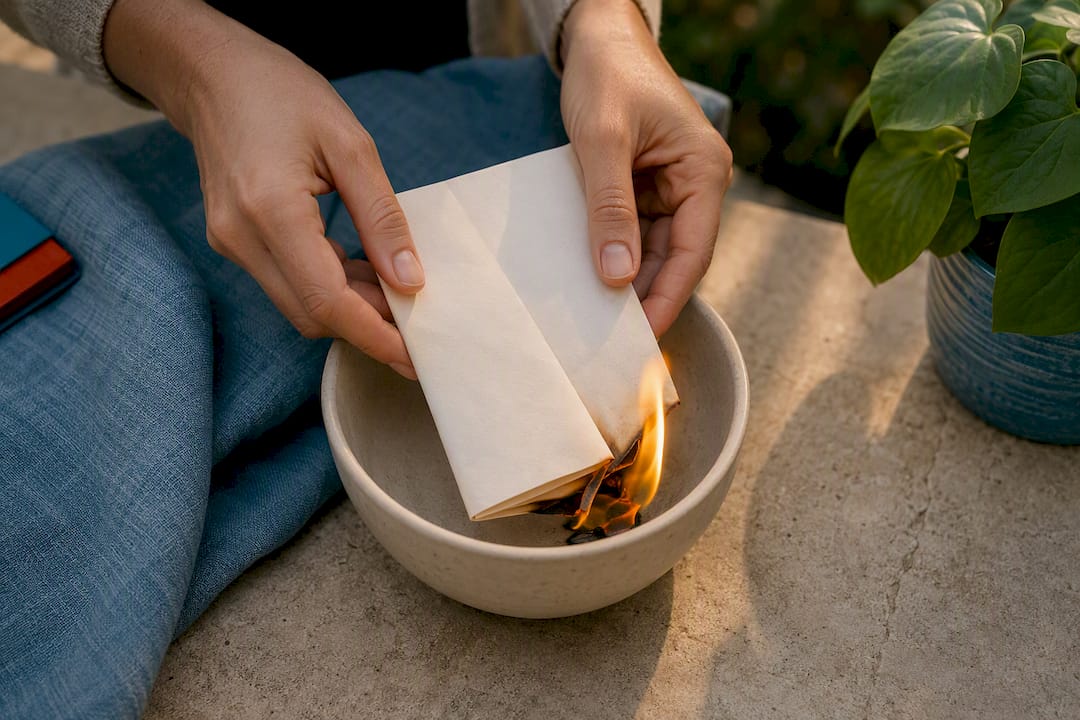
The fuller ritual. Set aside 20 to 30 minutes somewhere you will not be interrupted. Light a candle if you like the symbolism. Write the person’s name on paper and name, out loud, what the cord represents (control, guilt, hope for change). Move into the same grounding breath, then the same visualised cut, but hold the image longer. After cutting, imagine light or warm water sealing the wound where the cord was attached, then burn or tear the paper. Ground yourself afterwards by pressing your bare feet into the floor or the earth for a minute.
The remote or distance variant. When you cannot be alone, or the trigger hits mid-conversation with someone else, use a shortened mental version: three breaths, a fast mental image of the cord, one decisive cut, one hand on your sternum. This works in a car park, a bathroom stall, or before a phone call you are dreading.
Practical guides on the mechanics of the ritual, including variations on candle work and cleansing baths, are widely documented in step-by-step cord-cutting resources, and most converge on the same grounding-visualise-cut-seal structure.
Pro Tip: Do the ritual regularly at the same time of day to help train your nervous system to associate that moment with release rather than rumination, which matters more than getting the visualisation “perfect”. Repetition trains your nervous system to associate that moment with release rather than rumination, which matters more than getting the visualisation “perfect”.
What aftercare actually stabilises the results?
A ritual without aftercare tends to fade within days, because the nervous system that formed the trauma bond in the first place needs retraining, not just a symbolic gesture.
Start with the body. Racing thoughts and a tight chest after a cutting session usually mean your system is still in alert mode, so pair the ritual with nervous system regulation work: slow exhales, cold water on the wrists, or a short walk before you try to think your way through anything.
Boundaries do the rest of the work that visualisation alone cannot.
Grey rocking (giving flat, boring, minimal responses) removes the emotional reward a narcissist gets from provoking you.
Fixed contact windows, if any contact is unavoidable (co-parenting, shared work), stop every interaction from becoming an open-ended trigger.
Muting, blocking, or archiving their accounts removes the low-level drip of information that keeps the cord “warm”.
Energy protection routines are the third leg. A salt bath after a cutting ritual is a common practitioner recommendation, partly for the physical calm of warm water and partly for the symbolic cleansing. Simple shielding visualisations, imagining a layer of light or colour around your body before you leave the house, work well as a daily add-on. If chakra language feels natural to you, a short cleansing focused on the solar plexus (where most people picture the cord attaching) reinforces the same intention. For a fuller daily routine, see empath energy protection.
What are the risks and ethical lines of cord cutting?
Doing this from hatred usually backfires. If your intention is revenge or proving the narcissist wrong, your focus stays locked on them, which paradoxically feeds the exact attachment you are trying to sever. Compassionate intent, wishing them well from a distance while removing yourself from their orbit, tends to hold better, according to practitioner reports on repeated re-attachment. This is one of the clearer cord cutting side effects to watch for: if the same cord keeps reforming, the emotion behind the ritual is often the reason.
Expect to repeat the ritual. One cut rarely finishes deep, long-term bonds.
Repeated re-attachment usually signals unresolved grief, guilt, or an unmet need for validation, not a failed ritual.
Seek a trauma-informed therapist or energy practitioner if flashbacks, panic attacks, or suicidal thoughts appear. Cord cutting is a self-help layer, not clinical treatment.
How do you build a 30/60/90-day plan that actually sticks?
A single ritual gives short relief. A structured window gives you something to measure.
Days 1 to 30: A two-minute grounding and visualisation each morning, plus a nightly journal line answering “What did I feel today when I thought of them?” This builds the habit before you judge the results.
Days 31 to 60: Add a weekly trigger log (what set you off, how you responded) and a boundary audit: are you still checking their profile, still answering messages you said you would not?
Days 61 to 90: Move to twice-weekly rituals instead of daily, paired with a monthly check-in with a trusted friend or a professional, and a review of whether contact rules from week one still hold.
If triggers, intrusive thoughts, or physical symptoms persist after a sustained period of practicing rituals, it is advisable to seek professional support rather than repeating the same ritual indefinitely. Energy healing or QHHT sessions can address the layer a solo ritual cannot reach.
Is cord cutting safe, and does the science back it up?
Cord cutting is safe for most people when practised with realistic expectations and without replacing clinical care for severe trauma symptoms. The mechanism is not fully physiological, but that does not make the benefit imaginary.
Rituals mark a transition the outside world cannot always give you. When an abuser never apologises and never provides closure, a deliberate, repeated act lets your mind draw its own line under the relationship.
Research on placebo and meaning effects shows that belief and ritual can produce measurable health outcomes even when the biological pathway is not straightforward. Broader attachment research from Harvard Medical School on how relationships shape the brain supports the idea that repeated symbolic acts can shift entrenched neural patterns, while interdisciplinary work from the Royal Society links ritual behaviour to coordinated brain and body responses tied to psychological change. None of this replaces treatment for PTSD or acute crisis. It explains why a ritual that sounds simple can still produce a genuine shift in how safe your body feels.
How do you spot a narcissistic cord versus a normal attachment?
Not every lingering emotional pull is the same, and narcissistic relationships leave a distinct signature. A cord tied to a narcissist tends to carry a push-pull charge: longing mixed with dread, hope mixed with humiliation. Grief for a parent who died, or nostalgia for an old friend, usually feels warmer and more one-dimensional, even when it is painful.
Watch for these markers of a narcissist cord cutting practice specifically:
The trigger is unpredictable praise or contact, not just memory. A single text after months of silence can reactivate the whole cycle, which is a hallmark of intermittent reinforcement rather than ordinary grief.
The pull includes self-doubt. You question your own memory of events, not just your feelings about them. That confusion is the fingerprint of gaslighting, not simple loss.
The cord location often sits at the solar plexus or throat in visualisation work, linked respectively to personal power and voice, both of which narcissistic control tends to target directly.
Relief after cutting comes with guilt, an odd but common combination, because narcissistic relationships train you to feel responsible for the other person’s moods.
If you are unsure whether a cord belongs to the narcissist or to something else entirely (a parent, a sibling, an old friend caught in the same dynamic), visualise each person separately during your ritual. Cords rarely announce themselves cleanly; separating them one at a time gives you a clearer, more accurate cut.
What does successful cord cutting with a narcissist actually feel like?
Success rarely announces itself as a dramatic epiphany. It shows up as small, boring absences: the day you realise you have not checked their profile, the argument you replay less often, the physical calm that arrives faster after a trigger.
A handful of concrete signals suggest the work is holding:
You can think about the relationship without your heart rate spiking, even if the memory is still unpleasant.
Contact from them (or news about them) produces a brief flicker of feeling rather than a spiral lasting hours or days.
You stop rehearsing arguments you will never actually have with them.
Guilt about leaving, or about setting boundaries, fades from a constant hum to an occasional visitor.
You notice your own preferences and opinions returning, ones you had suppressed to keep the peace.
None of these arrive all at once, and they rarely arrive in order. A more useful sign than any single feeling is the shrinking gap between trigger and recovery: if a reminder used to cost you a whole afternoon and now costs you ten minutes, the cord is loosening even if it has not vanished completely. Expect setbacks around anniversaries, mutual friends, or unexpected contact. A relapse in feeling does not undo previous progress; it usually just means one more ritual is due.
What emotional processing pairs well with cutting a cord?
The visualisation handles the symbolic side. The feelings it stirs up, grief, rage, shame, still need somewhere to go, or they resurface as intrusive thoughts within days.
Journalling immediately after a ritual catches material the visualisation loosens but does not resolve. Write without editing for five minutes on whatever surfaces, even if it contradicts what you expected to feel. Body-based processing matters just as much: narcissistic relationships often live in the body as a clenched jaw, shallow breath, or a permanently raised shoulder line, so shaking out your limbs, humming, or a short walk after cutting a cord helps discharge what the mind alone cannot release. For a structured version of this, emotional release therapy offers exercises built specifically for that discharge phase.
Anger that arrives after a ritual is not a sign the ritual failed. It is usually the emotion the trauma bond suppressed while you were still trying to keep the relationship functional. Give it a physical outlet rather than a mental loop: write an unsent letter and burn it, hit a pillow, or say out loud everything you were never allowed to say. Suppressing that anger tends to feed the very cord you are trying to release.
How does cord cutting fit alongside therapy and somatic work?
Cord cutting works best as one layer in a stack, not a stand-alone fix. Trauma therapy (particularly approaches trained in narcissistic abuse recovery) addresses the cognitive distortions the relationship created: the self-blame, the confused loyalty, the fear of being unloveable outside the relationship. Ritual work rarely touches those beliefs directly.
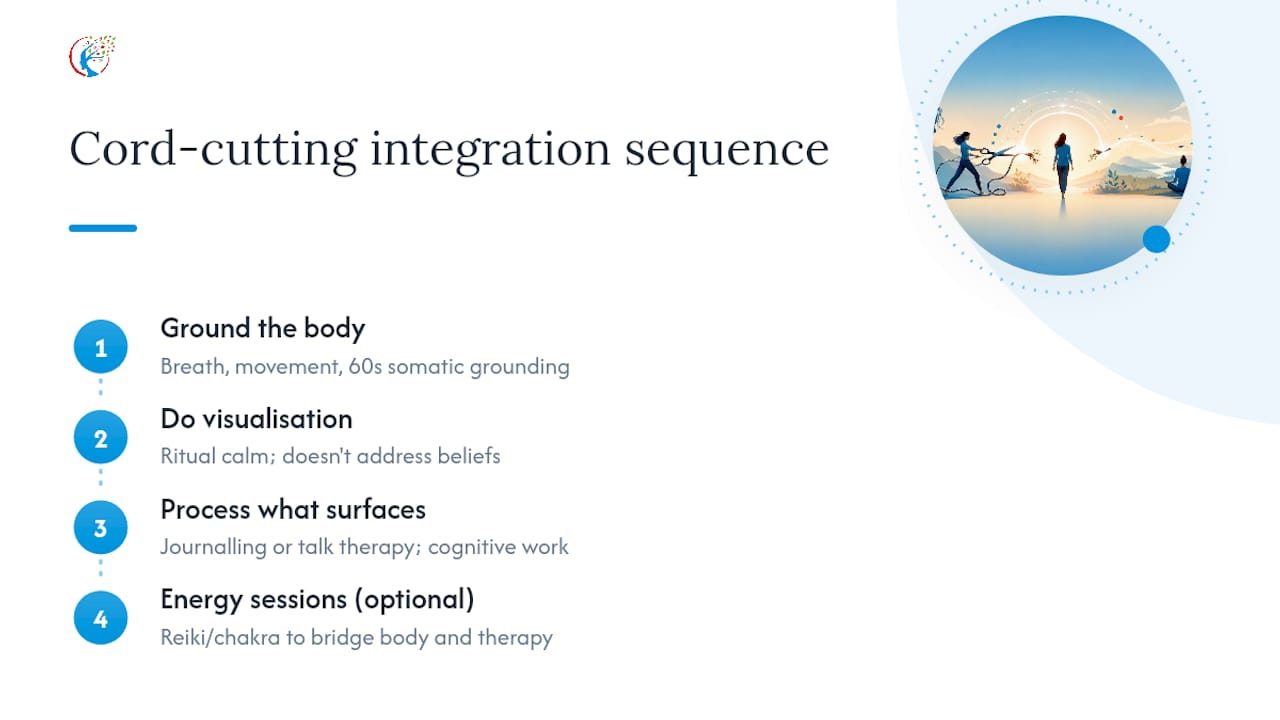
Somatic work fills the gap between the two. If the visualisation calms you in the moment but the same tightness returns within a day, that is usually a nervous-system issue rather than a spiritual one, and it responds better to breath work, movement, or bodywork than to another round of cutting. Practices like the 60-second somatic grounding technique are designed exactly for that window, immediately after a trigger, before the story in your head has a chance to spiral.
Sequence matters more than most people expect. Ground the body first, then run the visualisation, then process what surfaces through journalling or talk therapy. Doing it in reverse, trying to process feelings while your nervous system is still flooded, usually produces circular thinking rather than insight. Energy healing sessions that combine Reiki, chakra work, and guided release can bridge ritual and therapy well, because they give the body a structured, supported space to do both at once rather than treating cord cutting as a separate errand from the rest of your healing.
What can you actually say during the ritual?
A script gives your mind something concrete to hold onto when emotion makes visualisation slippery, particularly in the early weeks after leaving.
Try this during the cutting moment itself: “I see the cord between us. I acknowledge what it gave me and what it cost me. I choose to release it, not from hate, but because I choose my own peace. I cut this cord now, and I take my energy home.” Say it aloud if you can; the sound of your own voice claiming the sentence lands differently than reading it silently.
For the sealing stage afterwards: “What remains is mine. I close this space to further pull. I am safe in my own body.” Some people prefer something shorter for daily maintenance, a single line repeated each morning such as “My energy stays with me today,” rather than the fuller ritual every time.
Adjust the wording to your own voice rather than reciting these verbatim; a script that sounds like someone else’s words rarely holds the same weight. The content matters less than the repetition and the intention behind it, which is the same principle behind why rituals show measurable effects on wellbeing in the Pew Research data on sustained public engagement with spiritual practice.
Why compassionate cord cutting works better than angry cord cutting
The clients I have supported through narcissistic relationship healing almost always want the ritual to feel powerful, sharp, final. What actually holds, more often, is the quieter version: cutting from a place of tiredness and self-respect rather than fury. One person I worked with had performed the same angry visualisation for months with no lasting relief, then shifted the wording to something closer to grief, and the pull genuinely eased within weeks. Anger keeps you facing the narcissist. Grief lets you turn around.
If you have tried the ritual repeatedly and the cord keeps reforming, that is not a sign you are doing it wrong. It usually means there is deeper material, a belief about your own worth, a fear of being alone, that a visualisation cannot reach on its own. That is worth exploring with proper support rather than another solo attempt.
— Paul
How Paulstebles supports deeper release when a ritual alone is not enough
Cord-cutting rituals give you a starting point, but some attachments are wired in deeper than a visualisation can reach on its own, particularly when the relationship shaped your sense of self over years rather than months. Paulstebles offers in-person and remote sessions built for exactly that layer: Quantum Healing Hypnosis sessions access the subconscious mind directly, helping you understand why a particular bond formed and what it is still protecting you from feeling. Energy healing sessions combine Reiki, chakra balancing, and guided cord release with a practitioner present, which tends to hold better than solo work for long-standing trauma bonds. There is also a structured online course for anxiety and depression, for readers who want daily tools alongside occasional sessions.
Professional integration matters most when repeat cutting has not shifted the pull. A guided QHHT session can surface the belief keeping the cord active, while a facilitated energy healing session gives your nervous system support you cannot easily give yourself. If you are ready to take that next step, book a QHHT session directly, or read the QHHT and energy healing FAQ first if you have questions about what a session involves.
Sources
Recommended
Comments