Overcome depression naturally: practical steps for low mood


For mild-to-moderate depression, the most effective starting point is a combination of daily physical activity, structured sleep, and behavioural activation — scheduling small, meaningful activities even when motivation is absent. If you are experiencing suicidal thoughts, are unable to care for yourself, or have felt severely impaired without improvement, please seek help today rather than trying self-help first.
Start today:
Take a 20-minute walk outside, ideally in natural daylight
Book a free NHS talking therapies assessment via self-referral (no GP needed)
If you are in crisis: call Samaritans on 116 123 (free, 24/7), contact NHS 111, or call 999
Seek clinical help immediately if you notice:
Suicidal thoughts or urges to self-harm
Inability to eat, sleep, or carry out basic daily tasks for more than a few days
Psychotic symptoms (hearing voices, paranoid thoughts)
Symptoms that have persisted for an extended period without improvement
Natural approaches work well as a foundation for mild depression and as adjuncts to clinical care for moderate presentations. They are not a substitute for medical assessment when symptoms are severe.
Table of Contents
How to overcome depression naturally: the evidence-backed strategies
Clinical consensus recommends a staged approach: lifestyle and psychological self-help first for mild depression, combined clinical and lifestyle support for moderate cases, and urgent clinical care for severe presentations. The strategies below are ordered roughly by strength of evidence.
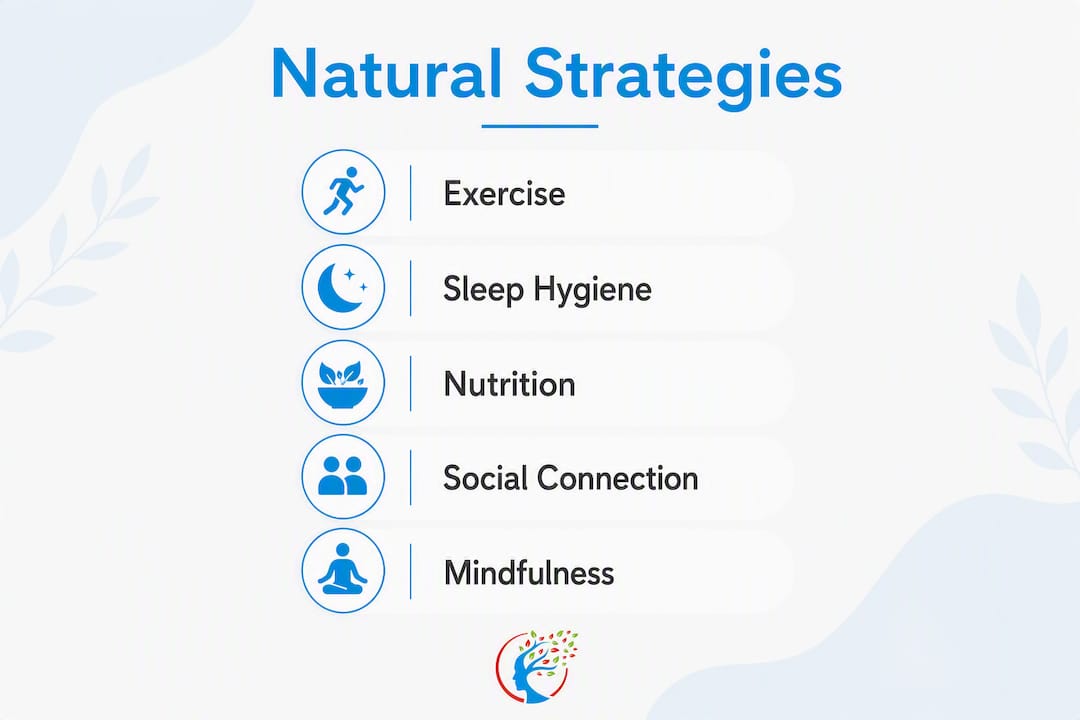
Exercise
Exercise has one of the most robust evidence bases of any natural intervention for depression. A 2023 meta-analysis, summarised by Simply Psychology, found consistent reductions in depressive symptoms across study populations. The mechanism is well understood: physical activity raises brain-derived neurotrophic factor (BDNF), supports neurogenesis in the hippocampus, and reduces inflammatory markers associated with low mood.

You do not need a gym membership. A moderate amount of brisk walking several times per week is enough to produce measurable benefit. If that feels too much right now, start with ten minutes and build from there. Movement-based approaches are among the most accessible mental health interventions available.
Sleep hygiene
Poor sleep and depression reinforce each other in a cycle that is hard to break without deliberate structure. Set a consistent wake time first (not a bedtime — the wake anchor is more powerful), avoid screens for 45 minutes before bed, and keep the bedroom cool and dark. Alcohol disrupts REM sleep even when it initially helps you drop off, so cutting evening drinking often produces noticeable mood improvement within days.
Nutrition
No single food fixes depression, but a diet high in ultra-processed foods, refined sugar, and alcohol consistently correlates with worse mood outcomes. The Mediterranean-style diet, rich in oily fish, leafy vegetables, legumes, and wholegrains, has the strongest dietary evidence base for mental health.
On supplements: omega-3 fatty acids (EPA-dominant formulations around 1–2 g/day) show consistent antidepressant effects in meta-analyses and are generally safe, with cardiovascular benefits as a secondary advantage. Vitamin D supplementation shows mixed results overall; the clearest benefit appears for people who are deficient at baseline, so testing levels first is the practical approach. St John’s wort has trial evidence for mild-to-moderate depression but interacts dangerously with many prescription drugs via CYP3A4 induction. Never take it alongside antidepressants, contraceptives, anticoagulants, or HIV medications without GP advice.
Social connection
Isolation amplifies depression. Even low-effort social contact, a brief phone call, a short walk with a neighbour, helps regulate the nervous system and interrupts rumination. If in-person contact feels impossible, structured online communities focused on shared activities (rather than venting) tend to be more beneficial than passive social media scrolling.

Reducing alcohol and recreational drugs
Both alcohol and cannabis are central nervous system depressants. Many people use them to manage low mood in the short term, which creates a pattern that deepens the depression over time. Reducing alcohol is one of the faster-acting natural mood interventions available, with many people noticing improvement relatively quickly.
Mindfulness and CBT-style self-help
Mindfulness-based cognitive therapy (MBCT) has strong trial evidence for preventing relapse in recurrent depression. For a first episode, CBT-informed self-help, including thought records, behavioural experiments, and activity scheduling, is available free through NHS-approved apps such as SilverCloud and through self-help books like Overcoming Depression by Paul Gilbert. Ten minutes of mindful breathing daily is a realistic starting point.
Natural sunlight and light therapy
Light exposure regulates circadian rhythm and serotonin production. Getting outside shortly after waking, even on overcast days, has a measurable effect on mood and energy. For seasonal affective disorder (SAD) or winter low mood, a 10,000-lux light therapy lamp used for 20–30 minutes each morning is a well-evidenced intervention.
Stress management and relaxation
Chronic stress sustains elevated cortisol, which directly suppresses mood. Yoga, progressive muscle relaxation, and diaphragmatic breathing exercises all reduce cortisol and activate the parasympathetic nervous system. Expressive approaches including journaling, art therapy, and movement therapies provide consistent small-to-moderate benefits and improve engagement with other treatments.
Expressive therapies: journaling and art
Writing about emotions for 15–20 minutes, three to four times per week, reduces the cognitive load of rumination and helps identify patterns in mood. Art therapy and creative movement serve a similar function for people who find verbal expression difficult. Neither requires skill; the process matters, not the output.
Evidence summary table
Strategy | Evidence strength | Practical starter action |
Exercise | Strong (large meta-analyses) | 20-min brisk walk, 5 days/week |
Sleep hygiene | Strong (clinical consensus) | Fix wake time; cut screens 45 min before bed |
Omega-3 supplementation | Moderate-strong (meta-analyses) | 1–2 g/day EPA-dominant; check with GP |
Mindfulness/CBT self-help | Strong (RCT evidence) | 10 min daily breathing; try SilverCloud |
Social connection | Moderate (observational) | One real conversation per day |
Reduce alcohol | Moderate (clinical consensus) | Alcohol-free days 3–4 times/week |
Light exposure | Moderate-strong (SAD trials) | Outside within 1 hour of waking |
Journaling/expressive therapy | Moderate (mixed trials) | 15 min writing, 3–4 times/week |
St John’s wort | Moderate (Cochrane) | GP consultation required; drug interactions |
Yoga/relaxation | Moderate (mixed trials) | 10-min breathing exercise each evening |
Behavioural activation: how to break the inactivity cycle
Behavioural activation directly counters the motivation loss typical of depression by creating predictable, low-effort actions that generate momentum. The core idea is simple: you act first, and the mood follows. Waiting to feel motivated before acting is the trap depression sets.
Step-by-step plan:
List ten activities you used to find enjoyable or functional, ranging from very easy (make a cup of tea, step outside for five minutes) to moderately demanding (cook a meal, call a friend).
Rate each activity from 0–10 for difficulty right now. Start with activities rated 2–4.
Schedule two to three activities per day at specific times. Write them down as implementation intentions: “At 9 AM on Monday, I will walk to the end of the street and back.”
Use if-then planning to handle obstacles: “If I feel too tired to walk at 9 AM, I will put on my shoes and stand outside for two minutes instead.”
Track completion, not mood. Tick the activity whether it felt good or not. Mood improvement usually lags behind action by several days.
Increase difficulty gradually over two weeks, moving up the list as easier tasks become habitual.
Practical scaffolding tips:
Habit stack: attach a new activity to something you already do (after brushing teeth, write three sentences in a journal)
Use an accountability buddy: text one person your plan for the day
Keep tasks micro: “reply to one message” beats “catch up on emails”
Pro Tip: Grade your tasks so the first week contains nothing rated above 4 out of 10. Overwhelm is the enemy of momentum. A two-minute walk completed beats a 30-minute run abandoned.
When and how to get professional help in the UK
Natural strategies are appropriate for mild depression. For moderate or severe presentations, they work best alongside clinical care, not instead of it.
Signs that warrant professional assessment:
Symptoms lasting more than two weeks with no improvement
Inability to work, maintain relationships, or carry out daily tasks
Suicidal thoughts or self-harm urges (seek help today)
Psychotic symptoms, severe weight loss, or inability to sleep for multiple nights
Depression following a major medical event, bereavement, or trauma
How to access NHS talking therapies (IAPT):
In the UK, you can self-refer for NHS talking therapies without a GP referral. Search “NHS talking therapies” plus your postcode, complete the online referral form, and expect an initial telephone assessment within a few weeks. You do not need a diagnosis to self-refer.
When you see your GP, bring a brief mood diary (even three to five days of notes on sleep, energy, and mood), a list of any supplements or medications you are taking, and a note of how long symptoms have been present. This makes the appointment more productive and helps the GP assess severity accurately.
Crisis resources (keep these to hand):
Samaritans: 116 123 (free, 24/7, any reason)
NHS 111: online at 111.nhs.uk or by phone for urgent non-emergency mental health support
Crisis text line: text SHOUT to 85258
Emergency services: 999 if you or someone else is in immediate danger
This article provides general information, not medical advice. Always discuss symptoms and any planned changes to treatment with a qualified clinician.
Complementary and energy-based approaches: what the evidence says
Complementary therapies are not a replacement for clinical assessment. Used as adjuncts, several have credible evidence and a reasonable safety profile.
Reiki
Systematic review evidence indicates that Reiki frequently performs better than placebo on clinically relevant depression and stress outcomes. The effect sizes are modest, and most trials are small, so the evidence supports Reiki as a supportive complement to other treatment rather than a standalone intervention.
Pranic Healing
A randomised double-blind controlled trial found that adding Pranic Healing to medication produced a larger median reduction in HAM-D depression scores than mock healing over five weeks (median decrease of 11 versus 6.5 in the mock group, in a 52-participant trial). The study was small, but the design was rigorous for the field. As with Reiki, the appropriate framing is adjuvant therapy.
QHHT and regression hypnotherapy
Quantum Healing Hypnosis Technique (QHHT) and regression hypnotherapy work at the level of the subconscious mind, helping clients explore emotional patterns, past experiences, and belief structures that may be sustaining low mood. Sessions typically involve deep relaxation, guided inner exploration, and a debrief. Clients commonly report improved sleep, reduced physical tension, and greater emotional clarity after sessions, which then supports engagement with other treatments.
Paulstebles offers in-person QHHT sessions in the Orpington and Bromley area, as well as remote energy healing combining Reiki, chakra balancing, cord cutting, and emotional release work. These sessions are designed as supportive, adjunctive work and do not replace GP or NHS care.
Safety checklist for choosing a complementary therapist:
Check qualifications and membership of a recognised professional body (e.g. CNHC, BWRT, BSCH for hypnotherapy)
Confirm the practitioner carries professional indemnity insurance
Ask whether they have a referral pathway to clinical services if needed
Ensure they obtain informed consent and provide a clear treatment plan
Never stop prescribed medication on a therapist’s advice without consulting your GP first
Your daily checklist and a sample week
Natural interventions need consistent application over weeks to produce sustained improvements. Expect some immediate lift from activity, but plan for several weeks before judging effectiveness.
Daily checklist:
Wake at the same time (even at weekends)
Get outside within one hour of waking for natural light
20–30 minutes of movement (walk, yoga, cycling)
One real social contact (call, message, or in-person)
10 minutes of mindful breathing or body scan
One expressive task (journaling, drawing, or creative movement)
No alcohol on at least four days per week
Consistent bedtime within a 30-minute window
Sample week (graded progression)
Day | Morning anchor | Afternoon/evening activity | Expressive task |
Monday | 10-min walk + light exposure | Call one friend or family member | 10-min journal entry |
Tuesday | 15-min yoga or stretching | Cook a simple meal from scratch | Sketch or doodle for 10 min |
Wednesday | 20-min brisk walk | Join an online or local group activity | Write three things that went okay |
Thursday | 10-min breathing exercise | Declutter one small area (micro-task) | Re-read journal; note any patterns |
Friday | 20-min walk + sunlight | Plan weekend activities in advance | Free writing for 15 min |
Saturday | Slightly longer walk (20 min) | Social activity (café, park, community group) | Creative project of choice |
Sunday | Gentle movement + rest | Prepare the coming week’s activity list | Mood review: rate 1–10, note triggers |
Tracking progress: keep a simple mood diary using a 1–10 scale, noting sleep hours, activity completed, and one sentence about the day. Review after four weeks. If mood has not shifted at all, or has worsened, book a GP appointment rather than extending the self-help trial.
Key takeaways
Consistent exercise, structured sleep, and behavioural activation form the most evidence-backed foundation for overcoming mild depression naturally, with professional NHS support essential when symptoms are moderate, severe, or persistent.
Point | Details |
Exercise is the strongest natural lever | Large meta-analyses show consistent benefit; start with 20-min daily walks and build gradually. |
Behavioural activation beats waiting for motivation | Schedule small activities first; mood improvement follows action, not the other way around. |
NHS self-referral is free and GP-free | You can self-refer to talking therapies online without a GP appointment. |
Supplements need medical oversight | Omega-3 (EPA-dominant, 1–2 g/day) has the best safety profile; St John’s wort requires GP sign-off due to drug interactions. |
Paulstebles offers adjunctive support | QHHT, energy healing, and the Rising Higher online course complement NHS care for those wanting deeper subconscious and emotional work. |
Natural approaches work best when they go deep enough
Most articles on beating depression naturally stop at the surface: walk more, sleep better, eat well. That advice is correct, and the evidence behind it is real. But for many people, those changes stall after a week or two, not because the strategies are wrong, but because the underlying emotional patterns driving the low mood have not been addressed.
Depression often has a subconscious architecture. Beliefs formed in childhood, unprocessed grief, or a persistent sense of disconnection from one’s own purpose can make even the most disciplined lifestyle routine feel hollow. This is where approaches like QHHT and energy healing offer something the standard self-help toolkit does not: access to the deeper layers of the mind where those patterns live.
That does not mean abandoning NHS care or dismissing medication when it is clinically indicated. It means recognising that the most durable recoveries tend to combine outer structure (the lifestyle changes, the therapy, the social connection) with inner work (understanding why the depression took hold, what it is protecting, and what needs to change at a belief level). The two are not in competition. They are complementary in the most literal sense.
The caution I would offer is this: do not use complementary therapies as a way to avoid clinical assessment when symptoms are serious. Use them as a way to go further once the foundation is stable.
How Paulstebles can support your recovery

Lifestyle changes and NHS talking therapies are the right foundation. For those who want to go further, Paulstebles offers a set of adjunctive services designed to work alongside that foundation, not replace it.
The Rising Higher online course is a structured, self-paced programme covering anxiety and depression through video content and practical exercises. It is available immediately, without a waiting list, and suits people who want guided support between therapy sessions or while waiting for NHS assessment.
For one-to-one work, in-person QHHT sessions in Orpington and Bromley combine deep relaxation with subconscious exploration, helping clients identify and release emotional patterns that sustain low mood. Remote energy healing sessions (Reiki, chakra balancing, cord cutting, and emotional release) are available for those outside the area. Sessions typically last 90 minutes to two hours; no prior experience is needed.
All services are adjunctive. Paulstebles encourages every client to maintain their GP relationship and to discuss any complementary work with their clinician. These sessions do not replace medical treatment.
To find out which option suits your situation, visit the QHHT and energy healing FAQ or book a session directly through the website.
Useful sources and further reading
The sources below are the primary references used in this article. When reading research on complementary therapies, check the sample size, whether the intervention was adjunctive, and the population studied before drawing conclusions.
NHS: How to cope with depression — NHS guidance on self-help strategies and self-referral to talking therapies
Simply Psychology: Natural remedies for depression — what the evidence says — evidence summaries for exercise, supplements, and lifestyle interventions
PMC: Reiki and related energy therapies systematic review — systematic review of Reiki for depression and stress
PMC: Reiki for depression and anxiety — further systematic review evidence
Harvard Health: The no-drug approach to mild depression — behavioural activation and lifestyle strategies
Oxford HExi: Complementary and holistic approaches for depression — evidence review for expressive therapies and mind-body practices
For personalised advice, always consult your GP, particularly before starting any supplement or making changes to prescribed medication.
Recommended
Comments