Past life and soulmates: how to know and what to do next


Intense recognition with someone can signal a past life soulmate connection, but it isn’t proof on its own. Practitioners who work with Quantum Healing Hypnosis Technique (QHHT), Paul Stebles among them, see this pattern often: two people meet and something in the nervous system reacts as though a chapter is being reopened, not started. Well-documented cases, including Jenny Cockell’s memories and the Antonia recordings, show why this feeling is widespread and taken seriously by people who’ve experienced it. That said, a racing heart and a sense of déjà vu are not evidence of reincarnation. They’re information worth sitting with.
Before anything else:
Breathe and slow down before assigning meaning to the intensity.
Journal what you noticed, when, and what it triggered emotionally.
Set a boundary if the connection feels destabilising rather than grounding.
If you want to explore further through regression, choose a qualified, experienced practitioner rather than an unsupervised group session.
Key Takeaways
Intense recognition can point to a past life soulmate connection, but confirming it safely requires grounded self-reflection before any regression work.
Point | Details |
Recognition isn’t proof | Instant familiarity and vivid dreams are meaningful signals, not confirmation, of a past life bond. |
Know your connection type | Karmic connections teach a lesson, soulmates build long-term harmony, twin flames mirror what needs healing. |
Cases inform, they don’t settle | Jenny Cockell, Antonia, and James Leininger show compelling detail but no scientific consensus. |
Boundaries come before regression | Journal, ground yourself, and check relational safety before pursuing deeper exploration. |
Work with a qualified practitioner | Paul Stebles’ QHHT sessions pair past-life exploration with structured aftercare and integration support. |
Table of Contents
Signs of a past life soulmate connection
Not every strong pull towards someone points to a past life. But certain patterns show up again and again in people who later describe the relationship as a soul connection rather than ordinary chemistry.
Instant familiarity that skips the usual stages. You feel like you already know how they take their tea, or you finish their sentences within a week of meeting. This isn’t the slow build of typical attraction; it reads more like recognition than discovery.
Recurring dreams featuring the person, sometimes before you’ve met them. Some people report dreaming of a face they later encounter in waking life, or dreaming repeatedly of a specific scene involving someone they already know.
Emotional activation that runs unusually hot. Practitioner analysis describes this as joy, obsession, or even old trauma resurfacing almost immediately, far beyond what the relationship’s timeline would normally explain.
Non-verbal rapport and shared talents or mission. You communicate in half-sentences and glances, or you discover you’re both drawn to the same unusual pursuit, as if picking up shared work rather than starting fresh.
A repeating on-off dynamic around the same wound. Common sign lists note that when a relationship cycles through the identical rupture and repair pattern without resolution, that’s often less a soulmate marker and more a karmic loop asking to be broken.
The last point matters more than people expect. A genuine soul connection can still be an unhealthy one to stay inside.
Pro Tip: Keep a simple two-column log: one side for the sensation (déjà vu, dream, sudden closeness), the other for what was actually happening in your life at that moment. Patterns tied to stress or loneliness look very different on paper than patterns tied to the other person specifically.
Karmic connections, soulmates and twin flames: what’s the difference?
People often use these three terms interchangeably, but practitioners who work with past-life material tend to separate them by function, not just intensity.
Karmic connections exist to teach a specific lesson, often around boundaries, self-worth, or forgiveness. They tend to burn hot and end once the lesson lands, sometimes painfully.
Soulmates describe a broader category: people you’ve shared previous lifetimes with in various roles, not always romantic. A soulmate relationship can be a decades-long marriage or a friendship that quietly shapes your direction. The hallmark is long-term harmony once early friction settles.
Twin flames are typically framed as a mirror-and-catalyst dynamic. The relationship surfaces exactly what each person needs to heal, which is why these pairings often feel simultaneously magnetic and volatile.
None of these categories are fixed destinies. A relationship can start as a karmic flashpoint and settle into something closer to steady soulmate territory once both people do the inner work. Treat the labels as a way to interpret what’s happening, not a script you’re obligated to follow.
What case studies and near-death research actually show
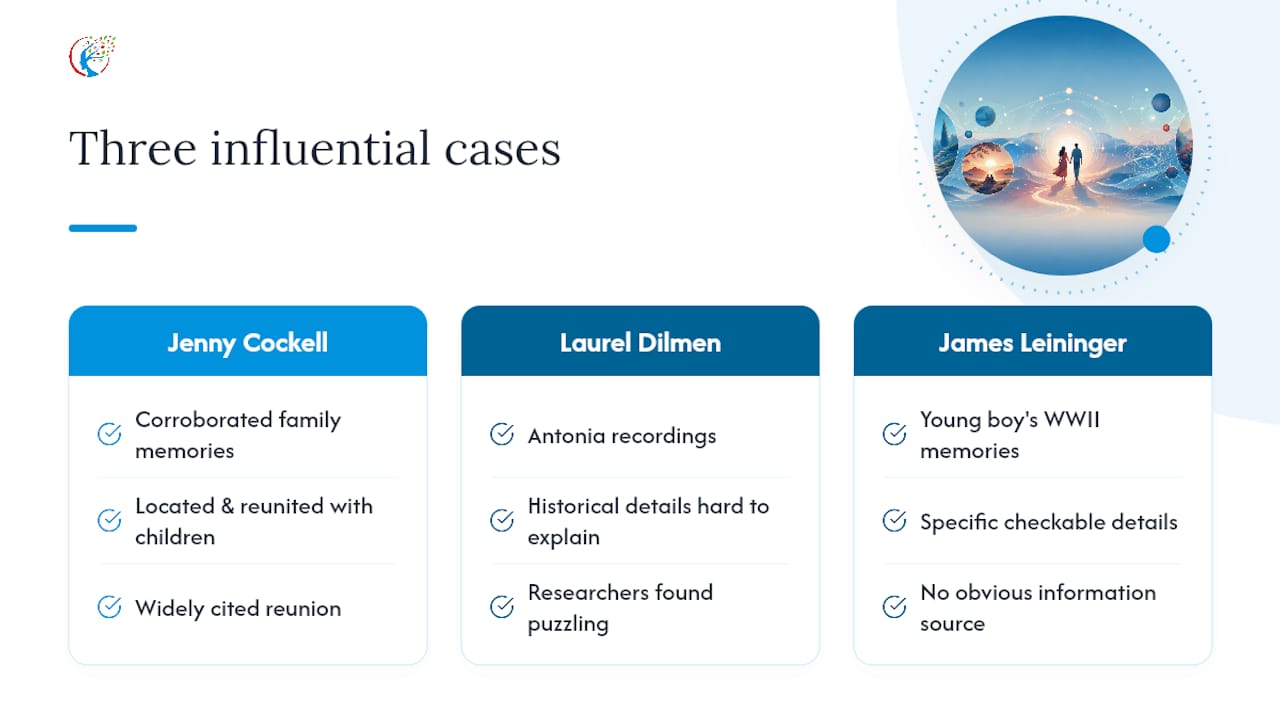
Three cases get cited more than any others in past-life literature, and each one illustrates a different kind of evidence.
Jenny Cockell recalled specific memories of a previous life as a woman named Mary Sutton, including details about her children. She eventually located and reconnected with those now-grown children, a reunion that’s become one of the most widely referenced reincarnation cases in the field. The Antonia recordings, involving a woman known as Laurel Dilmen, contain historical detail that researchers found difficult to explain through ordinary means. James Leininger’s case, involving a young boy’s detailed memories linked to a World War II pilot, is frequently raised in the same conversation for similar reasons: specific, checkable details appearing in someone with no obvious way of knowing them.
Cases like these persuade people because they combine vivid personal memory with details that were later corroborated. The Institute of Noetic Sciences frames this as genuinely puzzling territory rather than settled proof, noting that psi-based explanations, where information is accessed rather than remembered, remain a live alternative to straightforward reincarnation.
That distinction matters for how you hold your own experience. Reincarnation itself is treated across cultures and religious traditions as an accepted premise, yet mainstream science has never reached consensus on it. Neither position invalidates what you feel. It simply means the honest answer to “is this person my past life soulmate?” is usually “the feeling is real; the explanation is still open.”
How to explore a past life soulmate connection safely
Curiosity doesn’t require jumping straight to regression. Build up from the lowest-risk methods first.
Start with journalling and dream logs. Write down the sensations, the dreams, and the timing before you interpret any of it. Patterns become obvious after a few weeks that aren’t visible in the moment.
Run a boundary check. Ask honestly whether this connection adds stability to your life or destabilises it. That answer should guide how much energy you invest in exploring further.
Try grounding meditation before deeper work. Simple breath-based practices help you distinguish genuine insight from anxious projection.
Consider guided regression once you’re ready. A QHHT session typically involves a lengthy pre-talk, a guided hypnosis phase where past-life material can surface, and a closing integration conversation. It’s designed to access the subconscious mind directly rather than lead the client towards a predetermined answer.
Choose your practitioner carefully. Look for someone trained specifically in regression work who explains informed consent and aftercare before you begin, not after.
Pro Tip: Avoid group past-life workshops for your first experience if you’re processing something emotionally raw. One-to-one settings allow a practitioner to slow down or pause if material becomes overwhelming, which a group format can’t offer.
Watch for emotional destabilisation in the days after any regression work. Integration, not the session itself, is where most of the healing actually happens.

What to do next with a possible past life soulmate
Insight without action just becomes another story you tell yourself. Once you’ve recognised the pattern, the next step is deciding what it asks of you.
Check for red flags first. No soul-connection explanation justifies control, disrespect, or repeated harm. If the relationship is unsafe, the past-life framing doesn’t change that fact.
Bring in support that matches the intensity. Therapy, somatic practices, or resilience-building habits can help regulate a nervous system that’s been activated by an unusually strong connection.
Use creative expression to process what surfaces. Writing, art, or movement often reveal what direct analysis misses.
Decide with intention. Some connections are worth pursuing once boundaries are healthy. Others exist purely to reveal a wound, and the healthiest response is to learn the lesson and let the relationship go.
Inside a QHHT session with Paul Stebles
A typical session moves through distinct phases: a detailed pre-talk to understand your questions, a guided hypnosis phase where past-life material and higher self guidance can emerge, and time afterwards to integrate what surfaced.
Preparation matters as much as the session itself, so expect thorough discussion beforehand about what you hope to explore.
Aftercare and grounding work follow every session, since integration protocols including journalling and somatic check-ins help material settle rather than overwhelm.
Sessions are available in person and, for some services, remotely, depending on what suits you.
Guides on regression and common questions are available for anyone wanting more detail before booking.
Why clarity matters more than romantic certainty
The conventional advice on past-life soulmates leans hard into destiny language. Fated, meant to be, written in the stars. That framing sells well, but it does readers a disservice. The most useful question isn’t “is this my soulmate?” It’s “what is this connection asking me to learn or heal?”
Cases like Jenny Cockell’s or the Antonia recordings are compelling precisely because they resist easy conclusions. They show memory doing something unexplained, not proof of a cosmic contract guaranteeing anyone a happy ending. The same goes for the relationship in front of you. Intensity is data, not destiny.
What I’d prioritise first is boundary work, not regression. Too many people rush towards past-life explanations to justify staying in something painful, when the more honest step is asking whether the relationship is safe and mutual right now. Soul connections are real and worth taking seriously. They’re also not an excuse to skip the ordinary, unglamorous work of building a relationship that functions in this lifetime.
— Paul
Ready to explore your own past life soulmate connection?
If journalling and reflection have brought you to the edge of wanting deeper answers, the next step depends on what you actually need. QHHT sessions suit anyone wanting direct exploration of past-life material and higher self guidance, in a one-to-one setting built around consent and aftercare rather than a group script. Energy healing sessions, whether in person or remote, work well when you already know what’s surfaced and need help integrating it, through Reiki, cord cutting, or timeline healing. If you’d rather work at your own pace first, the online course on overcoming anxiety and depression offers structured exercises you can return to before committing to a session.
Every session begins with a thorough pre-talk so you understand exactly what to expect, and nothing is rushed. You can read through the QHHT FAQ for detail on safety and format, or go straight to booking a QHHT session when you’re ready to explore what your own past life connections have to teach you.
Sources
Recommended
Comments