Write It Down First: Spot and Record Past Life Dreams (UK)


Past life dreams are unusually vivid, first-person dreams that feel like memories rather than fiction. Objective proof is rare, but a handful of carefully documented cases exist, so the sensible response is calm, not conviction: write the dream down immediately, note how it affected you emotionally, and decide whether it’s simply fascinating or actually distressing before you go looking for meaning.
TL;DR:
Most vivid past-life dreams feature a clear, first-person perspective with detailed sensory narratives that recur over time and leave a strong emotional impact.
Only 1 to 2 percent of dreams contain full, coherent stories with specific historical or cultural details, making such dreams statistically rare.
Documenting dreams immediately after waking before any research or interpretation is essential to avoid bias and preserve evidential value.
Careful, non-leading recording followed by independent verification helps distinguish genuine past-life details from media-influenced imagination or fantasy intrusion.
Traumatic recurring dreams requiring support resemble posttraumatic nightmares and warrant professional intervention rather than casual interpretation.
Table of Contents
What makes a dream feel like a past life memory
Most dreams dissolve within minutes. Past life dreams tend to do the opposite: they stay sharp, sometimes for years, and they carry a strange sense that you were somewhere else, as someone else, for real. This distinction matters when you’re trying to work out whether what you experienced fits the pattern researchers and practitioners have documented, or whether it’s simply an unusually memorable ordinary dream.
A handful of recurring features show up across serious case reports:
First-person embodiment. You’re not watching a character. You’re inside a body that isn’t yours, feeling its sensations, speaking with an unfamiliar voice or in a language you don’t consciously know.
A coherent story, not a jumble. Ordinary dreams jump and mutate; these tend to run as an episodic narrative with a beginning, middle and end, often set in a specific period with sensory detail that feels oddly exact, an unfamiliar smell, particular clothing, an unusual room layout.
Repetition. The same scene returns, sometimes identically, night after night or across months.
An emotional aftertaste. Grief, fear or longing that lingers into the day, disproportionate to anything happening in your waking life.
A childhood pattern. Documented past-life cases skew towards young children, who sometimes describe a “different family” with unnerving specificity, and adults often trace their own recurring dream back to early childhood.
Children’s reports often arrive as night terrors or repeated nightmares rather than calm recollection, which is part of why parents mistake them for ordinary sleep problems. Adults tend to report the same dream returning across decades, sometimes triggered by a place, a smell, or a piece of music that has no obvious connection to their current life.
None of this proves reincarnation. It simply describes what separates a past-life-style dream from a standard anxiety dream about missing a train.
Why these dreams might happen: three competing explanations
Nobody has a single accepted answer for what’s happening when someone has a dream like this, and that’s worth sitting with rather than rushing past.
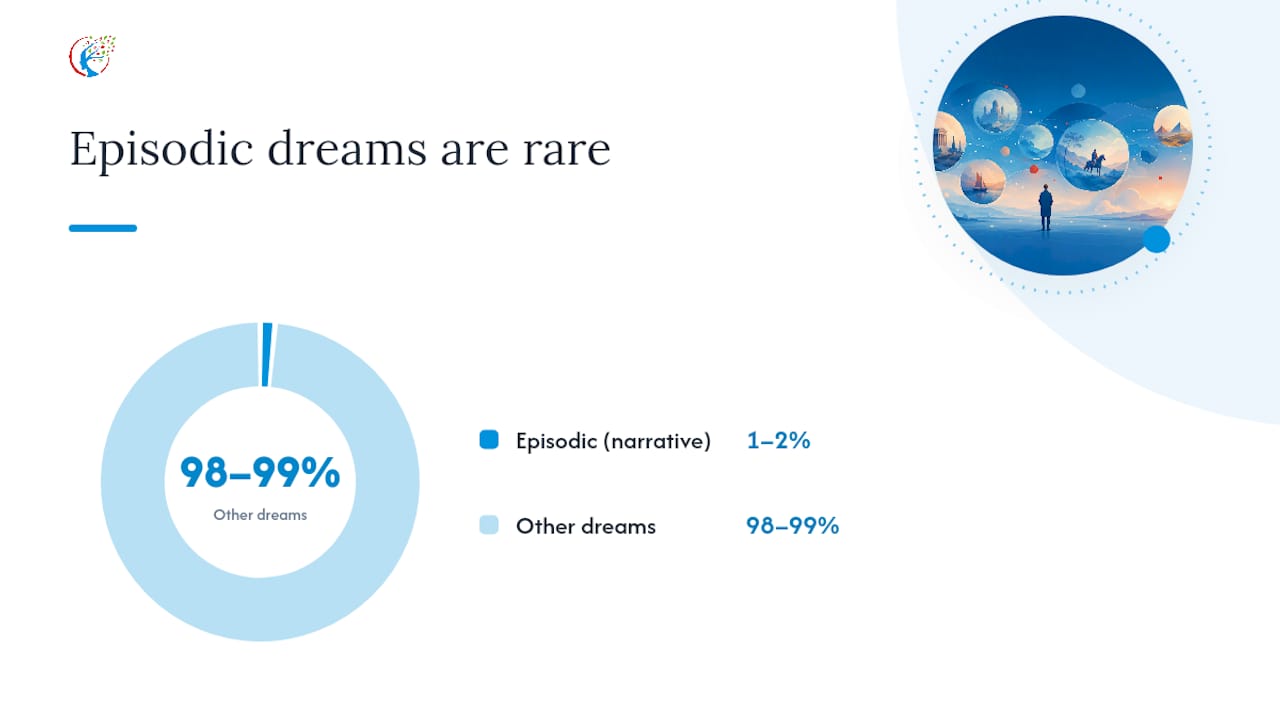
Episodic memories, dreams with a clear narrative and specific setting, appear in only 1 to 2% of dream reports generally. That figure matters more than it looks. It means the kind of vivid, story-like dream people describe as a past life memory is already statistically unusual before anyone starts debating what it means.
In numbers: episodic content shows up in roughly 1 to 2% of ordinary nocturnal dreams, which is why a dream with a full narrative arc feels so different from your usual dream fragments.
The psychological explanation treats these dreams as memory recombination, your brain stitching together fragments of books, films, half-remembered history lessons and archetypal imagery into something that feels foreign because none of the pieces are consciously recalled as familiar. REM sleep intensity and stress-related dream recall can push this kind of vivid narrative dreaming to the surface more often during difficult periods, according to research on dreaming and episodic memory.
The cultural and spiritual explanation sits inside reincarnation frameworks found across Hindu, Buddhist and various indigenous traditions, where dreams are treated as a legitimate channel for ancestral or past-life memory rather than noise to be explained away.
The parapsychological explanation is the most demanding one. It only holds weight when a dream contains detail that can, in principle, be checked, a name, a place, an event, and even then the Psi Encyclopedia’s review of past-life dream cases is blunt about the risk of fantasy intrusion and distortion creeping in before anyone starts verifying anything.
Watch for confirmation bias: once you decide a dream is “about” a specific era or person, you’ll unconsciously fit new details to match.
Watch for media priming: a documentary, novel or news story you consumed weeks earlier can resurface in dream form, feeling like it came from nowhere.
How to document and cautiously verify a past-life dream
The order you do things in matters more than most people expect. Research first, and you contaminate the memory before you’ve even written it down.
Record immediately, before anything else. Write the sequence of events, names, objects, locations, and any exact phrases spoken, in as much sensory detail as you can, within minutes of waking.
Date and store the record. A dated note, ideally shared with a trusted third party or emailed to yourself with a timestamp, is what turns a vague recollection into something with evidential weight later.
Only then start researching. Look for the place names, historical events or objects you recorded, not for validation of a theory you’ve already formed.
Keep a running log. Treat it like a research diary rather than a single entry, since recurring dreams often add detail over multiple nights.
This sequence isn’t just tidy record-keeping. Case literature on past-life dream sources shows that pre-verification documentation is precisely what allowed one well-known case, involving a woman’s recollections of a woman named Francine Donovan, to be taken seriously rather than dismissed, because the details were on paper before any historical research began.
Pro Tip: Never ask a leading question of yourself or anyone you tell the dream to (“was it France?”, “was he a soldier?”). Leading questions are how false memories get built, even with the best intentions.
Keep your expectations modest. Most dreams, even startlingly vivid ones, won’t produce a checkable name or date. That’s normal, not a failure.
When a past-life dream needs more than journalling
Not every vivid dream is a puzzle to solve calmly over a cup of tea. Some are a genuine sign of distress, and treating them purely as spiritual material when they’re actually a trauma response can leave someone stuck.
Watch for these signals:
Night terrors or the same traumatic dream recurring several nights a week, especially in children
Daytime intrusive re-experiencing, flashback-like intensity rather than simple recall
Worsening anxiety, avoidance of sleep, or noticeable sleep loss over weeks
Any sense that the dream is interfering with work, relationships or basic functioning
Recurring traumatic past-life dreams often resemble posttraumatic nightmares in structure and persistence, which is why trauma-aware clinical techniques sometimes help even when nobody is claiming to explain the dream’s origin. A GP referral is the right first step for severe sleep disruption, alongside basic sleep hygiene and relaxation practice. For emotional processing rather than crisis management, a trauma-informed spiritual practitioner or a guide to trying past-life regression safely can offer a calmer route through the material.
How careful documentation separates a serious case from a story
Anyone working with regression and dream material has a responsibility not to lead the person in front of them. The temptation to suggest an era, a name, a cause of death, is real, and it’s exactly what good practice guards against.
A client’s own words, recorded before any interpretation is offered, are worth more than the most confident-sounding explanation a practitioner could give afterwards. The moment suggestion enters the room, the evidential value of what follows starts to erode.
Practitioner intake should assess recent media exposure and suggestibility before a session even begins, coach the client towards neutral, unprompted recall rather than guided detail, and keep signed, dated notes before anyone looks anything up externally. That pre-verification discipline, recording first, researching second, is what let one documented case build a genuinely testable set of claims rather than a story shaped after the fact by hindsight.
Historical and cultural perspectives on past life dreams
Dreams as a channel for past-life or ancestral memory aren’t a modern invention dressed up in new language. Hindu and Buddhist traditions have treated dream recall of previous lives as consistent with reincarnation doctrine for centuries, with specific dream practices built around interpreting such material rather than dismissing it. West African and various indigenous traditions frame recurring dream figures as ancestral visitors rather than fictional characters, which changes how a family responds when a child describes an unfamiliar life in detail.
Western engagement with the idea is newer and more clinical by comparison. Ian Stevenson’s twentieth-century case work on children’s reincarnation claims, much of it built from waking statements rather than dreams specifically, set the template that later dream-focused researchers borrowed: document early, verify independently, stay sceptical of neat conclusions.
What’s changed more recently is exposure. A dream that once stayed within a family or a small community now gets shared, compared and occasionally investigated online within days, which means cultural framing spreads faster than it used to. Someone in the UK having a vivid dream about, say, Victorian London or wartime France is now far more likely to have absorbed period detail from documentaries, historical fiction or social media than someone dreaming the same thing a century ago would have been. That doesn’t make the dream meaningless. It does mean the historical backdrop to any past-life dream now includes the modern media landscape as much as any past-life dreams meaning drawn from older traditions.
Ways people try to encourage past life dreams
Curiosity about your own dream life is normal, and there are recognised methods people use to try to encourage this kind of material to surface, none of them guaranteed, all of them worth approaching with the same caution as interpreting the dreams themselves.
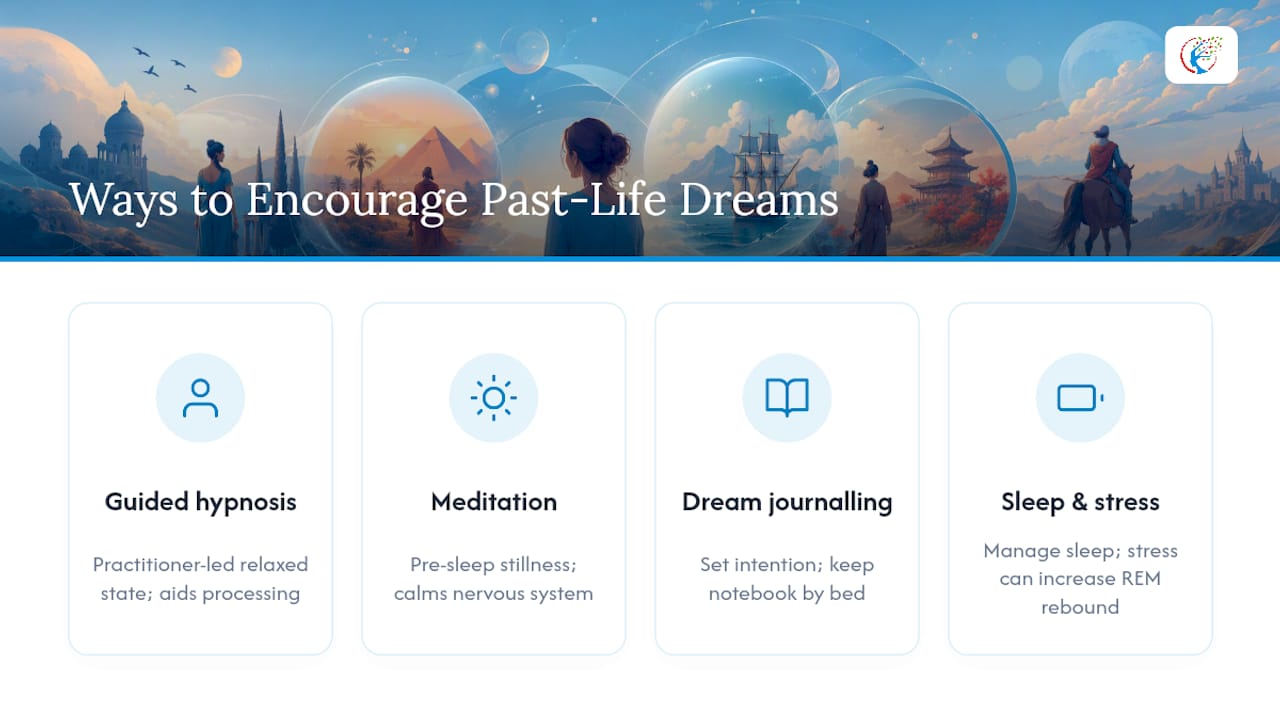
Guided hypnosis and regression is the most structured route. A trained practitioner leads you into a relaxed, focused state and asks open, non-leading questions, aiming to let material surface rather than supplying it. This is the basis of Quantum Healing Hypnosis Technique work, and its value lies less in producing a verifiable historical claim than in giving someone a safe, guided space to process whatever comes up.
Meditation and visualisation before sleep, particularly practices that focus on stillness and body awareness rather than active imagination, are commonly used to encourage deeper, more memorable dreaming generally. Structured meditation has recognised value for calming an overactive nervous system, which is part of why therapeutic meditation practice is used well beyond dream work, including in recovery and trauma settings.
Dream journalling and intention-setting, writing down a simple intention before sleep and keeping a notebook by the bed, is the lowest-effort method and often the most effective for improving general dream recall, past-life material or otherwise.
Sleep and stress management matters more than people expect. REM rebound during stressful or disrupted periods is linked to more vivid, narrative-heavy dreaming, so erratic sleep can produce more of this material, not necessarily more meaningful material.
Recurring themes and figures that show up across reports
Certain motifs turn up again and again across documented past-life dream cases, often across unrelated individuals with no contact with each other.
Sudden or violent death, drowning, war, fire or accident, appears disproportionately often, possibly because trauma tends to produce more vivid, sticky memories in general.
A specific historical period with sensory precision, particular clothing, food, architecture or dialect, rather than a vague “olden days” feeling.
An unfinished relationship or task, a person left behind, a promise unkept, a debt unpaid, which some interpretive frameworks read as unresolved emotional business.
Recognition of a person from the present life appearing in an unfamiliar role or era, often cited in the soulmate and karmic-connection literature.
A recurring object or symbol, a ring, a building, a piece of music, that anchors the dream and sometimes reappears unexpectedly in waking life.
Some of these themes overlap with the archetypal imagery Carl Jung described as recurring across unrelated dreamers regardless of culture, which is part of why psychologists caution against treating every recognisable motif as evidence of anything beyond a shared human imagination.
The case against taking past life dreams literally
The scepticism here isn’t fringe. It’s the default position in most psychological literature, and it deserves a fair hearing rather than a dismissive footnote.
The strongest argument against literal interpretation is base rate: genuinely episodic, narrative dreams are rare to begin with, so treating one as automatically significant ignores just how unusual any vivid, story-like dream is regardless of its content. The second argument is fantasy intrusion, the well-documented tendency for imagination, half-remembered media and cultural expectation to blend seamlessly into dream content without the dreamer noticing the seams. The Psi Encyclopedia’s review treats this as the central obstacle to taking most reported cases at face value.
The third, and probably fairest, criticism is retrospective fitting: once someone decides their dream relates to a real historical event, they tend to notice confirming details afterwards and forget the ones that didn’t fit, particularly after media exposure to a relevant historical story primed the association in the first place.
None of that means every case collapses under scrutiny. It means the burden of proof sits with pre-verification documentation, not with the emotional conviction the dreamer feels on waking. A dream that felt unmistakably real is still, on its own, a subjective report. What separates a genuinely interesting case from an ordinary vivid dream is whether the details were written down before anyone went looking for them, and whether those details survive contact with an actual historical record.
Our take: treat the feeling as real, treat the explanation as open
The conviction that comes with a past life dream is real and worth taking seriously as an emotional experience. What’s overrated is the rush to interpret it, either as definitive proof of reincarnation or as something to explain away with a shrug. Both instincts skip the one step that actually matters: writing the thing down before you’ve decided what it means.
Conventional advice tends to split into two unhelpful camps, uncritical acceptance or blanket dismissal, and misses the middle ground where most of these dreams actually live. A dream can be psychologically significant, emotionally important and worth processing without being literal history, and it can also, occasionally, contain a detail worth checking. Those two possibilities aren’t in competition.
If you take one thing from this, prioritise the record over the theory. Write it down first. Decide later whether it’s spiritual material, psychological material, or simply a striking dream. The case literature that gets taken seriously is the case literature with dates on it, not the case that arrives fully interpreted.
— Paul
If you want guided exploration through QHHT
Journalling and research will only take a dream so far. If what you’re carrying feels bigger than a notebook can hold, a guided QHHT session offers a structured, safe space to go deeper than solo reflection allows.

A typical session starts with a calm, unhurried conversation about what you want to explore, moves into guided regression while you remain fully relaxed and in control, and closes with time to process whatever surfaced, plus aftercare guidance for the days that follow. The goal isn’t a guaranteed verifiable fact from history. It’s insight: understanding why a dream or pattern has stayed with you, and what it might be pointing towards in your present life. Sessions are offered from Orpington and may be available across Bromley, Bexley, Croydon and the wider Greater London area, with an emphasis on letting material surface without suggestion and documenting it properly. If you’re weighing up cost and logistics first, the regression pricing guide covers what to expect. When you’re ready, you can book a QHHT session directly or check consent and format details on the QHHT FAQ page first.
Sources
FAQ
How do you tell if you had a past life dream?
Look for a first-person, embodied perspective, a coherent narrative with period-specific sensory detail, and a strong emotional aftertaste that lingers after waking, ideally recurring rather than a one-off.
What does it mean when you dream about a past life?
It can mean several things at once: a psychologically significant symbolic dream, a spiritually meaningful experience within a reincarnation framework, or occasionally a case with genuinely checkable detail, and the only way to tell which is careful documentation before you research anything.
What dreams should you never ignore?
Recurring nightmares that disrupt sleep, cause daytime anxiety, or involve intrusive re-experiencing should be taken seriously, as they may resemble posttraumatic nightmare patterns and could require professional support.
What is the rarest dream ever?
There’s no single “rarest dream,” but genuinely episodic dreams, ones with a coherent story and specific period detail, are themselves uncommon, appearing in only 1 to 2% of dream reports, which is part of why a vivid past-life-style dream stands out so sharply from ordinary dreaming.
Recommended
Comments