Past life regression cost in the UK: 2026 price guide


A single past life regression or QHHT session in the UK typically costs a moderate amount, with full-day QHHT intensives sitting at the higher end. For most people exploring emotional or spiritual healing, that range represents reasonable value, provided the practitioner is properly trained and the session is structured well.
Quick price snapshot:
Standard regression session (60–90 minutes): typically costs a moderate amount
Full QHHT session (3–5 hours, including intake and debrief): generally higher priced
Online regression session: usually offered at a lower price
Three-session package: available as discounted bundles
Sliding-scale or community clinic options: offered at reduced rates
The short verdict: if you are weighing up the cost of past life regression against weekly talking therapy, a single well-structured session with a QHHT-trained practitioner can deliver a concentrated experience that standard counselling rarely replicates in one sitting. The key is knowing what drives the price before you book.
Table of Contents
What determines the price of a past life regression session?
Practitioner training is the single biggest cost driver. A therapist who has completed formal QHHT training (the method developed by Dolores Cannon) or holds a hypnotherapy qualification recognised by a professional body will typically charge more than someone offering informal guided meditation rebranded as regression. That premium is usually worth paying.
Factors that move the price up or down:
In-person versus remote: Online sessions are generally cheaper. TherapyDen’s pricing data shows online sessions running noticeably below in-person equivalents, which makes them a practical entry point if you are outside a major city.
Pro Tip: If a practitioner’s website lists only a single price with no breakdown, ask specifically what is included: pre-session call, session length, recording, and follow-up contact. Any reputable therapist will answer without hesitation.
What does a typical session actually involve?
Understanding the structure helps you judge whether the time and price are proportionate.
Pre-session intake (30–60 minutes): Before the regression begins, a good practitioner will take a detailed history, cover informed consent, discuss your intentions, and screen for any contraindications (such as active psychosis or certain medications). This is not a formality; it shapes the entire session.
The regression itself: In a standard regression, the therapist guides you into a relaxed hypnotic state and invites the subconscious to surface memories or imagery that feel meaningful. A QHHT session goes further: it includes a “higher self” dialogue phase, where the practitioner asks questions on your behalf about your life purpose, health, or recurring patterns. This phase alone can run 60–90 minutes and is what distinguishes QHHT from a shorter regression module.
Integration and debrief (20–40 minutes): After the regression, you discuss what emerged, receive any recording, and get guidance on next steps. Skipping this phase is a cost-cutting measure that undermines the whole experience.
Timeline at a glance:
Pre-session intake: 30–60 minutes
Induction and regression: 60–120 minutes
Higher self dialogue (QHHT only): 60–90 minutes
Debrief and integration: 20–40 minutes
Total for a full QHHT session: approximately 3–5 hours
A shorter regression module omits the higher self phase and usually runs 90 minutes in total. Both formats are legitimate; the choice depends on your goals and budget.
What outcomes can you realistically expect?
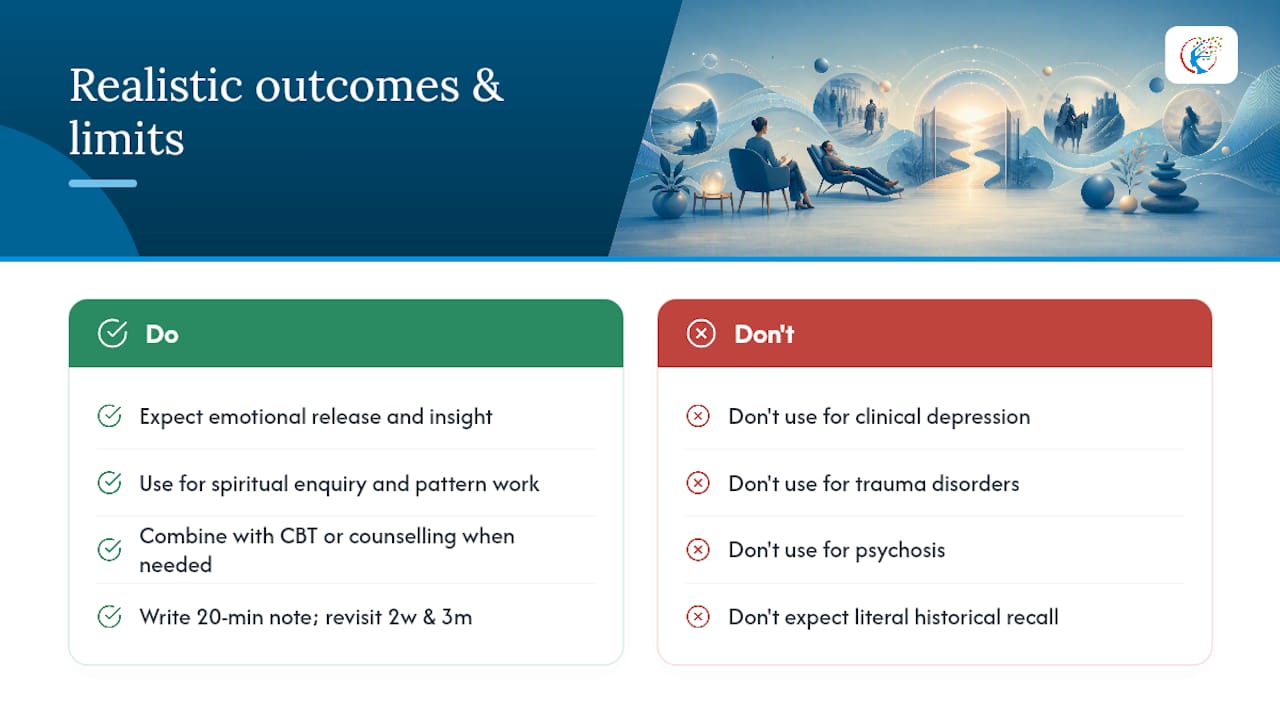
Clients commonly report emotional release, a shift in perspective on long-standing patterns, reduced anxiety, and a sense of symbolic insight into current life challenges. Some describe physical sensations of relief. These outcomes are real and meaningful for many people, though they are experiential rather than clinically measurable.
The limitations are equally worth stating plainly. Past life regression is not a treatment for clinical depression, trauma disorders, or psychosis. Recall during a session is subjective and symbolic; it is not a literal historical record. One session rarely resolves a deep-rooted issue on its own.
Pro Tip: After a session, spend 20 minutes writing down three specific things that felt significant and one question you want to sit with. Revisit that note at two weeks and again at three months. This simple practice turns a single session into a longer arc of reflection.
For persistent mental health concerns, regression works best alongside, not instead of, evidence-based support such as CBT or ongoing counselling. The cost of a single regression session is often comparable to two or three standard counselling sessions, so the value equation depends on what you are trying to achieve. Spiritual enquiry and pattern recognition are where regression earns its price. Clinical symptom management is where it reaches its limits.
You can read more about safe practice for past life regression before deciding whether a session fits your current situation.
Which credentials should you check before booking?
The UK has no statutory regulation of hypnotherapy, which means anyone can legally offer regression sessions. That makes your own due diligence non-negotiable.
Trust-signal checklist:
Membership of a recognised body: National Hypnotherapy Society, CNHC, or British Society of Clinical Hypnosis
Documented QHHT training (Level 1 minimum for basic sessions; Level 2 or 3 for full QHHT)
Professional indemnity insurance
A clear intake and consent process, including mental health screening
Transparent pricing and a written cancellation/refund policy
Verifiable testimonials or anonymised case notes
Ongoing CPD (continuing professional development)
Red flags: promises of guaranteed cures, pressure to purchase multiple sessions upfront, no consent process, and pricing that is either suspiciously low or entirely opaque.
For remote sessions, confirm that the practitioner uses a secure video platform, that the session will not be recorded without your consent, and that they have a protocol for supporting you if distress arises during the session.
Sample UK price breakdowns
Session type | Estimated UK price | Typical inclusions |
Standard regression (90 min) | £80–£150 | Intake, session, brief debrief |
Full QHHT session (3–5 hours) | £150–£250 | Intake, regression, higher self dialogue, recording, debrief |
Online regression session | £60–£120 | Video session, brief follow-up |
Three-session package | £300–£500 | Discounted per-session rate, follow-up support |
Sliding-scale / community option | £40–£80 | Basic session, limited materials |
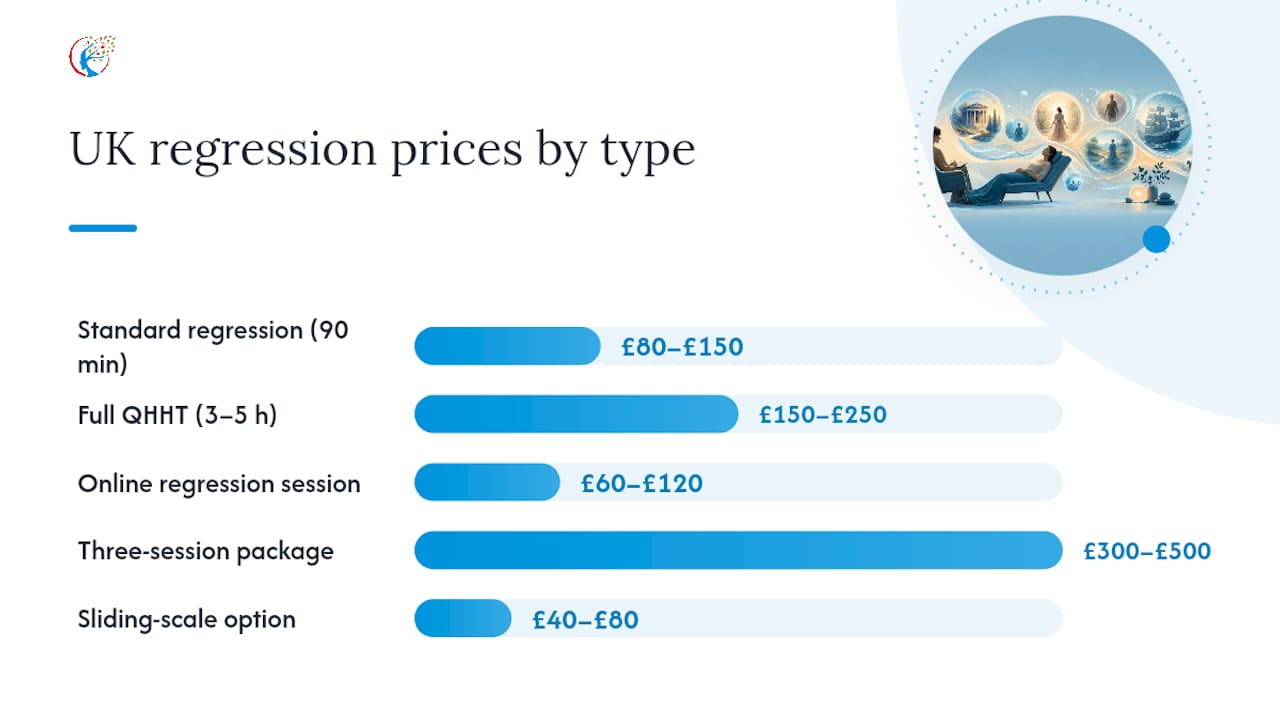
London and the South East sit at the top of these ranges; regional England typically falls in the middle or lower third. TherapyDen’s session data confirms that urban practitioners consistently charge more, and that packages offer a per-session saving but require a larger upfront commitment.
A three-session package at £300–£500 is typical, usually offering a per-session discount compared to booking sessions individually. The trade-off is flexibility: if the first session does not resonate, you have already committed. For a first experience, a single session is the lower-risk starting point.
For a broader sense of how past life regression pricing compares with other energy healing modalities, the gap between regression and standard talking therapy narrows considerably when you factor in session length.
What to ask before you book
What is your QHHT or regression hypnotherapy training, and at which level?
Are you a member of a recognised professional body, and do you hold indemnity insurance?
How long is the session in total, including intake and debrief?
Will I receive a recording of the session?
What is your cancellation and refund policy, and is a deposit required?
How do you screen clients for suitability before a session?
What aftercare or follow-up do you offer?
Can you share anonymised client feedback or case notes?
What should I do to prepare, and are there any restrictions beforehand?
Do you offer remote sessions, and if so, what platform do you use?
What to expect after a regression session
The 24 hours after a session are often the most vivid. Most clients feel a combination of calm and mild emotional sensitivity; some feel tired. This is normal and usually passes quickly.
Typical aftercare and integration steps:
Listen back to any session recording within 48 hours, while the imagery is still fresh
Journal key themes, symbols, and questions that arose
Avoid heavy alcohol or stimulants for 24 hours
Consider a follow-up email or call with your practitioner if anything feels unresolved
At two weeks: note any shifts in mood, perspective, or recurring thoughts
At three months: review your original intentions against where you are now
Additional costs to anticipate: a follow-up session (typically at the standard single-session rate), and, if deeper emotional material surfaced, a referral to a counsellor or therapist for ongoing support. Some practitioners include a follow-up email as standard; others charge for extended contact. Confirm this before you book.
Key takeaways
A single UK past life regression session typically costs £80–£250, with full QHHT intensives at the higher end, and the price is primarily driven by practitioner training, session length, and location.
Point | Details |
UK price range | Single sessions run £80–£250; full QHHT sessions sit at £150–£250 including intake and recording. |
Biggest cost driver | Practitioner training and certification (QHHT level, professional body membership) affects price most. |
Online vs in-person | Online sessions cost less, typically £60–£120, and suit clients outside major cities. |
Safety check | Verify CNHC or National Hypnotherapy Society membership, insurance, and a clear consent process before booking. |
Paulstebles option | Paulstebles offers in-person QHHT sessions in Orpington/Bromley with documented training and positive client testimonials. |
When is the investment worth it?
Most articles on this topic treat the cost question as purely financial. The more useful question is whether your goal is one that regression is actually suited to.
Regression earns its price when someone arrives with a specific, felt sense that something in their current life, a pattern, a fear, a relationship dynamic, has roots they have not been able to reach through conventional means. The session does not need to produce a dramatic revelation to be worthwhile. A shift in how you hold a long-standing question is often enough to justify the cost.
Where I would urge caution is with clients who are in acute distress or who are hoping regression will replace clinical support. It will not, and a practitioner worth their fee will tell you that plainly in the intake conversation. The sessions that tend to produce the most lasting value are those where the client arrives curious rather than desperate.
The spiritual enquiry angle, exploring past lives as a framework for understanding present patterns, is where regression is genuinely distinctive. No other modality quite replicates that particular kind of reflective depth. For that purpose, £150–£250 for a full QHHT session is, in my view, a fair price for what a skilled practitioner delivers.
Book a QHHT session with Paulstebles in Orpington
If you are ready to book with an experienced UK practitioner, Paulstebles offers in-person QHHT sessions from his practice in Orpington, Bromley. Sessions include a full pre-session intake, the regression and higher self dialogue, an audio recording, and a follow-up debrief. Mobile sessions are also available for clients who prefer to be seen at home.

Clients consistently highlight the calm, unhurried atmosphere and the clarity they take away from the session. Paul’s approach combines QHHT with energy healing, which means the session addresses emotional and physical dimensions together rather than treating them separately. Visit the QHHT FAQ page for full details on what to expect, how to prepare, and current availability. To book directly, use the session booking page.
Useful sources and further reading
This article is general information, not medical or psychological advice. If you have an active mental health condition, consult a qualified clinician before booking a regression session.
Recommended
Comments