Hypnosis for performance anxiety: does it actually work?


Hypnotherapy can meaningfully reduce performance anxiety for most people, and the evidence is stronger than many expect. Whether you freeze before a presentation, tense up on stage, or go blank in an audition, hypnosis targets the automatic, conditioned responses that sit beneath conscious control — the ones that willpower alone rarely shifts. People most likely to benefit include those with learned stage fright, public speakers, musicians, athletes, and anyone whose anxiety follows a predictable pattern tied to a specific performance context.
Those whose anxiety is triggered by a specific situation (a stage, a microphone, a sports pitch)
Musicians and performers whose technique is solid but whose nerves undermine it
Public speakers who blank, rush, or physically shake despite preparation
Athletes with pre-competition anxiety that disrupts sleep or focus
Anyone who has tried conscious strategies (breathing, positive thinking) without lasting relief
Pro Tip: Hypnotherapy works best when you practise between sessions. Even five minutes of guided audio rehearsal the night before a performance compounds the gains from clinical work significantly.
Key takeaways
Hypnotherapy is one of the better-evidenced complementary approaches for performance anxiety, with controlled studies showing reduced state anxiety and improved performance after as few as two sessions, particularly when combined with CBT techniques.
Point | Details |
Evidence is encouraging | Controlled studies in musicians and public speakers show reduced anxiety and improved performance after 2–6 sessions. |
Combined treatment works best | Hypnotherapy paired with CBT consistently outperforms either approach used alone for public speaking anxiety. |
Self-help techniques help | Diaphragmatic breathing, guided imagery rehearsal, and self-hypnosis audio can reduce acute anxiety before any performance. |
Check UK credentials | Look for NCH or CNHC registration; expect to pay £60–£150 per session; avoid practitioners who guarantee results. |
Paulstebles offers targeted sessions | In-person and remote hypnotherapy, QHHT regression, and an online anxiety course are available across South London and Kent. |
Table of Contents
What is performance anxiety (stage fright)?
Performance anxiety, clinically described as a form of situational anxiety, is the experience of significant apprehension before or during a performance that impairs functioning. It is not simply nerves. Most performers feel some pre-performance arousal, and a moderate amount actually sharpens focus. The problem arises when that arousal tips into a threat response: the body reads the stage, the podium, or the pitch as danger.
Common performance contexts include:
Public speaking (presentations, lectures, pitches)
Musical performance (recitals, auditions, live gigs)
Sport (competition, penalty situations, trials)
Examinations and academic assessments
Intimate or social performance situations
The distinction matters clinically. Normal pre-performance arousal is time-limited and manageable. Pathological performance anxiety persists, worsens with experience rather than improving, and can lead people to avoid situations entirely. At its most severe, it meets the criteria for social anxiety disorder or specific phobia under ICD-11.
Why does performance anxiety happen, and what does it feel like?
The mechanism is largely one of conditioned threat appraisal. At some point, the nervous system learned to associate a performance context with danger, and it now fires an alarm response automatically, before the rational mind has a chance to intervene. This is not a character flaw or a sign of insufficient preparation. It is the autonomic nervous system doing exactly what it was designed to do — just in the wrong context.
Physical symptoms typically include:
Rapid heartbeat or palpitations
Sweating, trembling, or shaking hands
Dry mouth and voice changes
Nausea or stomach discomfort
Muscle tension and shallow breathing
Cognitive symptoms include:
Intrusive self-monitoring (“everyone can see I’m nervous”)
Catastrophic thinking (“I’ll forget everything and humiliate myself”)
Mind-blanking or loss of access to well-rehearsed material
Difficulty concentrating on the task rather than the audience
Research note: Studies consistently find that music performance anxiety affects a substantial proportion of professional musicians, with some surveys suggesting high rates among orchestral players — though levels vary by instrument, career stage, and how anxiety is measured.
Can hypnotherapy help? What the research actually shows
The short answer is yes, with appropriate caveats about study size and context. A narrative review on hypnosis and anxiety concluded that hypnosis and hypnotherapy are effective in treating anxiety and may positively influence autonomic regulation, suggesting a physiological pathway beyond simple cognitive change.
For performance-specific work, the evidence is encouraging. A controlled study with 46 advanced pianists found that cognitive hypnotherapy produced significant reductions in state anxiety and improved performance ratings compared with a control group, after just two therapy sessions. That is a meaningful result from a brief intervention in a real performance population.
For public speaking specifically, a cognitive-behavioural hypnotherapy protocol outperformed CBT alone in a small controlled trial, with the hypnotic condition producing larger post-treatment gains. There is also an interesting expectancy effect: labelling an intervention as ‘hypnotic’ increases participants’ expectancies for improvement, and those expectancies correlate with better outcomes. Therapeutic framing, in other words, is part of the mechanism.
Limitations worth knowing:
Most performance-specific studies use small samples, so results need replication at scale
Protocols vary considerably between studies, making direct comparisons difficult
Hypnosis alone may be less durable than hypnosis combined with CBT skills
Pro Tip: Studies showing the strongest results typically used 2–6 sessions, not one. If a practitioner promises resolution in a single session for a longstanding pattern, treat that claim with scepticism.
How hypnotherapy works and what a typical course looks like
Hypnosis is not sleep, and it is not loss of control. It is a state of focused attention in which the critical, analytical mind becomes less dominant, making the subconscious more receptive to new associations and suggestions. For performance anxiety, this matters because the anxiety response is subconscious: it fires before conscious reasoning can intercept it.
A first session typically involves an assessment of the anxiety’s history and triggers, followed by an induction (a guided process of relaxation and focused attention), and then targeted suggestions or imagery rehearsal. The client remains aware throughout and can end the session at any point.
Hypnotherapy targets the learned alarm response linked to performance situations and uses imagery and suggestion to rehearse calmer automatic responses before the performance occurs. Think of it as reprogramming the conditioned reflex rather than arguing with it.
Most people with targeted performance issues see measurable progress within 2–4 sessions, though complex or longstanding histories may need longer work.
Practical self-help exercises from hypnotherapy you can try now
These techniques come directly from clinical hypnotherapy practice and are safe to use independently before a performance.
1. Diaphragmatic breathing with a count Breathe in for four counts, hold for two, breathe out for six. The extended exhale activates the parasympathetic nervous system. Do this for two minutes before you go on. It is the same pattern used at the start of most hypnotic inductions.
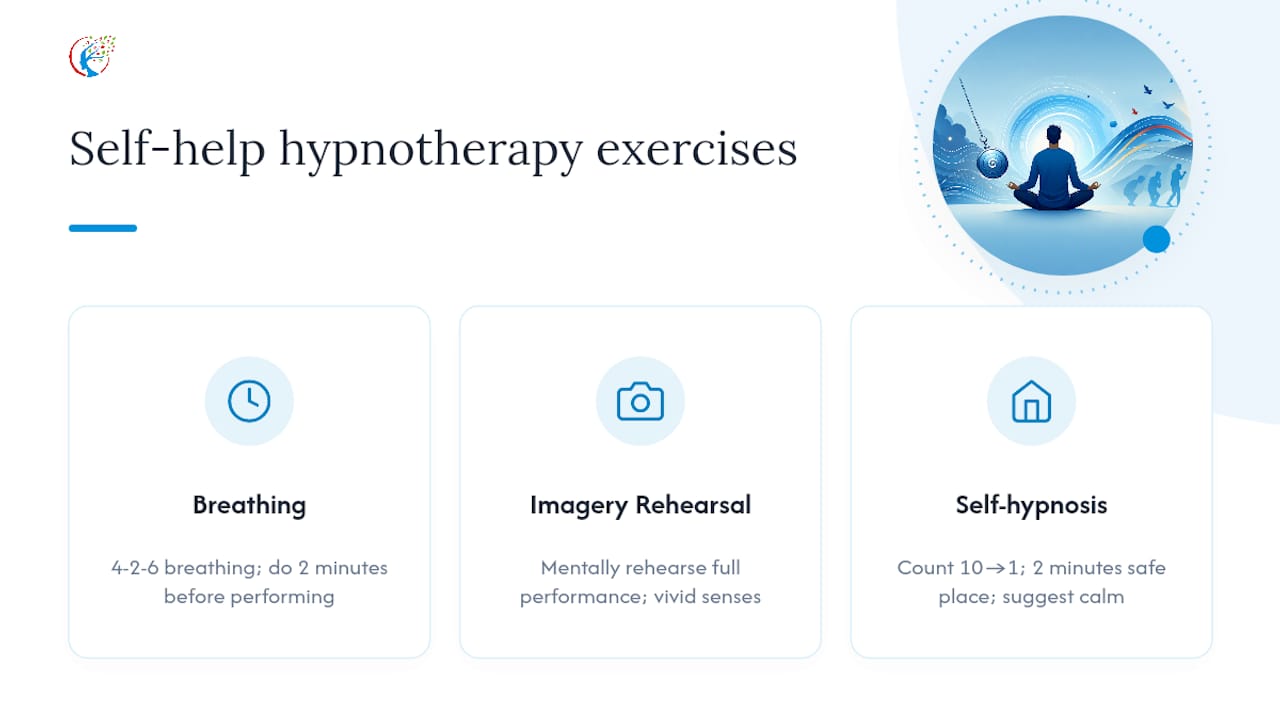
2. Guided imagery rehearsal Close your eyes and mentally walk through your performance from start to finish, but do it well. See the room, hear the sounds, feel your feet on the floor, and watch yourself performing calmly and competently. The brain processes vivid mental rehearsal similarly to actual experience, which is why athletes have used this technique for decades.
3. A simple self-hypnosis script Sit comfortably, close your eyes, and count slowly from ten down to one, imagining yourself descending a staircase with each number. At the bottom, picture a place where you feel completely safe and calm. Spend two minutes there, then suggest to yourself: “When I perform, I am focused, calm, and in control.” Count back up from one to five and open your eyes.
Pro Tip: Record a five-minute version of the imagery rehearsal on your phone and listen to it backstage or in the car before an event. Consistency matters more than duration — three minutes daily beats thirty minutes once a week.
How to find the right hypnotherapist in the UK
Hypnotherapy is not statutorily regulated in the UK, which means anyone can technically call themselves a hypnotherapist. That makes checking credentials non-negotiable.
What to look for:
Registration with the National Council for Hypnotherapy (NCH) or the Complementary and Natural Healthcare Council (CNHC), both of which require verified training and professional insurance
A qualification from an accredited training school (minimum diploma level)
Specific experience with performance or anxiety work, not just general practice
Willingness to discuss their approach, session plan, and evidence base before you commit
Questions to ask in a first call:
What training do you hold, and are you registered with a professional body?
How many sessions do you typically recommend for performance anxiety?
Do you use CBT techniques alongside hypnosis?
What does a typical session involve, and will I receive audio for home practice?
Typical costs in the UK range from around £60 to £150 per session depending on location and practitioner experience, with London-based practitioners generally at the higher end. A short course of 3–4 sessions is a reasonable starting budget for targeted work.
Red flags: guarantees of results in one session, claims that hypnosis can “cure” anxiety permanently, pressure to commit to long packages upfront, or any practitioner who cannot clearly explain their training.
Pro Tip: Ask whether the practitioner offers a short introductory call before booking. Most reputable hypnotherapists do, and it tells you a great deal about their communication style and clinical approach.
When to see your GP or choose other treatments
Hypnotherapy is not the right first step for everyone. See your GP before pursuing hypnotherapy if you experience:
Panic attacks that occur outside performance contexts
Persistent low mood, depression, or substance use alongside the anxiety
Anxiety so severe it prevents you from working or leaving the house
Any safety concerns, including thoughts of self-harm
The NHS offers access to Cognitive Behavioural Therapy (CBT) through the Improving Access to Psychological Therapies (IAPT) programme, now operating as NHS Talking Therapies, which is the first-line evidence-based treatment for anxiety disorders. Waiting times vary by area, but self-referral is available in most regions.
Medical hypnosis combined with CBT can produce rapid benefit for public-speaking anxiety, and for those whose physical symptoms (racing heart, trembling) are the primary problem, a GP may discuss beta-blockers such as propranolol as a short-term option. Propranolol addresses the physiological symptoms but does not change the underlying anxiety pattern, so it is often most useful as a bridge while psychological work takes effect.
Hypnotherapy works well alongside CBT rather than instead of it. If you are already in therapy, ask your therapist whether integrating hypnotic rehearsal techniques would complement your existing work.
What the research says and what practitioners observe
The peer-reviewed picture is consistent, if not yet definitive. Across music, sport, and public speaking contexts, hypnotherapy reduces state anxiety and tends to improve performance ratings. The pianist study (n = 46) showed significant gains after two sessions. The public speaking trial found hypnotic CBT outperformed standard CBT. The narrative review adds a physiological dimension, suggesting hypnosis may reduce sympathetic activation, not just change cognitions.
Early case series from the 1990s, including Stanton’s work on brief hypnotherapy protocols, reported rapid reductions in performance anxiety, though sample sizes limited generalisability. The field has grown since, but large-scale RCTs remain sparse.
What practitioners consistently observe is that expectancy matters enormously. Clients who arrive believing hypnosis might help tend to respond better, partly because they engage more fully with between-session practice. The expectancy effect is not placebo in a dismissive sense — it is a genuine therapeutic mechanism, and skilled practitioners use it deliberately through careful framing and collaborative goal-setting.
Key research findings at a glance:
Hypnotherapy reduces state anxiety in controlled performance studies
Combined hypnotherapy and CBT outperforms CBT alone for public speaking
Two sessions produced measurable gains in the pianist RCT
Autonomic effects (reduced sympathetic activation) may complement cognitive change
Expectancy and therapeutic framing are active ingredients, not noise
A practitioner’s perspective on performance anxiety work
What I see most often is people who have already done everything “right” — they have rehearsed, they know their material, they have tried breathing exercises — and the anxiety still fires. That tells me the pattern is subconscious and conditioned, not a knowledge problem. Hypnotherapy is the right tool for that specific situation.

My approach with performance anxiety typically begins with a thorough assessment: when did the pattern start, what triggers it, and what does the person most want to feel in the moment of performance? From there, I use a combination of focused suggestion, mental rehearsal, and where appropriate, regression work to explore whether an earlier experience is maintaining the pattern. For some clients, a short course of 3–4 sessions resolves a specific performance fear. For others, particularly where the anxiety connects to deeper beliefs about worth or failure, QHHT and regression hypnotherapy offers a way to address the root rather than just the symptom.
I also integrate energy healing where clients are open to it, particularly where the anxiety has a strong somatic component — chronic tension, disrupted sleep, or a sense of being physiologically “stuck.” That combination of approaches is what distinguishes deeper therapeutic work from a simple relaxation technique.
When performance anxiety is part of a broader clinical picture — significant depression, panic disorder, or trauma — I refer to a GP or clinical psychologist first and work collaboratively alongside that care.
Working with Paulstebles: sessions, booking, and next steps
If the evidence in this article resonates and you are ready to do something about your performance anxiety, Paulstebles offers in-person and remote sessions from South London and the surrounding areas, including Bromley, Orpington, Croydon, and Bexley.

Relevant services include targeted hypnotherapy for performance and anxiety, QHHT regression sessions for deeper subconscious work, energy healing for those with a strong somatic anxiety pattern, and an online anxiety and depression course available through Udemy for those who want structured self-guided support. Mobile sessions are also available for clients who prefer to work in their own environment.
Most clients with a specific performance anxiety see meaningful change within 3–4 sessions. To find out whether the approach fits your situation, review the QHHT and session details or book directly through the Paulstebles website at Paulstebles.
Sources
This article provides general information about hypnotherapy for performance anxiety and is not a substitute for professional medical or psychological advice. If your anxiety is severe or affects daily functioning, please consult your GP or a qualified mental health professional.
Recommended
Comments