5 Quick Grounding Steps for Psychic Attack Symptoms and Medical Checks


If your symptoms started suddenly, feel aimed at you rather than random, and don’t lift with normal rest, they may fit the pattern practitioners call a psychic attack. That’s the working verdict. But the first move isn’t a salt bath; it’s ruling out medical or psychological causes, because the same cluster (headaches, insomnia, sudden dread) can just as easily point to an underlying illness, medication issue, or mental-health flare that needs a GP, not a cleansing ritual.
TL;DR:
Symptoms typically begin suddenly and cluster in physical, mental, sleep, and behavioral categories, often with no clear medical cause.
Key indicators include targeted feelings of being watched or pressed, intrusive thoughts, and sleep disturbances that persist despite rest.
Ruling out urgent medical issues takes priority, with focus on identifying a datable onset, feeling directed at you, and resistance to self-care as signs of an energetic pattern.
Immediate self-help includes grounding exercises, visualizing protective boundaries, and clearing physical space, while avoiding retaliatory rituals.
Proactive daily protection through grounding, boundary visualization, and maintaining good sleep hygiene reduces vulnerability to these energetic disruptions.
Table of Contents
What are the common psychic attack symptoms?
The pattern practitioners describe rarely shows up as one dramatic sign. It’s usually a cluster: several ordinary complaints stacking up in the same short window, none of them explained by anything obvious in your life.
Physical signs tend to arrive first. Unexplained headaches that come and go with no clear trigger, sudden illness that appears out of nowhere, chronic fatigue that sleep doesn’t touch, and a specific, hard-to-describe sensation of being “pressed on” or watched. The College of Psychic Studies lists anxiety, nausea, and headache-type symptoms among the most commonly reported.
Emotional and mental signs run alongside the physical ones: intrusive thoughts that feel like they’re not yours, a sudden drop into despair with no obvious cause, flashes of reactive anger, or a creeping paranoia that something is wrong even though nothing has actually changed.
Sleep disturbance is one of the clearest tells. Recurring nightmares, sleep paralysis, waking up exhausted despite a full night, or dreams that keep circling back to one specific person all point in the same direction.
Behavioural and life effects show up more slowly: a run of bad luck that feels concentrated rather than random, sudden friction in relationships that were previously fine, or strange smells and objects appearing without explanation.
Physical: headaches, sudden illness, exhaustion, a pressed or watched feeling
Emotional/mental: intrusive hostile thoughts, sudden despair, reactive anger, paranoia
Sleep: nightmares, sleep paralysis, non-restorative waking, person-specific dreams
Behavioural: clustered bad luck, relationship strain, unexplained objects or smells
Practitioner guides consistently note that no single symptom is conclusive on its own; it’s the totality that matters, several categories firing at once, in a short timeframe. The concept practitioners lean on most is directionality, whether the distress feels like it’s coming from inside you (a bad week, a health issue, an anxious mind) or feels aimed at you from outside. That felt sense of being targeted, arriving with an abrupt, datable shift in mood or energy, is what separates ordinary stress from something practitioners would call an energy attack.
Distinguishing psychic attack from stress, illness or mental-health issues
This is the step most guides skip, and it’s the one that matters most. Ruling out medical and psychological causes isn’t a formality. It protects you from mislabelling a treatable condition as something spiritual and delaying the care you actually need.
Seek urgent medical attention first if you notice any of these red flags, regardless of how “aimed” the symptoms feel:
Chest pain, severe or worsening headache, or sudden confusion
Any thought of self-harm or suicide
Fainting, physical collapse, or a rapid, unexplained decline in function
Symptoms that match a known medication side effect, infection, or existing condition flaring up
Once those are ruled out, three markers help identify a genuinely energetic pattern: sudden, datable onset (you can name the day or week it started), directionality (it feels targeted rather than generalised), and resistance to ordinary rest and self-care (sleep, food, and downtime don’t touch it).
A quick practitioner-reported test: silently repeat a release phrase such as “I release what is not mine” and notice what happens over the next few minutes. If the heaviness lifts quickly, that’s a meaningful data point, though not proof on its own.
Pro Tip: Keep a short symptom log for a week: note when each symptom started, what triggered it, how you slept, and who was around you that day. Patterns that repeat around the same person or event are far more telling than any single bad night.
Immediate self-help: grounding and clearing steps to try now
When symptoms are active, you want something you can do in minutes, not a long ritual. This sequence works whether the cause turns out to be energetic or simply an anxious nervous system in overdrive.
Ground physically. Sit or stand with both feet flat on the floor and breathe slowly for sixty seconds, in for four counts, out for six. This somatic grounding technique calms the body regardless of the cause.
Visualise a boundary. Picture a golden egg of light surrounding you, or a simple protective sphere, and hold the image for a minute or two.
Say the release phrase. Silently or aloud: “I release what is not mine.” Notice any shift in tension.
Cleanse physically. A salt bath, or simply washing your hands and face with intention, is a practical ritual many practitioners recommend as a reset.
Clear the room. Open a window, tidy visible clutter, and remove any object you don’t recognise or can’t account for.
Avoid aggressive “return to sender” techniques if you’re new to this. Guides consistently warn that retaliatory methods can escalate a conflict rather than resolve it; neutralising and calming the situation is the safer route for most people.
Pro Tip: If you don’t feel any shift after this sequence, or symptoms return within hours, that’s useful information too. It’s a sign to keep the symptom log going and consider speaking to a GP or an experienced practitioner rather than repeating the same steps indefinitely.
Rest afterwards. Don’t stack the sequence with caffeine or a stressful conversation straight after. Give your body a chance to settle before judging whether it worked.
Building daily protection so you’re less vulnerable
Emergency clearing has its place, but proactive protection consistently outperforms reactive fixes. A body and mind that are already regulated have far less room for anything, energetic or psychological, to take hold.
Start each day with a two-minute grounding practice before checking your phone or email.
Add a morning boundary visualisation, the same golden egg or sphere image, as a five-second habit before you leave the house.
Build a tiny pre-contact ritual before stressful meetings or difficult people: one breath, one boundary image, one grounding phrase.
Protect your sleep hygiene: consistent bedtime, reduced screens, and less reliance on alcohol or other intoxicants, all of which thin out your natural resilience.
Keep real social support in place. Isolation is where both stress and energetic vulnerability tend to deepen.
Do the slower emotional release work (journaling, therapy, or mindfulness practice) rather than only reaching for quick fixes when things flare up.
Historical self-defence writing makes the same point in older language: fear and reactive emotion are the opening that most attacks exploit. Protection works best as a baseline you maintain, not a fire extinguisher you grab once the room is already burning.
When to get professional support
Some signs need a phone call, not a visualisation. Contact a GP or mental-health service immediately for suicidal thoughts, severe physical collapse, or sudden confusion. These override any energetic explanation until ruled out.
A GP or mental-health professional checks for medical or psychiatric causes first, which protects you from mislabelling something treatable
An experienced energy practitioner will look at pattern, timing, and directionality rather than any single symptom
A safe practitioner should be upfront about their training, keep clear boundaries, ask for informed consent, and offer aftercare guidance, not vague promises
If symptoms persist despite basic clearing, it may point to a deeper, longer-standing issue that needs more focused repair work rather than another quick session
How psychic attacks are believed to work
Practitioners generally describe psychic attacks as a transfer or projection of concentrated intention, usually anger, envy, or fear, directed at a specific person. The theory rests on the idea that thoughts and emotions carry energy, and a strong enough emotional charge, especially when repeated or fixated, can affect someone else’s energetic field even without physical contact.
This isn’t framed as anyone consciously “casting a spell” in most modern accounts. It’s often unconscious: a person consumed by resentment or obsessive focus on you can, in this view, project that intensity outward without meaning to. That’s why practitioners talk about energy (the raw charge), intention (the direction it’s aimed), and a broader spiritual context (the idea that everyone has some form of energetic boundary that can be worn down or breached under enough pressure).
The mechanism proposed is less about a bolt of harm being fired and more about a weakening of your natural boundary. Fear, exhaustion, and emotional instability are consistently described as the entry points, which is why so much practitioner advice circles back to nervous-system regulation rather than dramatic countermeasures. A steady, grounded person is harder to affect than someone already frayed and reactive.
Whether you take this literally or as a useful metaphor for emotional contagion, the practical advice converges either way: manage the boundary, manage the emotional charge, and don’t wait until you’re depleted to start doing either.
What happens if symptoms go unaddressed
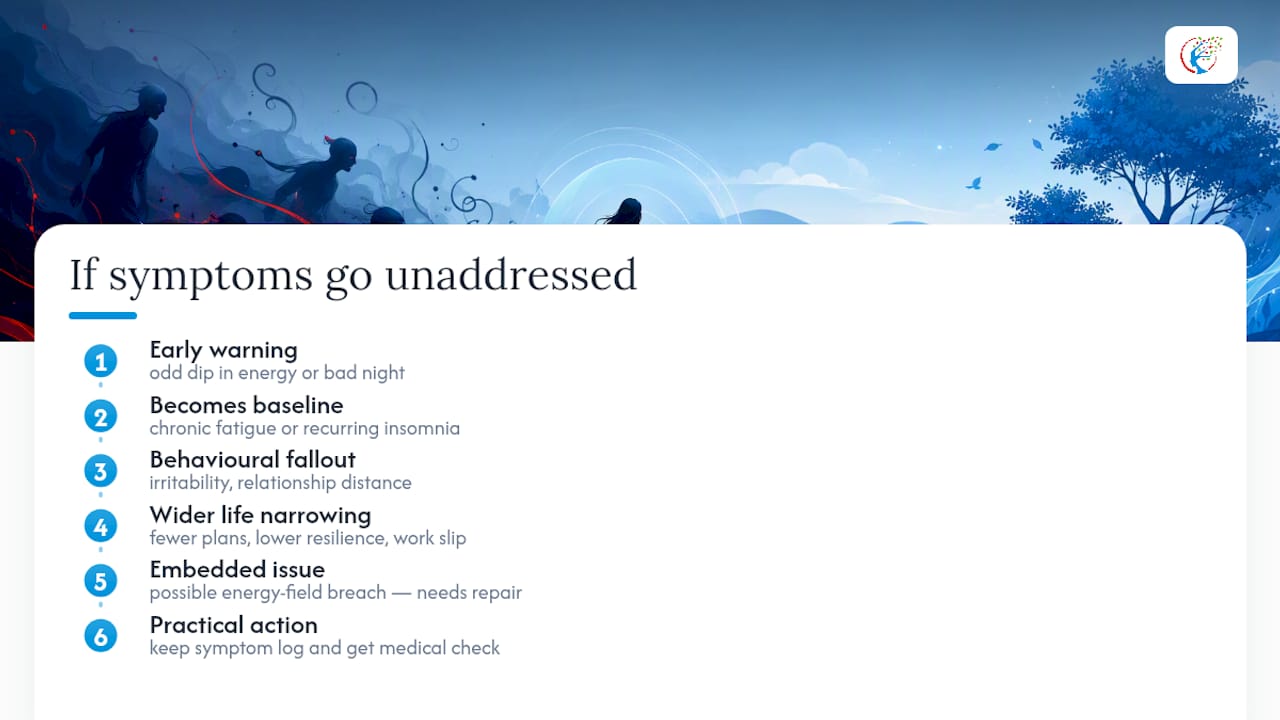
Left unaddressed, the symptoms described earlier don’t tend to stay static. Chronic fatigue that started as an odd, unexplained dip can settle into a baseline low that colours every part of daily life. Sleep disruption that began as the occasional bad night can calcify into a pattern of insomnia or recurring nightmares that erodes both mood and physical health over months.
The behavioural knock-on effects are often what people notice last but regret most. Relationship friction that started as minor irritability can compound into genuine distance from people you care about, especially if the underlying dread or paranoia keeps getting projected onto them. Work performance can slip as concentration and energy decline. Some people describe a gradual narrowing of their world: fewer social plans, less resilience to normal setbacks, a persistent sense of being on guard.
Practitioner accounts note that where clearing and grounding don’t resolve things, it can point to something more embedded, sometimes described as a breach in the personal energy field linked to earlier trauma or a major physical event like surgery. In that scenario, repeated shallow clearings won’t do much; what’s needed is more focused repair work rather than another round of the same emergency steps.
The practical takeaway is the same one that runs through this whole article: don’t let ambiguous symptoms drift for months. A short symptom log and an honest medical check early on will save you from either under treating a real health issue or letting a genuinely energetic pattern settle in and become harder to shift.
Psychic attack versus psychic influence: what’s the difference?
These two terms get used almost interchangeably, but they describe different things. A psychic attack, as covered throughout this article, is generally described as an acute, often unconscious projection of strong emotion, fear, anger, envy, aimed at a specific person over a short window. It tends to feel sudden and has that directional, “aimed at me” quality.
Psychic influence or manipulation is usually framed as something more deliberate and sustained. It’s less about a burst of emotional charge and more about one person consistently steering another’s thoughts, decisions, or emotional state over time, sometimes through ordinary psychological manipulation dressed up in energetic language, sometimes through repeated, intentional energetic pressure.
The practical distinction matters because the response differs. A psychic attack, in the practitioner framework, often responds to grounding, clearing, and boundary work because it’s a single concentrated event. Ongoing influence or manipulation usually needs a different kind of intervention: recognising the relationship pattern itself, setting firmer boundaries with the specific person involved, and in many cases, genuine psychological support to unpick manipulation tactics that have nothing to do with energy at all.
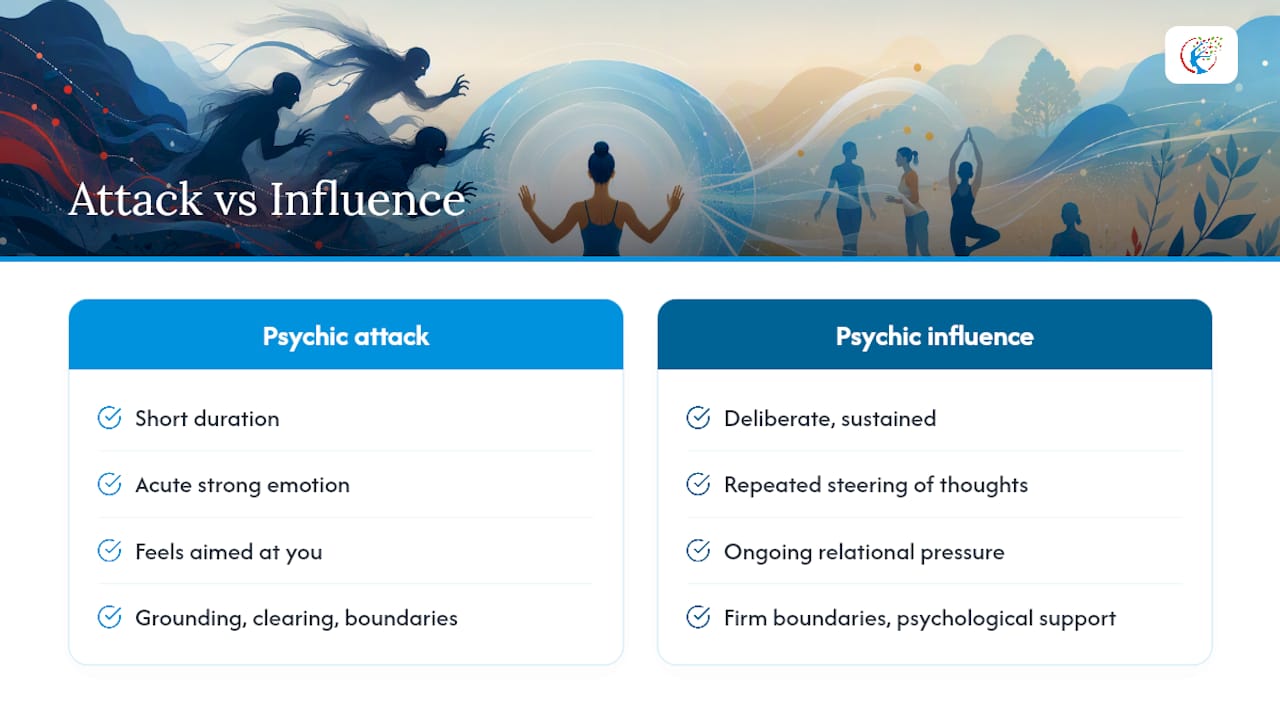
If your symptoms trace back to one identifiable, short-lived spike, that fits the attack pattern. If they trace back to a long-running relationship where you consistently feel controlled, second-guessed, or emotionally destabilised by the same person, that’s closer to influence, and it deserves a different, more relational solution than a salt bath.
Cultural and historical roots of the idea
The idea that thought or intention can harm someone at a distance isn’t new, and it isn’t confined to one tradition. Folk magic traditions across Europe described the “evil eye,” a belief that envy or ill will, even unspoken, could cause misfortune or illness in the person it was directed at. Similar concepts appear in West African, Caribbean, and South Asian traditions under different names, often tied to protective charms, amulets, or rituals meant to deflect ill intention before it lands.
In the early twentieth century, British occultist Dion Fortune wrote what remains one of the most cited texts on the subject, framing psychic attack as a real, if often unconscious, hazard of close relationships and describing emotional stability as the primary defence. Her work still shapes how contemporary practitioners talk about boundaries and grounding almost a century later.
What’s consistent across cultures and centuries is the same underlying logic: strong emotion, left unchecked, is dangerous, and stability, however you build it, is protective. Modern practitioner guidance, grounding, visualisation, symptom tracking, medical-first checks, is really just a more structured, less superstitious version of instincts that show up in folk traditions worldwide.
A practitioner’s note on emotional stability
People who build emotional regulation and somatic grounding into daily life report far fewer of these draining episodes than those who only reach for a fix once symptoms are already severe. Clients often describe the shift not as one dramatic clearing, but as steadier weeks strung together once grounding became routine. If any of this resonates, personalised support can help you explore what’s actually happening beneath the surface.
— Paul
Getting specialist, personalised support
Reading a symptoms list is a starting point, not a diagnosis. If the pattern described here matches what you’re experiencing, and a GP has already ruled out a medical cause, working one-to-one often gets you further than another round of self-guided grounding.

Healing practitioners offer various routes to support different needs. These may include Quantum Healing Hypnosis sessions to access deeper subconscious roots of recurring emotional or physical patterns, energy healing sessions combining modalities like Reiki and chakra balancing available in person and remotely, and structured online courses for anxiety and depression with video content and practical exercises for self-paced learning.
If you’re dealing with acute physical symptoms, chest pain, fainting, or thoughts of self-harm, see a GP or urgent care first; this work is a complement to medical care, never a replacement for it. Full details on what a first QHHT session involves, including preparation and typical follow-up, are covered on the QHHT FAQ page. To book a session directly, visit the QHHT booking page.
Sources
For more detail beyond this article, the College of Psychic Studies explainer is a solid starting point, alongside practical routines from MotherOdessa’s protection guide and grounding techniques collected at Clarity Insight Wellness.
FAQ
How can I protect myself from a psychic attack?
Build a daily baseline of grounding and boundary work, a short visualisation each morning, regulated sleep, and less reliance on alcohol, rather than waiting to react once symptoms appear. Proactive protection consistently works better than emergency clearing done after the fact.
How do you know if someone is sending you bad energy?
Look for directionality: the sense that distress feels aimed at you rather than generalised, paired with a sudden, datable onset and symptoms that don’t ease with normal rest. No single sign confirms it; the pattern across several categories is what practitioners weigh.
How do you know if you are spiritually attacked?
A cluster of physical, emotional, sleep, and behavioural symptoms appearing together in a short window, especially after ruling out medical or psychiatric causes, fits the pattern practitioners describe. A quick release-intention test that brings fast relief is one supporting sign, though not proof on its own.
What are common signs and symptoms of negative energy?
Headaches, unexplained fatigue, intrusive hostile thoughts, sudden despair, nightmares or sleep paralysis, and a felt sense of being watched or pressed on are the most frequently reported. Always rule out a medical or mental-health cause first before treating these as energetic.
Recommended
Comments