See Reiki Benefits in 8 Sessions: Evidence and a Clinician's Protocol

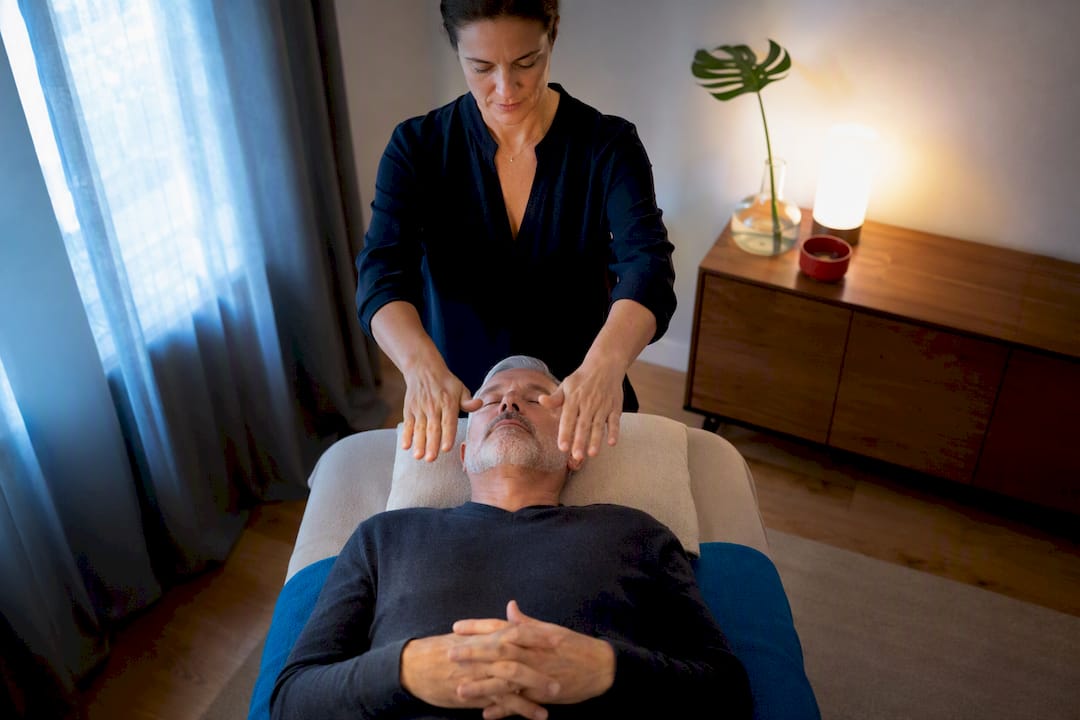
Reiki reliably delivers relaxation, lower perceived stress and anxiety, and modest improvements in sleep and mood for many people. Pain relief and quality-of-life gains show up too, though less consistently. The evidence is real but limited: the strongest signals come from small randomised trials and meta-analyses that flag their own methodological weaknesses. This article breaks down which benefits are best supported, what a session actually feels like, the safety points worth knowing, and how a practitioner structures sessions to give you a fair trial.
TL;DR:
Benefits are most reliable for stress and anxiety reduction, with physiological markers like lower heart rate and blood pressure showing measurable changes.
Small improvements in quality of life are statistically significant but remain modest, especially after multiple sessions or longer treatment durations.
Most evidence relies on subjective reports, with limited objective data, and positive effects tend to increase with at least eight sessions of 60 minutes each.
Reiki is typically safe as a complementary therapy but should never replace urgent medical care or be used to treat serious health conditions.
Structured, goal-oriented trials are more effective for evaluating personal benefits, with client participation and tracking key metrics essential for assessing progress.
Table of Contents
Reiki benefits for stress, pain, sleep and mood
Stress and anxiety reduction is where Reiki has the most consistent backing. Controlled trials measuring both subjective anxiety scores and physiological markers, heart rate and blood pressure among them, have recorded measurable drops after sessions. That matters because subjective reporting alone can inflate perceived benefit, but pairing it with an objective marker gives the finding more weight. A 2022 systematic review found possible effects on clinical stress, depression and anxiety symptoms, though the authors were upfront about inconsistent study quality across the trials pooled.
Pain and fatigue tell a messier story. Oncology and chronic pain trials have reported meaningful reductions for some patients, but nearly all rely on self-reported scales rather than objective pain measurement, which leaves room for expectation to shape the result. Sleep and mood fare a little better in short courses: several small trials show improvement after just a handful of sessions, with effects generally stronger across repeat visits rather than a single one-off treatment.
Quality of life has the clearest quantitative backing. A 2025 meta-analysis of randomised controlled trials pooling 11 studies and 661 participants found a small but statistically significant improvement (SMD = 0.28, 95% CI 0.01 to 0.56). Subgroup analysis pointed to something practical: people who received eight or more sessions, or longer session durations, tended to see stronger results than those who had one or two short treatments.
What’s actually happening physiologically? Several clinical reviews describe changes consistent with a relaxation response: lower heart rate, reduced blood pressure, increased salivary IgA. This lines up with parasympathetic nervous system activation, the “rest and digest” state your body enters when stress hormones drop. What’s missing is any validated instrument that detects the “energy field” Reiki practitioners describe as the mechanism. The relaxation response is measurable. The energy claim is not.
In short, the commonly reported benefits break down as:
Reduced stress and anxiety, with some physiological markers to back it up
Modest pain relief, mostly from subjective reporting
Better sleep, particularly with repeated sessions
Small but statistically real quality-of-life gains, strongest with ≥8 sessions
How strong is the research on Reiki, really?
The 2025 meta-analysis is the best single data point available: 11 trials, 661 participants, an SMD of 0.28 for quality of life (95% CI 0.01 to 0.56). That’s a real, statistically significant effect, but it’s small, and the confidence interval creeps close to zero at its lower bound. Other reviews and individual RCTs point the same direction on stress, mood and comfort, without ever producing a large or dramatic effect size.
By the numbers: 11 studies, 661 participants, SMD 0.28 (95% CI 0.01–0.56) for quality-of-life improvement after Reiki, with larger gains linked to several sessions or more.
The limitations are consistent across the literature:
Small sample sizes, often under 100 participants per trial
Heavy reliance on subjective outcome measures rather than objective clinical markers
Genuine difficulty blinding participants to whether they received Reiki or a sham version
Risk of bias in surveys run by practitioners with a stake in positive results
There’s a practical pattern worth noting. Acute interventions, sessions of 20 minutes or less, tend to be studied for immediate relaxation before procedures like surgery. Longer courses of eight-plus sessions, each lasting 60 minutes or more, are the ones linked to measurable quality-of-life change. The honest summary: Reiki looks plausible as low-risk adjunctive support for stress, comfort and wellbeing. It is not backed by evidence strong enough to support any curative claim, and no reputable source suggests it should be.
What actually happens in a Reiki session
A typical appointment starts with a short intake conversation, then settles into a treatment window of 20 to 60 minutes. You stay fully clothed, either seated or lying down, while the practitioner places their hands lightly on or near the body in a set sequence.
Common experiences during and after a session include; see practical resources on emotional regulation and resilience that complement energy-healing approaches.
A deep sense of relaxation, often compared to the drowsy state just before sleep
Warmth or a light tingling sensation where hands are placed
Emotional release, sometimes unexpected tearfulness
Drifting into light sleep during the session itself
All of these are considered normal responses, not signs anything has gone wrong. Afterwards, drink water, rest if you can, and jot down any emotional or physical shifts you notice over the following day or two, useful if you’re tracking whether repeat sessions build on each other. Read more on aftercare from a practitioner’s perspective.
Pro Tip: Keep a one-line note after each session, sleep quality, mood, pain level, on a 1 to 10 scale. Over eight sessions that log tells you far more than memory alone.
Who benefits most, and when to see a doctor first
People managing cancer treatment side effects, chronic pain, high stress or insomnia most often report noticeable benefit from Reiki. Cancer Research UK notes it can help people feel deeply relaxed and cope emotionally, while stating plainly there is no evidence it cures or prevents cancer.
Safety-wise, reported harms in trials are minimal. The real risk isn’t the session itself, it’s using Reiki as a substitute for medical treatment that a condition actually requires.
Seek medical attention first for new or unexplained severe symptoms
Treat urgent medical signs, chest pain, sudden severe headache, difficulty breathing, as emergencies, not sessions to book
Suicidal ideation or severe psychiatric symptoms need a clinician immediately, not energy work
Tell your medical team you’re having Reiki sessions, and keep following guideline-based care for any diagnosed condition
Cleveland Clinic frames this well: use Reiki as complementary care alongside medicine, never as a replacement for it.
A practitioner’s approach: protocols and honest expectations
In practice, a structured trial works better than a single one-off session. For chronic or autoimmune-type symptoms, a six to eight-week approach, weekly or fortnightly sessions with a symptom log kept from day one, gives you and your practitioner something concrete to review at the four and eight week marks. Full detail on that protocol is in this six to eight week trial approach.
Client participation matters more than people expect. Practitioners consistently observe that openness and a bit of preparation, arriving rested, setting a clear intention, seem to shape how strongly someone experiences a session.
Log symptoms weekly, not just after each session
Set one measurable goal before you start (sleep quality, anxiety score, pain rating)
Review progress at week four, adjust frequency if needed
Keep any prescribed medical treatment running in parallel, without exception
Pro Tip: Pick a single measure to track, sleep hours, a 1 to 10 stress rating, whatever matters most to you, and stick with just that one number for the full trial period. Switching metrics halfway through makes progress impossible to judge.
Reiki versus other complementary therapies
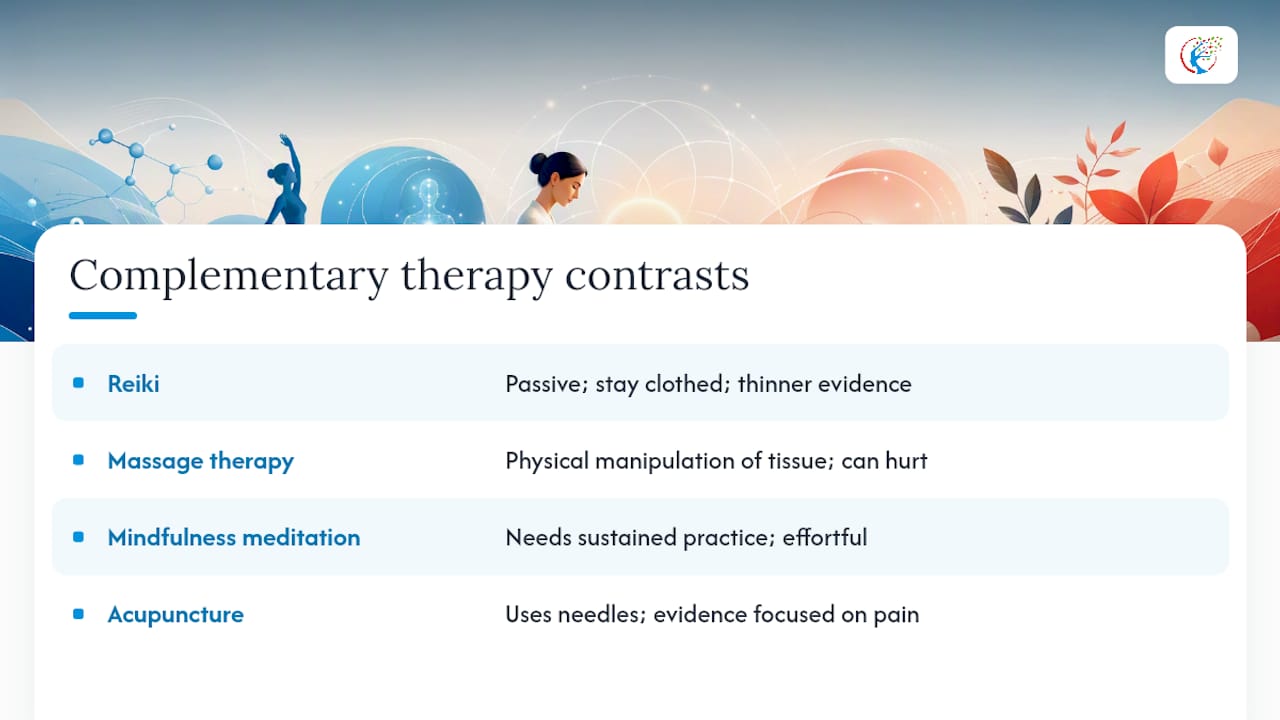
Reiki sits in the same broad category as massage therapy, mindfulness meditation and acupuncture: none of them claim to cure disease, and all of them are studied primarily for their effect on stress, comfort and subjective wellbeing rather than pathology.
Where Reiki differs is contact and effort. Massage requires physical manipulation of tissue and can be uncomfortable for people with certain pain conditions. Meditation demands sustained personal effort and practice to see benefit, which suits some people and frustrates others. Acupuncture involves needles, a barrier for anyone needle averse, and has its own separate evidence base focused more on pain than mood.
Reiki asks almost nothing of the client physically, you stay clothed, still and passive, which makes it accessible to people who find other therapies too demanding, painful or effortful. The trade off is that its evidence base, while real, tends to be thinner and smaller in scale than the research behind mindfulness-based stress reduction or acupuncture for pain. None of these therapies replace medical treatment. All of them, Reiki included, work best as one part of a wider approach to managing stress, pain or a chronic condition, not the whole approach.
Why realistic expectations matter more than the science debate
Most clients who come in aren’t chasing a miracle. They want to sleep better, feel less wound up, or process something emotionally heavy. Reiki tends to deliver on those fronts more reliably than on pain or physical symptoms, and that’s worth saying plainly rather than overselling.
Respect for conventional medicine isn’t a caveat bolted on for legal cover, it’s the honest starting point. Before your first session, pick one measurable goal, sleep, an anxiety score, whatever matters to you, and track it. That’s how you’ll actually know if it’s working.
— Paul
If you want to try Reiki: how to book a session
Curious whether a structured trial of Reiki fits your situation? Energy healing sessions built around exactly the kind of measurable, honest approach covered above are offered, alongside Quantum Healing Hypnosis Technique (QHHT) sessions for people wanting to explore the subconscious mind and life purpose at a deeper level.
A first appointment starts with a conversation about what you want to track, sleep, stress, pain, or emotional processing, before any hands-on work begins. Sessions run remotely or in person. If cancer, chronic illness or a psychiatric condition is part of your picture, Reiki and QHHT sit alongside your existing medical care, not instead of it, and your clinician should stay in the loop throughout.
Ready to see what a structured session could do for your sleep, stress or emotional processing? Book a Quantum Healing Hypnosis session or explore energy healing options to find the right starting point.
Sources
This article is general information, not a substitute for advice from a qualified doctor. Consult a qualified healthcare professional about your own circumstances before acting on anything here.
Recommended
Comments