Yes, you can release emotional blocks: a safe first practice


Yes. Many people can loosen, and often release, emotional blocks using a safety-first, body-first approach. It’s usually a process rather than a single dramatic event, more like thawing than switching off a light. Here’s a 60-second practice to feel the difference before you read any further.
20 seconds: breathe slowly, in through the nose, longer exhale than inhale. Feel your feet on the floor.
20 seconds: bring gentle attention to one small area (jaw, chest, or stomach). Just notice. Don’t dig.
20 seconds: soften your exhale, let your shoulders drop, and re-ground by naming three things you can see.
Pro Tip: If you feel faint, dissociated, or suddenly overwhelmed at any point, stop the practice, open your eyes fully, and place both feet firmly on the ground. That sensation is information, not failure.
Key Takeaways
Releasing emotional blocks works best as a body-first, regulated process combining brief safe contact with sensation and consistent integration, not a single cathartic breakthrough.
Point | Details |
Start small | Use the regulate → contact → integrate framework in windows of 20 to 90 seconds rather than forcing a big release. |
Track sensation, not stories | Notice chest, throat, jaw, stomach, hips, and shoulders directly rather than only analysing the memory. |
Expect waves | Re-emergence of a feeling weeks later usually signals integration continuing, not failure. |
Know your red flags | Suicidal thoughts, severe flashbacks, or persistent dissociation need immediate professional support. |
Consider guided work | Paul Stebles’ QHHT and energy healing sessions suit patterns that self-practice alone hasn’t shifted. |
Table of Contents
What we mean by an emotional block or trapped emotion
An emotional block, sometimes called a trapped emotion, describes a pattern where feeling connected to a past event or memory seems to get stuck in the body and behaviour rather than processing through. You might notice it as a chest that tightens whenever someone raises their voice, or a habit of going silent during conflict that you can’t quite explain.
It’s worth being straight with you here: “trapped emotion” is a useful working model, not a formal diagnosis you’ll find in a clinical manual. Health journalism reviewing the evidence on this notes that many people report genuine physical symptom relief after somatic and mind-body therapies, even though researchers haven’t settled on trapped emotions as a fixed clinical entity.
The body often responds to old emotional activation as though it’s still current, tightening the same muscles, quickening the same breath, long after the original event has passed. Working with the body, not just the story about it, is often where change actually happens.
That’s precisely why body-first methods, rather than talking your way to a new opinion about the past, tend to be where lasting shifts start.
How do emotions get trapped in the first place?
Emotional blocks usually form through repetition, not a single incident. When a feeling arrives and there’s no safe way to express it, express it in front of someone, cry, shake, say no, the nervous system often does the next best thing: it holds the charge and moves on. Do that enough times and the holding becomes automatic.
Several mechanisms tend to reinforce this pattern:
Avoidance — steering away from people, places, or conversations that might stir the feeling, which prevents the nervous system from ever completing its response.
Suppression — consciously pushing a feeling down “to cope,” which works short-term but keeps the physiological activation switched on underneath.
Trauma responses — freeze, fight, flight, or dissociation kick in when a threat feels too big to process in the moment, and the body can stay braced long after the threat has gone.
Learned protection — many people grew up in households where certain emotions weren’t welcome, so the nervous system learned that suppressing them was safer than expressing them.
This is also why thinking your way to insight rarely finishes the job on its own. Clinical literature on emotional processing describes mechanisms by which unresolved emotional activation gets encoded into bodily responses and behaviour, which is a fairly clinical way of saying the body keeps score even when the mind has moved on.
How can you tell if you have an emotional block?
You’re looking for patterns that repeat despite your best intentions, and for a body that reacts before your mind has caught up.
Repeating emotional patterns. The same argument, the same shutdown, the same overreaction to a small trigger, across different relationships or situations.
Avoidance loops. You reliably dodge certain topics, people, or feelings, and notice relief followed by a nagging sense that you’ve dodged something real.
Identity statements. Phrases like “I’m just not a crier” or “I don’t do conflict” that sound like personality but function as a lid on a specific feeling.
Chronic physical tension. A jaw that clenches overnight, a chest that tightens under mild stress, gut discomfort with no medical cause, or shoulders that live near your ears.
Disproportionate reactions. Fury, tears, or numbness that feels far bigger than the situation warrants, a sign the current moment has hooked into an older one.
If any of this comes with flashbacks, dissociation that’s hard to interrupt, or thoughts of harming yourself, that’s no longer a self-help project. Move straight to professional support, covered later in this guide.
Where in the body do people store emotions?
Sensation tends to cluster in a handful of predictable places, though the exact map differs from person to person because everyone’s nervous system learned its habits through a different history.
Chest: tightness, heaviness, a sense of pressure, often tied to grief or held-back sadness.
Throat: a lump, constriction, or the urge to swallow, commonly linked to unspoken words.
Jaw: clenching or aching, frequently associated with suppressed anger.
Stomach: knots, nausea, or a hollow feeling, often connected to fear or anxiety.
Hips and shoulders: stiffness or a “locked” quality, often built up through chronic bracing rather than one single event.
Practitioners working with body-first methods commonly ask clients to hold attention on one such area for 20 to 90 seconds at a time, a brief window that limits how much sensation the nervous system has to process before you ground again. To try it yourself, pick one location, rest a hand there, breathe, and simply notice temperature, texture, or movement for a slow count of thirty, then release your hand and take three grounding breaths.
How do you actually release an emotional block?
The most reliable structure is also the simplest: regulate first, make brief contact with the sensation, then integrate what surfaced. Skipping straight to “contact,” diving into the memory or the feeling before your body is settled, is the most common reason people end up more wound up than when they started.

Stage one: regulate. Before touching anything difficult, get your baseline nervous system settled. A few slow breaths, a hand on your chest, or naming five things you can see all count. This isn’t a warm-up you can skip. It’s the container that makes the next stage safe.
Stage two: contact. Approach the stored sensation in small, timed windows rather than throwing yourself in.
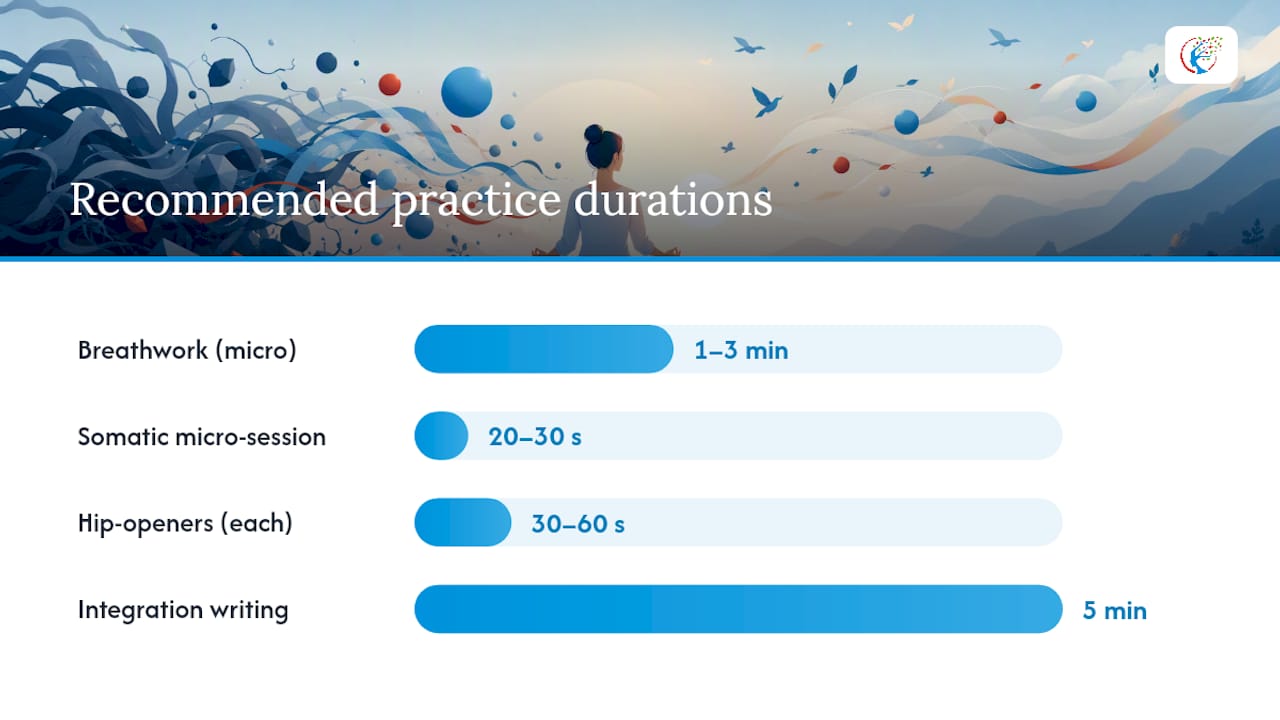
Breathwork micro-protocol (1 to 3 minutes): inhale for four counts, hold for two, exhale for six. Repeat for up to twelve breaths, stopping earlier if lightheadedness appears.
Somatic experiencing micro-session: bring attention to a body location, notice the sensation for 20 to 30 seconds, then deliberately shift attention to something neutral (your feet, a wall colour) before returning if it feels safe to.
Guided body scan: move attention slowly from feet to head, pausing wherever tension shows up, without trying to fix it, just noting it.
Three safe hip-openers: a supported figure-four stretch, gentle seated butterfly, or a slow standing hip circle, each held for 30 to 60 seconds with normal breathing throughout. Movement-based practice like this can help signal safety to the nervous system, which is often what allows stored activation to finally complete.
EFT tapping quick routine: tap the side of the hand, eyebrow, side of eye, under eye, and collarbone points, five to seven taps each, while naming the feeling aloud (“even though I feel this tightness, I’m allowing it to be here”).
Stage three: integrate. This is where a lot of self-guided work quietly stops, and where the actual change gets locked in.
Write for five minutes on: “What did that sensation want me to know?”
Name one small, realistic action connected to what surfaced (a conversation to have, a boundary to set).
Schedule that action within 48 hours, while the insight is still fresh.
Pro Tip: Never do stage two for longer than feels manageable. Ninety seconds of genuine contact beats twenty minutes of forcing it, and stopping early is a skill, not a failure.
A note on hypnotherapy: guided regression work, the kind offered through QHHT and regression hypnotherapy, can access subconscious material that self-guided journaling rarely reaches, but its intensity means it works best with a trained practitioner rather than as a solo experiment. If a pattern has resisted months of consistent self-practice, that’s usually the signal to bring in guided support rather than pushing harder alone.
How long does it take to release an emotional block?
Some shifts happen in minutes: a tight chest that finally loosens during a single breathwork session, a wave of tears that leaves you calmer afterwards. Deeper patterns, the ones built over years, tend to take weeks or months of repeated, gentle contact.
Expect the same feeling to resurface days or weeks later, sometimes at lower intensity, sometimes seemingly out of nowhere.
That return usually means integration is still happening, not that the earlier work failed.
Track one simple signal daily, such as jaw tension on waking or chest tightness before a difficult call, rather than trying to monitor everything at once.
Progress in this kind of work rarely moves in a straight line. Think spiral, not staircase.
When should you seek professional help instead of self-practice?
Self-guided practice has real limits, and knowing where they sit matters more than any single technique.
Suicidal thoughts or self-harm urges: stop self-practice and contact a crisis service immediately, such as Samaritans or NHS urgent mental health support.
Severe flashbacks or dissociation that won’t interrupt: this needs a trauma-informed therapist, not a home routine.
No improvement after weeks of consistent practice: a stuck pattern that isn’t shifting is a reasonable prompt to bring in guided support.
When choosing a therapist, ask directly about their experience with somatic methods, their safeguarding practices, and how they handle a client becoming overwhelmed mid-session. A somatic and trauma-informed approach to coping works best when the practitioner can slow things down, not just talk through them.
How does Paul Stebles approach emotional block release?
Paul Stebles works with clients across Orpington, Bromley, and the wider South East London area using two complementary methods: Quantum Healing Hypnosis Technique (QHHT), a form of regression hypnotherapy that accesses the subconscious mind, and energy healing drawing on Reiki, chakra balancing, and cord-cutting practices.
QHHT suits readers whose self-practice has plateaued and who want to explore the roots of a stuck pattern directly with a trained practitioner.
Energy healing works well as an adjunct alongside somatic self-practice, particularly for people who feel physically braced rather than emotionally overwhelmed.
Sessions are available in person or remotely, and typically involve a preparation conversation beforehand and a settling, integration-focused close afterwards.
Deeper subconscious work isn’t a replacement for daily regulation practice. It’s what you reach for when the pattern keeps returning despite doing everything right on your own.
Full detail on session structure and screening sits on the QHHT and regression hypnotherapy page.
A steady, compassionate approach beats a dramatic one

The single biggest mistake I see in this space is treating release as a performance, something you should feel happening, ideally with tears, ideally today. It rarely works that way. The people who make genuine progress tend to do less, more consistently, and forgive themselves for the days it doesn’t move at all.
Pair small daily practice with proper professional support when a pattern has real depth to it. Pick the technique you’ll actually do at 11pm on a bad day, not the one that sounds most impressive.
Booking a session with Paul Stebles when you need guided support
Paul Stebles offers three routes depending on where you are in this process: QHHT for deep subconscious exploration when self-practice has stalled, energy healing as gentler adjunct support alongside your own regulation work, and a structured online course for readers who want to work through anxiety and depression at their own pace.

A QHHT session typically runs several hours, in person or remotely, and includes a preparation conversation to talk through what you’d like to explore, followed by the guided regression itself and a settling period afterwards to integrate whatever surfaced. Energy healing sessions are shorter and more physically focused, useful if what you’re carrying feels stored in the body rather than tied to a specific memory. Every client goes through a screening conversation first, so the approach fits your situation rather than the other way round.
If a pattern in your life has resisted weeks of consistent self-practice, or you simply want experienced support exploring what’s underneath it, you can book a QHHT session directly and take the next concrete step.
Frequently asked questions
Can you actually release emotional blocks on your own, without therapy? Often, yes, particularly for milder patterns. Breathwork, body scans, and journaling can create real shifts, but deeper trauma-related patterns usually respond better with professional, trauma-informed guidance.
Why do released emotions sometimes come back? A returning feeling usually means your nervous system is processing in layers, not that the earlier work didn’t count. Waves of re-emergence are a normal part of integration.
Are trapped emotions a real medical diagnosis? No. It’s a useful working concept in somatic and body-first practice, but it isn’t a formal clinical diagnosis, even though many people report genuine symptom relief from related therapies.
How is an emotional block different from a diagnosed mental health condition? An emotional block describes a specific stuck pattern tied to a particular feeling or memory. Conditions like depression or PTSD involve broader, clinically defined symptom patterns and usually need formal diagnosis and treatment alongside any self-practice.
What is QHHT and how does it relate to releasing emotional blocks? QHHT is a regression hypnotherapy technique that accesses subconscious material, sometimes underlying long-standing emotional patterns. It’s best used with a trained practitioner given the intensity involved. Details sit on the QHHT service page.
This article is general information, not a substitute for advice from a qualified doctor. Consult a qualified healthcare professional about your own circumstances before acting on anything here.
Sources
Recommended
Comments