Is your sacral chakra blocked? Here's how to tell and what to do

If you feel emotionally flat, creatively stuck, or oddly disconnected from pleasure and intimacy, alongside tight hips or a heavy lower back, your sacral chakra is probably running low. This energy centre governs how freely you feel, create, and connect, and when it stalls, life tends to feel muted rather than dramatic. The good news: you can start shifting it in the next two minutes.
Sit with both feet flat on the floor. Breathe in for four counts, out for six, and on each exhale let your hips sway gently side to side, like you’re loosening a stiff hinge. Do this for one minute before reading on.
Emotional numbness or difficulty accessing pleasure — a common marker cited across sacral chakra research
Creative shutdown — ideas feel forced or absent entirely
Physical tightness in the hips, lower back, or pelvis
Yoga Journal locates this centre in the lower abdomen, tied to the water element, which explains why blockage so often shows up as physical rigidity rather than pure emotion. Practitioners like Paul Stebles, who works with energy healing and nervous-system integration, see this pattern regularly in clients who’ve spent years managing feelings by suppressing them.
Key Takeaways
A blocked sacral chakra combines emotional numbness, creative shutdown, and physical pelvic or hip tension, and it responds best to sequenced somatic practice rather than a single fix.
Point | Details |
Spot the pattern | Look for emotional numbness, creative shutdown, and hip or pelvic tightness together, not in isolation. |
Trace the root | Suppressed childhood emotion, trauma, and chronic stress are the most common causes of sacral blockage. |
Sequence your practice | Ground first, then move through hip openers, breath, and creative expression, never in reverse. |
Watch the direction | Steady creative flow signals healthy opening; impulsivity or volatility signals overactivity needing calming. |
Get guided support | Paulstebles offers QHHT and energy healing sessions for readers wanting supervised nervous-system and sacral integration. |
Table of Contents
Blocked sacral chakra symptoms: what to look for
The sacral chakra, or Svadhisthana in the yogic tradition, sits roughly two inches below your navel. It governs creativity, sensuality, and emotional fluidity, and when it’s blocked, the fallout rarely stays in one lane. It bleeds into your mood, your relationships, and often your body.
Emotional signs tend to surface first. You might notice a persistent numbness, as though feelings arrive muffled rather than sharp. Healthline lists detachment, low libido, and a lack of creative inspiration among the clearest markers. Shame around desire, whether sexual or simply the desire to want things, is another common thread. Creativity dries up too. Someone who used to paint, write, or cook experimentally suddenly finds every idea feels flat or pointless.
Behavioural patterns often follow. Some people withdraw from intimacy altogether, avoiding closeness because it feels unsafe or exhausting. Others swing the opposite way, chasing compulsive stimulation (excessive scrolling, overeating, impulsive spending) to fill a void they can’t name. Creative avoidance shows up as procrastination dressed up as “I’m just not inspired right now.”
Physical symptoms are where this stops being abstract. Chronic tightness in the hips and lower back is one of the most consistently reported physical correlates. Menstrual irregularities, reproductive discomfort, and pelvic tension appear frequently in both Healthline’s and Yoga Journal’s descriptions of imbalance. Some people also notice digestive sensitivity or bladder issues that flare during emotionally difficult periods.
Consider a woman who’s spent a decade in a high-pressure job, rarely taking creative risks, rarely dating, and waking most mornings with hip stiffness she assumes is just posture. That combination, flat emotion, physical rigidity, and creative drought, is a textbook sacral pattern. If pelvic or reproductive symptoms are persistent or severe, see a doctor first. Energy work supports wellbeing; it doesn’t replace medical care.
What causes a sacral chakra imbalance?
Blockage rarely appears overnight. It usually builds from years of learned suppression, and understanding the pattern matters more than fighting the symptom.
Childhood environments that discouraged emotional expression, “stop crying,” “don’t make a scene,” “that’s inappropriate”, teach the body to clamp down on feeling before it even fully forms. Sexual or relational trauma is another major route, often lodging directly in the pelvis as physical holding rather than conscious memory. Chronic stress plays a role too: prolonged nervous-system dysregulation keeps the body braced, which leaves little room for the ease that sacral energy needs to flow.
Learned shame about pleasure or desire
Unprocessed trauma held physically in the hips and pelvis
Long-term stress with no outlet for release
Beliefs that creativity or bodily needs are indulgent or unsafe
Britt Chemla Jones frames this well: blockage often starts as an early-life interruption to emotional flow, not a single dramatic event. That reframing matters because it stops people blaming themselves for feeling stuck.
Pro Tip: If you suspect trauma is part of your pattern, pair self-practice with a trauma-aware practitioner rather than pushing through alone. Sacral work can surface strong emotion fast, and having support changes the outcome.
How to unblock your sacral chakra safely
Unblocking sacral energy works best as a sequence, not a single fix. Jumping straight into intense hip-opening yoga without nervous-system prep can flood you with more emotion than you’re ready to process. Build it in stages.
Ground first. Spend two to three minutes on slow breathing (four counts in, six counts out) with your feet firmly planted. This settles your nervous system before you ask your body to release anything.
Move through gentle hip openers. Pelvic tilts, bound angle pose, child’s pose variations, and happy baby pose are all accessible starting points, and Yoga Journal lists these among the most reliable for sacral release. Hold each for several breaths rather than forcing depth.
Add breath and sound. Some practitioners use the seed sound “VAM” during exhalation as a focal point. It’s optional, not essential, but it gives the mind something to anchor to while the body opens.
Free-move or dance. Once you’re warm, put on music and let your hips move however they want for three to five minutes. No choreography, no mirror.
Journal without editing. Write for five minutes on “what do I actually want right now?” without censoring the answer.
Beyond the sequence itself, a few supportive rituals help consolidate the shift:
A warm bath with a few drops of orange or sandalwood essential oil
Visualising warm orange light pooling in your lower abdomen
Holding a carnelian or orange calcite crystal during meditation, useful as a focus object rather than a cure
Practising small, guilt-free pleasures daily, a good meal, unhurried time outdoors, saying no without over-explaining
Thalira Wisdom’s breakdown of chakra balancing techniques makes an important distinction here: blocked chakras generally need gentle stimulation, while overactive ones need calming. Applying the wrong approach can leave you feeling worse, not better.
Pro Tip: If a practice brings up tears, anger, or sudden fatigue, that’s not a sign you did it wrong. Slow down, breathe, and let the feeling move rather than pushing through the rest of the routine. If emotion feels overwhelming or unmanageable, that’s your cue to pause and bring in professional support.
Why somatic practices work better than thinking your way through it
Trying to reason your way out of a blocked chakra rarely works, because the blockage lives in the body, not the intellect, highlighting the importance of understanding the mind body spirit connection. A PubMed-indexed review connects yoga, breathwork, and other mind-body practices to measurable shifts in autonomic and emotional regulation. The effects are correlational and depend on consistent practice, but the mechanism makes sense: movement and sensation reset the nervous system in ways that thinking alone doesn’t reach.
The logic is bottom-up rather than top-down. Practitioners often describe this as shifting from a defensive, sympathetic-nervous-system state into a calmer, more socially engaged one, sometimes called a ventral-vagal state, where emotional openness feels safe again rather than threatening.
Sacral work isn’t about forcing a release. It’s about creating enough safety in the body that feeling can move on its own, the way it was always meant to.
In practice, this means:
Ten to fifteen minutes of somatic practice most days beats one long session once a week
Give yourself five to ten minutes after any releasing practice to simply rest before returning to normal activity
Titrate slowly. If a movement or breath practice stirs too much too fast, dial back the intensity rather than pushing through
Sessions structured around gradual titration, rather than dramatic breakthroughs, tend to integrate more sustainably over weeks.
Sacral chakra opening vs overactive: how to tell the difference
Progress doesn’t always feel calm. Sometimes it feels like more, not less, which can be confusing if you’re expecting a steady climb towards peace.
Signs of healthy opening include a steadier creative flow, more comfort with intimacy, and pleasure that feels natural rather than guilty or forced. You might find yourself saying yes to things you’d have avoided a month earlier.
Signs of overactivity look different: impulsivity, a growing reliance on sensation or stimulation to feel okay, and emotional swings that feel disproportionate to the trigger. If this happens, ease off stimulating practices and lean into grounding ones instead, slower breath, longer holds, more stillness.
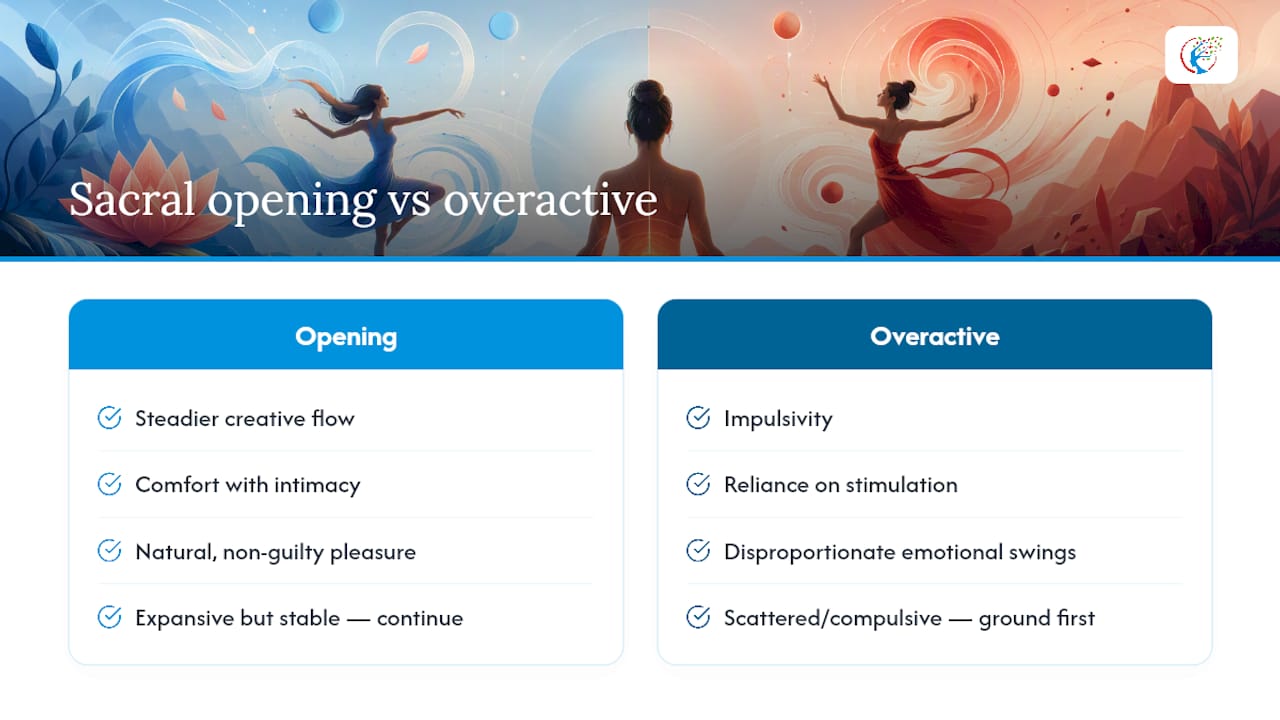
Quick guide: if you feel expansive but stable, keep going. If you feel scattered or compulsive, ground first and revisit sacral work later.
Dietary or lifestyle factors that can influence sacral chakra health
What you eat and how you live day to day shapes how freely sacral energy moves, mostly through its effect on your nervous system and hormones. Hydration matters more than people expect, given the sacral chakra’s association with the water element; chronic dehydration correlates with the same stiffness and sluggishness that blockage produces physically.
Orange foods, sweet potatoes, carrots, oranges, mangoes, are traditionally associated with this centre, less for any proven biochemical effect and more as a symbolic anchor that keeps the practice front of mind. What matters more concretely is reducing habits that numb sensation: excessive alcohol, compulsive screen use, or skipping meals under stress all dull the very sensitivity this work tries to restore.
Movement matters just as much as diet. Sedentary days compound pelvic tightness, while regular walking, swimming, or dancing keeps the hips and lower back mobile. Sleep quality also plays a quieter role: a dysregulated nervous system from poor sleep makes emotional flow harder regardless of how much yoga you do. None of these factors work in isolation. A single hip-opening class won’t undo months of dehydration, stress, and stillness, but small, consistent shifts across all three tend to compound.

Building sacral chakra healing into your daily routine
Sustainable change comes from small, repeatable habits rather than occasional intense sessions. Morning is often the easiest place to start: two minutes of grounding breath before checking your phone sets a different tone for the whole day.
Midday, a short movement break, even thirty seconds of hip circles at your desk, interrupts the physical bracing that builds up during long stretches of sitting. Evening works well for reflection: a few lines in a journal about what felt good today, however small, trains your attention back towards pleasure rather than deficit.
Weekly, set aside twenty minutes for a fuller practice, the movement sequence, a warm bath, or simply dancing to music you love without an audience. Consistency matters more than duration. Ten minutes daily reliably outperforms one long weekend session, because the nervous system responds to repetition, not intensity. For readers who want more structured guidance alongside self-practice, the Paulstebles blog covers nervous-system reset and embodied healing in more depth.
Practitioner perspective: realistic timelines and integration
Clients often ask how long sacral healing takes, and honestly, it varies. Some notice shifts within a few weeks; others move through plateaus for months before something releases. Self-practice paired with a trauma-aware practitioner tends to move faster and more safely than either alone. Consent, pacing, and proper aftercare aren’t optional extras. They’re what makes the process durable rather than just intense.
— Paul
Guided support for deeper sacral and emotional healing
Self-practice takes you a long way, but some blockages, especially trauma-rooted ones, respond better with guided support. Paulstebles offers a route self-practice alone can’t: direct access to the subconscious through Quantum Healing Hypnosis Technique, paired with energy healing that works the nervous system and the sacral centre together in one session.

Sessions with Paul combine Reiki, chakra balancing, and cord-cutting work aimed at emotional release rather than symptom management. Most clients come in carrying long-held pelvic tension, creative shutdown, or relationship patterns they can’t quite name, and leave with a felt sense of what emotional flow actually feels like, often after a single guided session. Aftercare is built into the process, not an afterthought, so integration happens gradually rather than all at once.
If you recognise the patterns in this article, book a QHHT session or read the QHHT FAQ to see whether guided sacral and nervous-system work fits where you are right now.
Sources
Recommended
Comments