Break Self Sabotage With a UK Practitioner's 5 Hour QHHT Method


QHHT combined with energy healing is a genuine option for resolving self-sabotage if the cause sits deeper than habit or willpower. The method works by guiding you into a trance state to surface the subconscious belief driving the pattern, then clearing the energetic charge attached to it through Reiki, chakra work, or cord cutting. This combined approach is offered in person and remotely, with booking details available on the corresponding website.
TL;DR:
QHHT uncovers subconscious triggers for self-sabotage through deep regression, often revealing past-life or subconscious origins of patterns.
Energy healing techniques like Reiki, chakra work, and cord cutting target energetic residues left by patterns, especially in safety and confidence chakras.
Sessions last around five hours and include an intake, trance induction, regression, energy clearing, and a debrief, with recordings provided for integration.
This method suits those open to spiritual frameworks, who want insight and energetic shifts, and have already tried other self-help or therapy methods.
QHHT is not suitable for severe mental health crises or active trauma, and its insights depend on client receptivity and follow-through.
Table of Contents
What is self sabotage healing through QHHT?
The Quantum Healing Hypnosis Technique guides you into a somnambulistic trance, a deep theta brainwave state where the conscious mind steps back and the subconscious becomes accessible. This is where QHHT accesses subconscious and higher self material that ordinary waking awareness cannot reach, including the origin of repeated self-defeating behaviour.
Self-sabotage often behaves less like a bad habit and more like a loop: you set a goal, get close, then quietly undermine it. QHHT works on the theory that this loop was written somewhere, often in a past experience or a past-life impression, and the subconscious keeps replaying it because nobody has told it the danger has passed. During regression, you or your higher self may name the moment the pattern started and why it once made sense.
Energy healing complements this by working on the body’s felt experience of the pattern rather than only its story. Reiki, chakra balancing, and timeline or belief work aim to shift what practitioners describe as stagnant energy tied to root and solar-plexus imbalance, the areas most linked to safety and confidence.
The proposed mechanism, then, has two parts: uncovering the subconscious trigger through regression and higher-self dialogue, then releasing its energetic residue through hands-on or intention-based healing. Outcomes vary. Some clients report a single decisive insight; others need the pattern named more than once before it loosens its grip.
Who does this approach suit, and who should look elsewhere first?
This method tends to suit people who already sit comfortably with spiritual or subconscious frameworks. If you have tried journalling, therapy, or self-help books and still feel stuck at the same wall, and you are curious rather than sceptical about past-life or higher-self work, you are the right fit.
Before booking, ask yourself three things: are you open to a spiritual framing of your pattern rather than a purely clinical one? Can you sit with strong emotion while in a trance without needing to control it? Are you looking for insight and energetic shift rather than a step-by-step behavioural plan?
QHHT is not appropriate as a first response to active psychosis, severe untreated trauma, or an acute mental health crisis. Anyone in that position needs conventional medical or psychiatric support first, alongside or instead of energy work. Where talk therapy analyses behaviour, this approach looks for the belief underneath it, which is why some clients choose it after therapy has explained the pattern but not shifted it.
What actually happens in a session
A full QHHT and energy-healing session is a long appointment, not a quick consultation. Expect sessions to run around five hours once you include the interview, the trance work, and the debrief afterwards.
The structure generally runs like this:
An extended intake interview, where you and the practitioner map your self-sabotage pattern and prepare questions for your higher self.
Induction into a deep trance state, moving gradually from relaxation into the somnambulistic level needed for regression.
The regression itself, exploring a past life or subconscious scene connected to the pattern, followed by dialogue with the higher self for direct answers.
An energetic body scan and healing phase, addressing whatever blockages surfaced during the regression.
A gentle return to waking awareness and a debrief, where you talk through what came up while it is still fresh.
Sessions can run in person or remotely, and most practitioners record the audio and provide written notes afterwards so you are not relying on memory alone. Physical responses during trance vary: some people feel warmth or tingling during energy work, others cry during an emotional release, and a few feel very little in the moment but notice shifts over the following days.
Pro Tip: Listen to your session recording once straight after, then again about a week later. Insights that felt abstract in the room often click into place once you have had time to live alongside them.
The energy techniques behind the healing
Regression uncovers the story. Energy work addresses what that story left behind in the body, and several specific techniques tend to appear across a self-sabotage focused session.
Reiki and energetic clearing: hands-on or intention-directed energy aimed at releasing stuck energy, particularly where a pattern has left you feeling physically or emotionally frozen.
Solar plexus and root chakra focus: targeted attention on the centres linked to confidence and safety, since self-sabotage is often framed as an energetic pattern tied to specific chakras rather than a purely psychological habit.
Timeline and belief transformation: reframing the subconscious script uncovered during regression, replacing an outdated survival belief with one that fits your present life.
Cord cutting and ancestral framing: severing energetic attachments to old relationships or inherited family patterns, useful where a self-sabotage habit seems to echo something older than your own experience. Read more on ancestral trauma healing if this resonates.
None of these techniques work in isolation from the regression. The insight from trance gives the energy work something specific to target, rather than a generic clearing session.
Preparing for a session and integrating the healing afterwards
Preparation shapes how much you get from the session. Turn up rested, having eaten a light meal beforehand, and wear something comfortable you can relax in for several hours. Write down two or three genuine questions for your higher self in advance; vague questions tend to produce vague answers.
Immediate aftercare matters just as much as the session itself. Try this sequence over the following days:
Rest and hydrate on the day itself. Trance work is tiring even when nothing dramatic happened on the surface.
Listen back to your recording within 48 hours and journal whatever surfaces, even if it feels disconnected from the original question.
Build a short daily energy reset, five to ten minutes of grounding or breathwork, to keep the shift from fading back into old patterns.
Book a follow-up if a difficult memory surfaced that needs more unpacking, or if the original pattern reappears within a few weeks.
Pro Tip: If a session brings up material that feels bigger than expected, a brief grounding practice like slow diaphragmatic breathing can settle the nervous system faster than trying to think your way through it; structured daily emotional regulation exercises are worth building into your week regardless of when your next session falls.
Contact your practitioner directly if integration brings up material you cannot process alone, rather than waiting for your next scheduled session.
Why do people self-sabotage in the first place?
Self-sabotage rarely announces itself as sabotage. It shows up as procrastinating on the one task that would move you forward, picking a fight right before something good happens, or quietly avoiding the opportunity you said you wanted. Underneath, most patterns trace back to one of a handful of roots: a fear of failure so strong that not trying feels safer than trying and losing, a fear of success that threatens an old identity, or a deep-seated belief that you do not deserve the outcome you are chasing.
Conventional psychology usually locates these roots in childhood conditioning, attachment wounds, or learned survival strategies that once protected you and now get in the way. The subconscious and energetic view does not reject that explanation so much as extend it, treating the belief as something stored energetically as well as psychologically, sometimes reaching back further than childhood into inherited or past-life material.
What both views agree on is that self-sabotage is protective at its core. The pattern exists because, at some point, it kept you safe from disappointment, judgement, or exposure. That is precisely why willpower alone rarely dissolves it: you cannot argue a protective mechanism out of existence, you have to show it that the threat it is guarding against no longer applies. Whether you arrive at that recognition through therapy, through regression, or through both, the goal is the same.
How does this compare with other ways to heal self sabotage?
Cognitive and behavioural approaches treat self-sabotage as a set of learned thoughts and actions to identify and retrain, usually through structured weekly sessions and homework between them. That model works well for people who want a logical framework and steady, incremental progress they can track.
QHHT with energy healing takes a different route to a similar destination. Rather than gradually retraining thought patterns, it aims to locate the original moment the pattern formed in a single extended session, then clear its emotional and energetic charge directly. Where coaching or behavioural work asks “what do I do instead?”, this approach asks “why did this start, and is it still needed?”
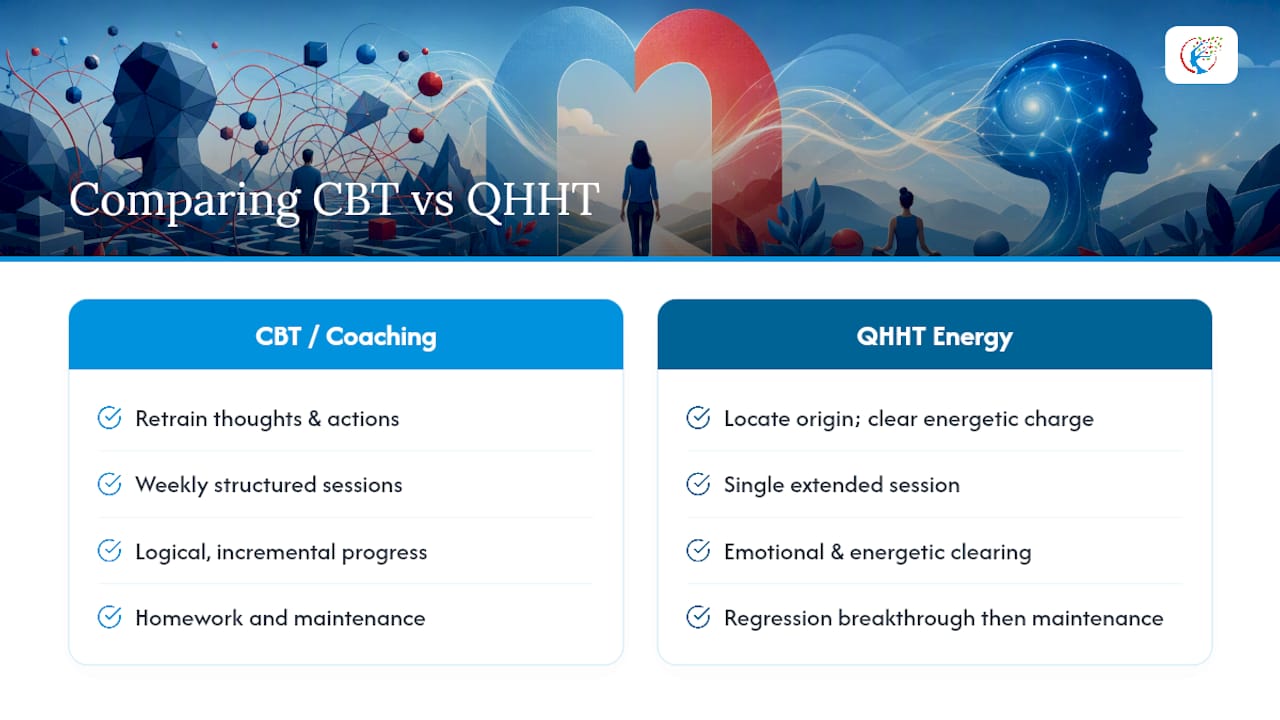
Neither approach is inherently superior. Someone who processes experience intellectually and wants measurable weekly progress may get more from a structured programme. Someone who has already tried that route, understands their pattern conceptually but still cannot shift it, or who simply resonates more with spiritual and energetic explanations, often finds QHHT reaches something talk-based work could not touch. Many people combine both across different stages of their healing, using regression for the breakthrough and behavioural tools for the daily maintenance afterwards.
Where QHHT falls short and what it cannot promise
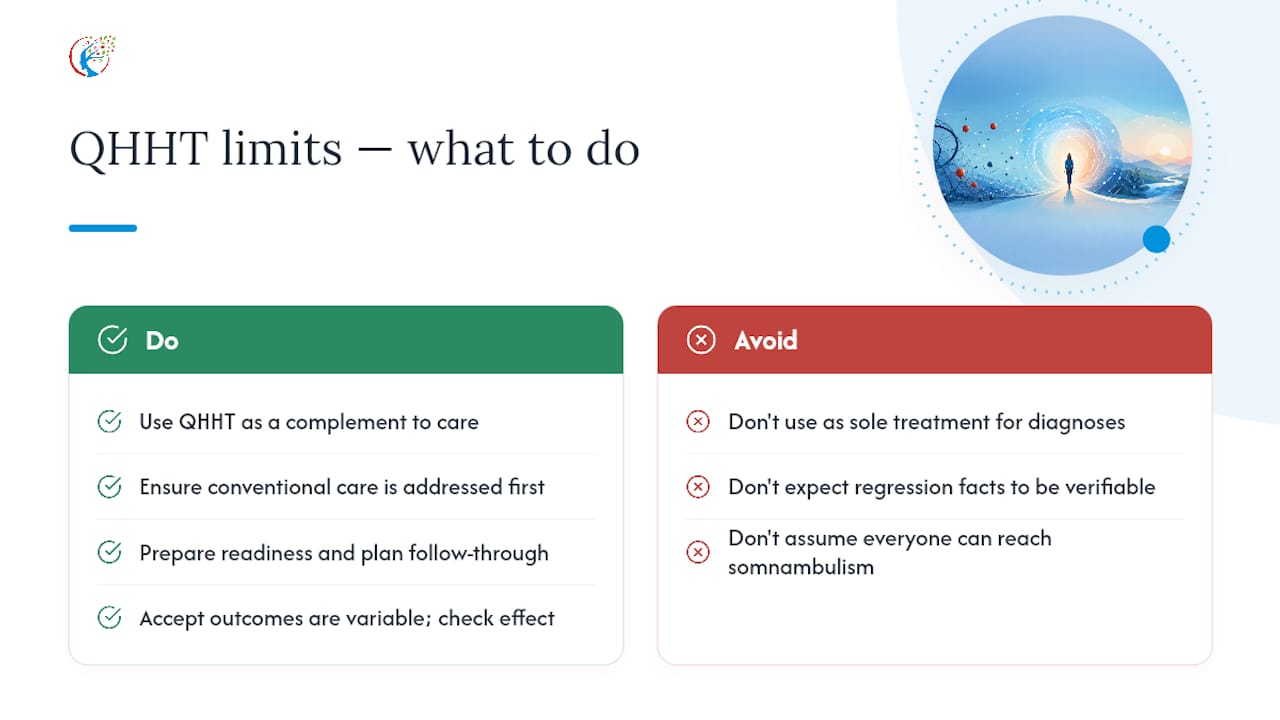
QHHT has real limits worth naming honestly. It relies heavily on your capacity to enter a deep trance state; a small minority of people do not reach the somnambulistic level needed for the clearest regression work, even with an experienced practitioner guiding them.
The regression material itself, whether it surfaces as a past life or a subconscious memory, cannot be independently verified. What matters clinically is not historical accuracy but whether the insight produces a genuine shift in the pattern, and that shift is reported as variable rather than guaranteed, depending heavily on the client’s readiness and follow-through afterwards.
It is also not a substitute for treating diagnosed mental health conditions. A single long session, however powerful in the room, is not equivalent to sustained clinical care for depression, anxiety disorders, or trauma that requires structured, ongoing treatment. The honest framing is that QHHT and energy healing work best as a complement to, or a next step after, addressing anything that needs conventional care first, not as a replacement for it.
An author’s perspective on what actually shifts
In my sessions, the clients who see the most lasting change are rarely the ones looking for a single dramatic past-life reveal. They are the ones willing to sit with an uncomfortable belief once it surfaces and let the energy work settle it rather than rushing back to normal life. QHHT paired with Reiki and chakra-focused clearing tends to produce a calmer, steadier shift than either practice alone, which is why I combine them as standard rather than offering them separately.
Clients most often report relief that arrives gradually over the days following a session, not always in the room itself, alongside a noticeably different relationship with the original trigger. If solar plexus confidence or ancestral patterns feature in your story, the solar plexus healing work often explains why certain sessions land harder than others.
— Paul
Ready to book a QHHT and energy healing session?
If reading this stirred up recognition rather than scepticism, that is usually a sign the approach is worth trying. QHHT sessions are offered that combine regression to find where the pattern started with Reiki, chakra work, or cord cutting to clear what it left behind, available in person or remotely.

A first appointment starts with a conversation about what you are hoping to shift, followed by the full session structure covered earlier: interview, trance, regression, energy work, and debrief. You will leave with an audio recording and written notes, plus guidance on integration so the insight does not fade within a week. Many clients describe the calm, unhurried pace of the sessions as much as the content that surfaced during them.
If you have questions before committing, the QHHT FAQ covers the practical details most people ask about first. When you are ready, you can book a QHHT session directly and choose a date that gives you enough time afterwards to properly integrate what comes up.
Sources
Recommended
Comments