Shadow work for beginners: a practical starting guide

Updated: Sep 10

Shadow work is the practice of noticing and working with the parts of yourself you’ve pushed out of sight, the traits, urges, and reactions you learned to disown because they weren’t safe or acceptable to show. The single best move for beginners isn’t a meditation or a ritual. It’s starting a two-week reaction log, a plain written record of moments when you overreact, freeze, or feel a jolt of shame or anger that seems bigger than the situation warrants.
That’s it. No candles required.
Before you start, one caveat matters more than any exercise: if you’re carrying significant trauma, or dealing with severe depression, anxiety, or suicidal thoughts, shadow work isn’t the place to begin alone.
Start a reaction log: one line, facts only, whenever you notice a disproportionate reaction.
Keep sessions short and bounded, don’t let this turn into hours of rumination.
If trauma or severe symptoms are present, work with a licensed therapist alongside or instead of self-guided practice.
Table of Contents
What is shadow work and where does the idea come from?
The term comes from Carl Jung, the Swiss psychiatrist who described the “shadow” as the part of the personality made up of traits, impulses, and memories the conscious mind rejects. Jung believed everyone has one. It’s not evidence of being broken, it’s a normal by-product of growing up inside a family and a culture that only had room for certain versions of you.
Here’s how it typically forms. As children, we learn fast which emotions and behaviours get approval and which get punished, ignored, or mocked. Anger might have been unwelcome in your house, so you buried it. Ambition might have been called selfish, so you learned to shrink it. Neediness might have got you laughed at, so you taught yourself never to ask. Those exiled pieces don’t disappear, according to Cleveland Clinic, which describes shadow work as a self-exploration process rooted in Jungian depth psychology aimed at uncovering these repressed or disowned aspects of personality. They sit underground, and they leak out sideways, usually as projection: getting irrationally irritated by a trait in someone else that you can’t stand in yourself.
Integration, the actual goal of shadow work, means bringing those traits into conscious awareness so they stop running the show from the basement. Done well, it reduces projection and reclaims energy that’s currently spent suppressing things, energy you can redirect into something useful. It isn’t about becoming a “shadow-free” person. It’s about knowing your own machinery well enough that it stops surprising you.
What can you realistically expect from shadow work?
People who stick with shadow work commonly report sharper self-awareness, calmer reactions to conflict, and relationships that feel less loaded with old resentments. WebMD notes it can help you explore the unconscious reasons behind strong reactions, though the evidence backing these outcomes comes mostly from clinical observation and practitioner experience rather than controlled trials.
That distinction matters for how you approach it. Shadow work isn’t a clinical treatment, and it won’t fix a diagnosable condition on its own.
Commonly reported: better self-awareness, less reactivity, improved relationships, more self-acceptance.
Genuine limits: not a substitute for therapy, evidence is largely observational, results vary person to person.
Temporary cost: many people feel worse before they feel better, old material surfacing can be uncomfortable.
Reality check: early sessions often stir up more discomfort, not less. That’s expected, not a sign you’re doing it wrong.
Curiosity beats judgement every time here. If you approach your own reactions like a detective gathering clues rather than a judge handing down a verdict, you’ll get further with less collateral damage to your self-esteem.
How do you start shadow work as a beginner: the first fortnight plan
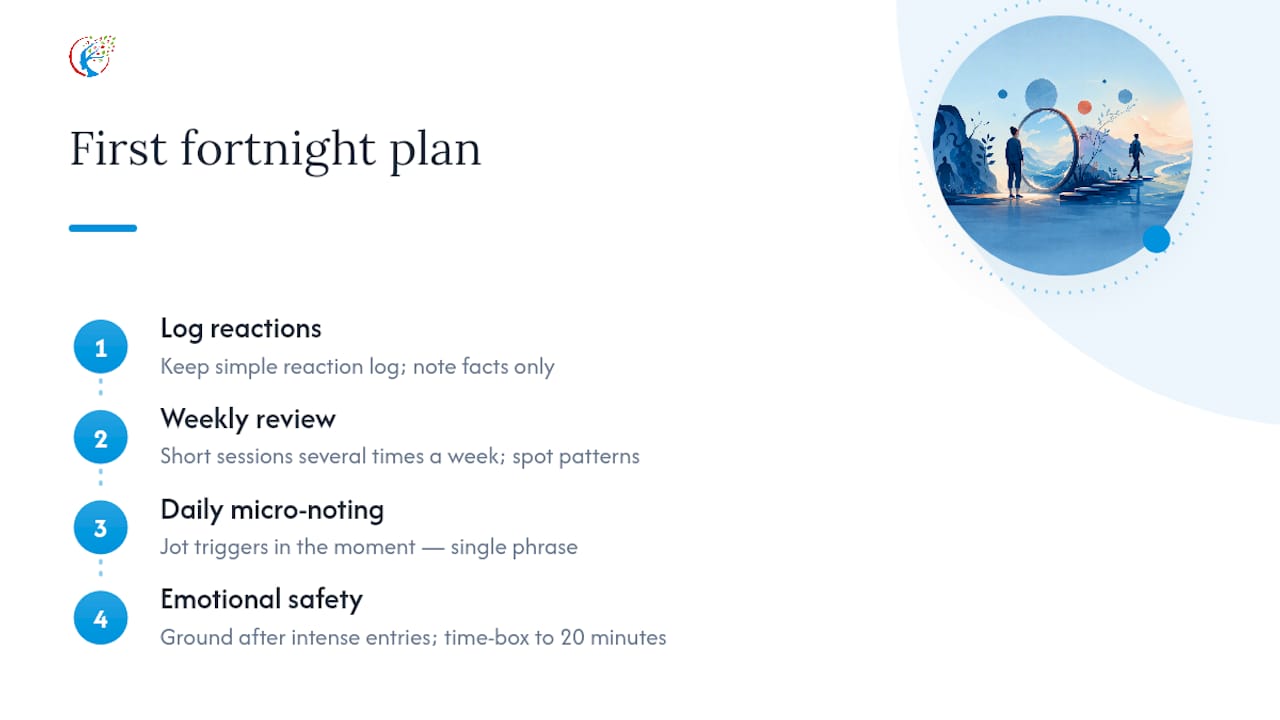
Start by keeping a simple reaction log over a period of time with nothing more elaborate than a notebook or notes app. Every time you notice a reaction that feels bigger than the trigger deserves, jot the facts: what happened, what you felt in your body, what you said or wanted to say. No analysis yet, just the raw data. 2. Have several short sessions each week sitting with your log entries and looking for repeats. Same person setting you off? Same phrase landing like an insult? Patterns are the whole point. 3. Daily micro-noting. Beyond the formal sessions, jot triggers in the moment. A single phrase is enough. This is where most of your raw material comes from. 4. Ground yourself after intense entries. A short walk, a few minutes of slow breathing, or ten minutes outside resets your nervous system faster than trying to think your way calm. Guided meditations can help if sitting still feels hard at first. 5. Pause and reassess weekly. If the log is generating insight, continue. If it’s generating dread or panic, stop and consider professional support before pushing on.
Keep entries factual rather than self-critical. “Snapped at my partner over a comment about being late, felt heat in my chest, wanted to walk out” gives you something to work with. “I’m a terrible partner” gives you nothing but shame.
Pro Tip: Write your log entries in the past tense and third person, “she felt a flash of rage when he interrupted,” rather than “I felt a flash of rage.” That small shift creates enough distance to observe the reaction instead of being swallowed by it.
Watch for warning signs that mean pause: entries that spiral into self-attack, sleep disruption, or a sense of being overwhelmed rather than curious. Time-boxing sessions to 20 minutes isn’t arbitrary, open-ended digging is exactly what tips reflection into rumination.
Beginner shadow work exercises and prompts you can try now
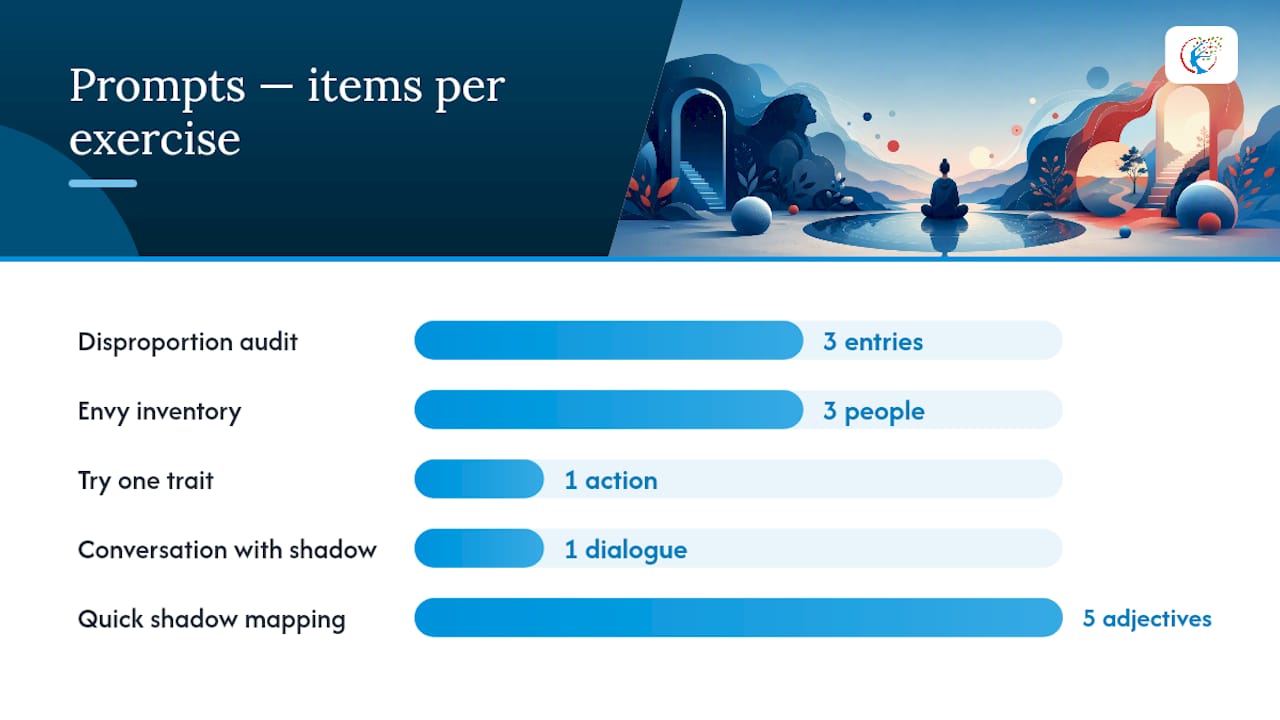
Once you’ve got a week or two of reaction log entries, these exercises turn raw notes into insight. Try them in this order.
The disproportion audit. Pick your three most intense log entries. For each, ask: does the size of my reaction match the size of the event? A mismatch usually points to an old wound getting triggered, not the present moment.
The envy inventory. List three people whose lives, traits, or success genuinely irritate you. Then ask, for each: what do they have permission to do that I don’t give myself permission to do? Envy is often shadow material wearing a disguise.
Pick one disowned trait you’ve identified, say, directness, or asking for help.
Predict what will happen if you express a tiny, safe dose of it this week.
Act on it once, in a low-stakes setting.
Record what actually happened against your prediction.
Conversation with the shadow. Write a short imagined dialogue between “you” and the trait you’re avoiding. Let it speak first. Most people are surprised by what it says when it’s finally allowed to talk.
Quick shadow mapping. List five adjectives you’d never want used to describe you. For each, write one sentence about a time you actually behaved that way. Uncomfortable, but clarifying.
Repeat these across a few weeks rather than all in one sitting, Verywell Mind points out that concrete, event-based prompts produce far more usable material than vague self-judgement ever does.
Turning shadow work insight into small, safe changes
Insight that never becomes behaviour is just an interesting diary entry.
Run tests small and specific. If your log revealed a pattern of over-apologising, don’t overhaul your personality this week, just try one conversation where you hold your ground without a reflexive “sorry”. Record what happened, adjust, repeat.
Try the eulogy exercise for traits you dislike in yourself. Write a short, generous tribute to the trait, as if it had done its job protecting you and was retiring. A tendency to control situations, reframed, might have kept you safe during genuinely chaotic years. Finding the function humanises the trait instead of just condemning it.
Run one small behavioural test per week, nothing bigger.
Reframe a disliked trait by asking what it was originally protecting you from.
Practise boundaries in low-stakes settings before high-stakes ones.
Check in with yourself after each experiment: did the outcome match the prediction?
None of this needs to be dramatic. Quiet, repeated, small adjustments outperform one big cathartic breakthrough that fades by the following week.
When to pause shadow work and get professional support
Shadow work can surface real intensity, and knowing your limits matters as much as knowing the exercises. Cleveland Clinic frames this as a legitimate self-exploration process, but one with genuine limits when deeper psychological material is involved.
Stop and consult a licensed therapist if you notice any of the following: flashbacks or trauma memories surfacing, thoughts of self-harm or suicide, depression or anxiety that feels unmanageable, or a general sense that you’re unravelling rather than integrating. None of that is a sign you’ve failed at shadow work. It’s a sign the material is bigger than a notebook and a fortnight can hold.
Between sessions, grounding matters. Breathing exercises, gentle movement, and time outdoors help settle an activated nervous system, and trauma-sensitive meditation techniques can offer a gentler entry point if stillness itself feels triggering.
Shadow work is meant to loosen old patterns gradually, not to force a confrontation with everything at once. If a session leaves you shaking, sleepless, or unable to function the next day, that’s the signal to slow down, not push harder.
A trained practitioner can hold space for material that’s too heavy to process solo, which is where guided regression and hypnotherapy sessions can support the same underlying goal with more structure and safety.
A practitioner’s note on going deeper safely
I work with clients using Quantum Healing Hypnosis and energy healing precisely because some subconscious material needs a guided, held space rather than a notebook at the kitchen table. Journalling and reaction logs get many people remarkably far. But when old patterns feel stuck or physically heavy, a structured session can access what solo reflection often can’t reach alone.
How Paul Stebles can support you if self-guided shadow work isn’t enough
It’s free, private, and you set the pace. But some material sits deeper than a notebook can reach, and that’s when a guided session earns its place.

A Quantum Healing Hypnosis session with Paulstebles works differently to solo journalling. Rather than piecing together fragments from a reaction log, you’re guided into a relaxed state where deeper subconscious material, old patterns, blocked emotions, unresolved themes, can surface directly, with someone experienced holding the space so it stays safe rather than overwhelming. Sessions are structured around your pace, with time built in for grounding and integration afterwards, not just the exploration itself.
If your reaction log keeps circling the same unresolved theme, or a solo session has left you shaken rather than settled, that’s usually the signal to book guided support rather than push further alone. Read the QHHT frequently asked questions to see exactly what a session involves, or go straight to booking your session if you’re ready to take that next step.
Consistent shadow work works because it pairs small, factual self-observation with bounded action, not endless analysis, and knows when to bring in guided support.
Point | Details |
Start with facts, not judgement | Keep a two-week reaction log noting only what happened and what you felt, no self-criticism. |
Bound your sessions | Limit reflection to 20 minutes, two to three times a week, to avoid tipping into rumination. |
Test insight in real life | Use the 5% experiment: predict, act in a small safe dose, record the actual outcome. |
Know the red flags | Trauma symptoms, suicidal thoughts, or unmanageable anxiety mean pause and see a licensed therapist. |
Guided support goes deeper | Paulstebles offers Quantum Healing Hypnosis for readers whose shadow material needs a held, structured space rather than solo journalling. |
Sources
Cleveland Clinic gives a clear clinical overview with sensible safety framing. Verywell Mind offers concrete prompts and journalling exercises. WebMD covers accessible steps alongside honest mental-health cautions.
Recommended
Comments