Soul Purpose Discovery: A Practical UK Guide


You discover your soul purpose less by finding a single answer and more by paying steady attention to what gives you life, trying small experiments, and letting a sense of direction build over time. Quiet reflection, honest journaling and, if you want deeper guidance, a session that reaches the subconscious mind can all help. This guide sets out how each works, what the research says about purpose and wellbeing, and how to turn insight into everyday choices.
TL;DR
Soul purpose is the deeper sense of why you are here. Life purpose is how it shows up now, in work, relationships and causes. The two are connected, and both can change.
Ten minutes a day of journaling, meditation or an evening review is enough to start noticing what energises you and what drains you.
Treat purpose as something you form through small steps, not a hidden answer you must find at once.
Research links a stronger sense of purpose with lower anxiety and depression, but it does not show that purpose can be “discovered” in a single moment.
If you want guided exploration, QHHT® with Paul Stebles starts at £369, and a shorter Evolve Quantum Healing session is £99.
Table of Contents
What soul purpose means, and how it differs from life purpose
Most people use the two phrases loosely, so it helps to separate them. Soul purpose is the spiritual idea that you came here for a reason that runs deeper than any job title. It is usually described in terms of growth, love, learning or expansion. Life purpose is the practical expression: the work you do, the people you look after, the causes you give time to, the skills you are drawn to use.
That difference matters because it takes pressure off. You do not have to name your soul’s reason for being before you can act. You can begin with the visible layer, noticing what you are drawn to now, and let the deeper layer reveal itself through that. Many people find that a role they once thought was their purpose fades, while the underlying thread (helping, creating, teaching, healing) stays.
It also helps to know that purpose, in the everyday psychological sense, is not fixed. Ross White, writing on Psyche, argues that purpose is something you form rather than find, growing from ideas and activities that already bring vitality, and needing cultivation. That is a gentle and encouraging way to look at it: the seeds are probably already in your life.

Why the search can feel so heavy
If you are searching for your soul purpose, you may already feel stuck, overwhelmed or flat. Some of that is the search itself. Todd Kashdan, a professor at George Mason University, says purpose can work like a compass you choose to follow rather than something that governs your behaviour, as reported by The Seattle Times. A compass points a direction. It does not demand that you arrive tomorrow.
Three patterns tend to make the search harder:
Waiting for certainty. You hold off acting until you feel sure, and the feeling never arrives.
Treating ordinary things as beneath you. Everyday tasks, caring and routine work are part of a purposeful life, not a distraction from it.
Carrying emotional weight. Old hurts, grief, anxiety or the habit of absorbing other people’s moods can drown out the quieter signals that point to what matters to you.
The third is one we see often. When someone feels energetically blocked, the first job is not to find purpose but to make enough calm for it to be heard. Our guide to emotional release techniques covers ways to start, and if your mind loops at night, the 90-second rumination reset is a simple place to begin.
Signs that something is meaningful to you
Purpose rarely announces itself. It tends to show up as a pattern of small signals. Here are the ones worth watching for, drawn from common reflective practice rather than from any single study:
Time disappears. You lose track of the hour when you are doing it, and feel better afterwards, not just distracted.
You keep returning. The subject, craft or kind of conversation keeps pulling you back, even when nobody asks you to.
Envy points the way. What you quietly envy in others often shows what you want more of.
Other people bring it to you. Friends or colleagues keep asking for your help with the same sort of thing.
You feel more like yourself. After the activity you feel steadier, not depleted.
Discomfort with a purpose. Something about your current life feels like a small, persistent mismatch.
Psychologists Burnett and Evans, quoted in The Guardian, name four components of meaning-making: wonder, flow, coherence and community. Use them as a checklist. Where in your week do you feel wonder? Where do you feel flow? Where does your life make sense to you, and where do you feel part of something with other people?
A simple daily practice to start with
You do not need a retreat. The University of Minnesota’s Taking Charge of Your Wellbeing programme suggests reflective practices such as journaling, meditation and guided imagery, and gives concrete ones. Each evening, spend five to ten minutes reviewing the day and asking which experiences were life-giving and which were life-draining. Sit for 10 to 20 minutes with no agenda, simply noticing what arises. Keep a journal where you can be honest about both lists.
Here is how that might look in a week:
Day | Practice | Time |
Monday | Evening review: one life-giving moment, one draining moment | 5 to 10 minutes |
Tuesday | Sit with no agenda, notice what comes up | 10 minutes |
Wednesday | Write about what you felt today and why | 10 minutes |
Thursday | Sit again, then jot down anything that surfaced | 10 to 15 minutes |
Friday | Evening review, then compare with Monday | 10 minutes |
Saturday | Read the week’s notes and underline repeating themes | 15 minutes |
Sunday | Choose one small experiment for next week | 10 minutes |
If you want prompts to get you started, these spiritual journaling prompts offer a seven-day structure you can adapt. If sitting still is hard because you feel scattered, a brief grounding meditation can help you settle before you write.
Journaling is also kind to your mind. Verywell Mind reports on a 2022 study in which journaling was linked with reduced anxiety, PTSD and depression symptoms, by 9%, 6% and 2% respectively. Those are modest figures, so treat the practice as a steadying habit, not a treatment.

After two or three weeks, read everything back. Look for words you keep using, people you keep mentioning and moments of ease. That repeated material is the closest thing to a map you will get from reflection alone.
Turning insight into small experiments
Insight without action fades. The most useful advice from the research is to keep the stakes low. Burnett and Evans advise readers in The Guardian to look creatively at dissatisfaction, come up with many possible solutions and try them with a low bar. If you are thinking about a career change, talk to someone who does the job. If you think writing a book would give your life meaning, try 500 words a day for a week.
Here is a way to apply that:
Name the theme. From your journal, choose one word or phrase, such as “teaching”, “making things” or “helping people feel calm”.
Pick a one-week test. Volunteer for an afternoon, take a short class, or have one conversation with someone living that theme.
Score it honestly. Did it leave you with more energy or less?
Adjust. Keep what gave you life. Change or drop the rest without judgement.
Do not forget the unglamorous parts of life. The What Works Wellbeing report on what matters for our sense of purpose found that a meaningful job matters, but so does what we do outside work. Spending leisure time outdoors, moderate to vigorous physical activity at least weekly and cultural activities were among the things supporting a sense of worthwhile. A walk, a class or a regular visit to a gallery can be part of your purpose work.
You can also use our post on what to ask your higher self as a reflective prompt list between sessions of journaling.
What research says about purpose and wellbeing
It is worth being clear about what is established and what is belief. The belief that your soul chose a purpose before birth is spiritual, and each person holds it in their own way. The link between having a sense of meaning and feeling well is something researchers have measured.
A meta-analysis of 99 studies and 66,468 participants found that greater purpose in life was associated with lower depression and anxiety, with correlations of -0.49 and -0.36, and stronger links in clinical populations.
A UK Biobank study of 153,505 people found that higher meaning in life was associated with a lower risk of death from any cause over up to six years, after accounting for socioeconomic, clinical and behavioural factors.
Research from the University of Cambridge found that women living in deprivation who felt in control and had purpose and meaning were less likely to have anxiety.
A meta-analysis of 60 trials found that meaning-centred therapies produced large improvements in quality of life and psychological stress.
These are associations, and they do not prove that any one method will reveal a soul purpose. What they do support is the idea that spending time on meaning is worthwhile for your mental and physical health. If low mood or anxiety is affecting your daily life, speak to your GP as well. Our NHS-aligned anxiety self-help exercises can sit alongside that care.
When guided support helps
Self-reflection works well for many people. Others find that reflection circles the same thoughts, and they want a guide. The kinds of support people usually consider include:
Talking therapies and counselling, particularly where anxiety, grief or depression are in the way. Your GP can point you towards NHS options.
Coaching or mentoring, for practical career and life direction.
Spiritual and subconscious approaches, such as meditation groups, energy healing and regression hypnotherapy, for people who want to explore the deeper layer of purpose.
Choose a practitioner who explains clearly what a session involves, how long it takes and how they create a safe space. The right guide should leave you feeling supported and in charge. Ask about their approach before you book, and tell them about any medical or mental health conditions so the session suits you.
Our perspective
We see the same thing again and again: people do not lack a purpose, they lack quiet. When you are overwhelmed, anxious or carrying other people’s energy, the part of you that knows what matters is simply hard to hear. That is why our work combines Quantum Healing Hypnosis with energy healing. In a QHHT session, we guide you into a deeply relaxed state to reach the subconscious mind, where you can explore past lives, connect with your higher self and ask the questions that matter to you. Energy work then supports release and balance, so the insight can land. We build every session around a calm, safe, trauma-informed space, and we allow generous time so nothing feels rushed. Clients tell us they come away with a stronger sense of support and direction. We would never promise a single dramatic answer. What we aim to offer is a clearer relationship with yourself, which is where purpose tends to grow from. Used alongside daily reflection, a session can give your journaling and your small experiments a deeper point to start from. Paul
Exploring your purpose with Paul Stebles
If you would like guidance, there are two ways to work with us. A QHHT® session is our longer, in-depth session for subconscious exploration, past life regression and higher self guidance, and it costs £369. A mobile QHHT® session, where we come to you, is £399. Our Evolve Quantum Healing session, in person or remote, combines Reiki, chakra balancing, cord cutting, timeline healing, belief transformation and emotional release, and costs £99.
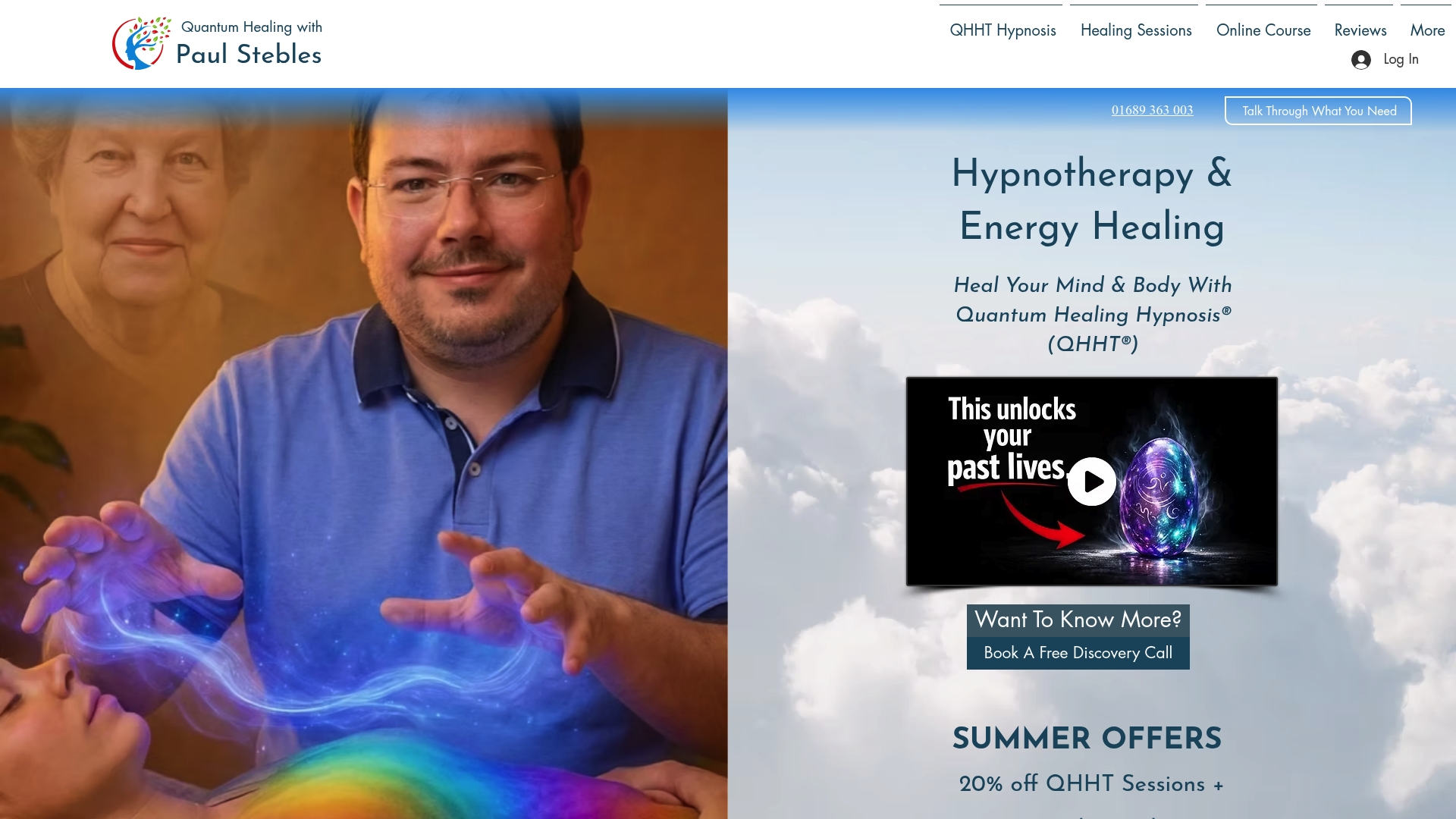
You can see how it works in our guide to life purpose hypnosis in the UK, read about past life regression and purpose, or book a session through the calendar. If you would rather start at home, our Rising Higher online course offers structured exercises and video content for anxiety and depression.
FAQ
Is soul purpose the same as life purpose?
Not quite. Soul purpose is the deeper sense of why you are here, while life purpose is how it shows up in your work, relationships and interests right now. Your life purpose can change over the years, while the underlying thread often stays recognisable.
How long does it take to discover your soul purpose?
There is no set timeline, and it is better thought of as a gradual process. Many people notice clearer themes after two or three weeks of daily journaling and reflection. Small experiments over the following months then help those themes become choices.
Can hypnosis help with life purpose?
Many people find that deep relaxation makes it easier to reflect and to hear their own intuition. In our QHHT® sessions, we guide you to explore your subconscious and connect with your higher self, and you can bring your own questions about direction. Experiences vary from person to person.
What if I feel too anxious or low to think about purpose?
Start with calm, not answers. Grounding, breathing and gentle routines come first, and your GP is the right person to speak to if low mood or anxiety is affecting daily life. Once you feel steadier, reflection becomes much easier.
Sources
Your purpose isn’t something to find, it’s something you form (Psyche)
Why the search for meaning can cause purpose anxiety (The Seattle Times)
Soul Searching: What It Actually Means and How to Do It (Verywell Mind)
What matters for our sense of purpose? (What Works Wellbeing)
Purpose in life and depression and anxiety meta-analysis (PubMed)
Sense of control and meaning helps protect women from anxiety (University of Cambridge)
Effects of meaning-centred therapies (Palliative & Supportive Care)
Recommended
Comments