Throat chakra blocked: how to tell and what to do


If your throat chakra is blocked, the most telling signs are difficulty saying what you actually mean, a persistent lump-in-throat sensation, and chronic tension in your neck, jaw, or shoulders. The good news is you can begin releasing that tension quickly.
Two immediate actions to try right now:
Lion’s Breath with ‘HAM’ sound: Inhale deeply through your nose, then exhale forcefully through your mouth with your tongue extended, making a “HAM” sound as you release. Repeat three times slowly. This combines breathwork with the bija mantra associated with Vishuddha, the throat chakra, and can shift stuck energy almost immediately.
Gentle neck rolls: Drop your chin to your chest, then slowly roll your head to the right, back, left, and forward again. Do two full circles in each direction, breathing steadily throughout.
Pro Tip: If you feel a sudden urge to cry or laugh during these exercises, let it happen. That release is often the point.
One important caveat: if you have persistent difficulty swallowing, unexplained voice loss, a lump that does not resolve, or any other worrying physical symptom, see your GP before attributing it to an energy imbalance.
Key takeaways
A blocked throat chakra shows most clearly as difficulty expressing your truth, physical tension in the throat and neck, and a persistent pattern of swallowing what you actually want to say. The most effective approach combines immediate breathwork and sound practices with a structured daily routine and, where patterns run deep, professional energy-healing support.
Point | Details |
Recognise the pattern | Emotional signs (fear of speaking, people-pleasing) and physical signs (hoarseness, neck tension) together suggest a throat-chakra imbalance. |
Start with sound and breath | Lion’s Breath and ‘HAM’ chanting take under two minutes and can shift acute tension immediately. |
Follow the 7-day routine | Each day targets a different layer: breath, body, journalling, movement, voice, listening, and review. |
Seek medical advice for physical symptoms | Persistent swallowing difficulty, unexplained voice loss, or an unresolved lump needs a GP review before energetic work. |
Paulstebles offers deeper support | In-person and remote QHHT and energy-healing sessions address the subconscious patterns behind communication blocks. |
Table of Contents
What is the throat chakra (Vishuddha) and what does it govern?
Vishuddha is the fifth chakra in the traditional yogic model, located at the centre of the throat, roughly at the level of the cervical spine. Its name translates from Sanskrit as “pure” or “purification.” In energetic terms, it sits between the heart (emotion) and the third eye (thought), acting as the channel through which inner experience becomes outward expression.
The chakra model describes energy as flowing through the body in currents. When that flow is unobstructed at the throat, communication feels natural and honest. When it is restricted, the energy does not disappear; it stagnates, and that stagnation tends to show up in predictable ways across body and behaviour.
The throat chakra’s primary functions include:
Speaking your truth clearly and without excessive fear
Listening with genuine attention, not just waiting to respond
Creative expression through voice, writing, or art
Governing the physical systems of the throat: vocal cords, thyroid, jaw, and cervical vertebrae
What are the signs of a blocked throat chakra?
Yoga Journal notes that physical symptoms associated with throat-chakra imbalance include thyroid issues, hoarseness, sore throats, TMJ, and neck and shoulder tension. The emotional picture is equally specific.
Emotional signs | Physical signs |
Fear of speaking up or being judged | Persistent sore throat or hoarseness |
People-pleasing; saying yes when you mean no | Lump-in-throat sensation |
Rehearsing conversations but never having them | Neck, jaw, or shoulder tension |
Feeling your words are not worth hearing | Chronic throat-clearing |
Difficulty putting thoughts into words | Thyroid sensitivity or imbalance |
Replaying past conversations, wishing you’d said something different | TMJ or teeth-grinding |
Swallowing anger or grief rather than expressing it | Restricted breathing or shallow breath |
Siddhi Yoga’s diagnostic guide also identifies an overactive pattern, which is just as much an imbalance as the blocked one. Signs of an overactive throat chakra include:
Talking over others or dominating conversations
Compulsive over-sharing or inability to keep confidences
Harsh, critical, or cutting speech
Restlessness when required to be quiet
Difficulty listening without interrupting
Pro Tip: A lump in your throat during a moving piece of music or a moment of deep gratitude is not a blockage. Art of Living explains that intense grief or gratitude can produce a natural upward energy surge through the chest and throat. The distinction is persistence: a chronic pattern across many situations, not a single emotional moment.
What causes a throat chakra blockage?
Most throat-chakra blockages have identifiable roots, and recognising yours makes the healing work more targeted.
Interpersonal and developmental causes:
Being told as a child that your opinions did not matter, or that children should be seen and not heard
Repeated dismissal, ridicule, or punishment for speaking up
Growing up in a household where conflict was avoided at all costs, making honest expression feel dangerous
Public-speaking humiliation (a classroom incident, a presentation that went badly) that lodged as a physical memory
Internal drivers:
Chronic anxiety, which tightens the throat and makes the voice feel unreliable
Perfectionism: waiting until you can say something perfectly before saying it at all
People-pleasing as a survival strategy, where keeping others comfortable matters more than your own truth
Fear of judgement, rejection, or being seen as difficult
Everyday situations reinforce these patterns quietly. A workplace culture where speaking up is subtly punished, a relationship where one partner consistently talks over the other, or a social circle where vulnerability is met with deflection: all of these can maintain a blockage that started somewhere else entirely. Insights by Omkar points out that habitual silence often has clear social origins, and that rebuilding vocal confidence works best when you start in low-stakes contexts, speaking small truths before the bigger ones.
Quick self-check: is your throat chakra blocked?
Answer yes or no to each question. Be honest; no one else is reading this.
Do you regularly rehearse what you want to say but then say something different, or nothing at all?
Do you find yourself agreeing with people to avoid conflict, even when you disagree?
Do you experience a persistent sore throat, hoarseness, or throat-clearing that has no clear medical cause?
Do you feel your voice shakes, goes quiet, or disappears when you need to say something important?
Do you frequently swallow your feelings rather than express them?
Do you feel tension in your neck, jaw, or shoulders that worsens in stressful social situations?
Do you find it hard to ask for what you need, even from people you trust?
Do you often feel that what you have to say is not worth the risk of saying it?
Scoring:
5 or more “yes” answers: A blocked or underactive throat chakra is a likely pattern. The practices in the next section are a good starting point.
3–4 “yes” answers: A partial or situational imbalance. You may find certain contexts (work, family) trigger the pattern more than others.
Mostly “yes” to the physical questions but few emotional ones: Rule out a physical cause first. See your GP if symptoms are persistent.
This quiz is not a medical diagnosis. Persistent physical symptoms, particularly difficulty swallowing, voice changes, or a lump that does not resolve, need a GP review regardless of your score.
How to unblock your throat chakra: practical methods that work
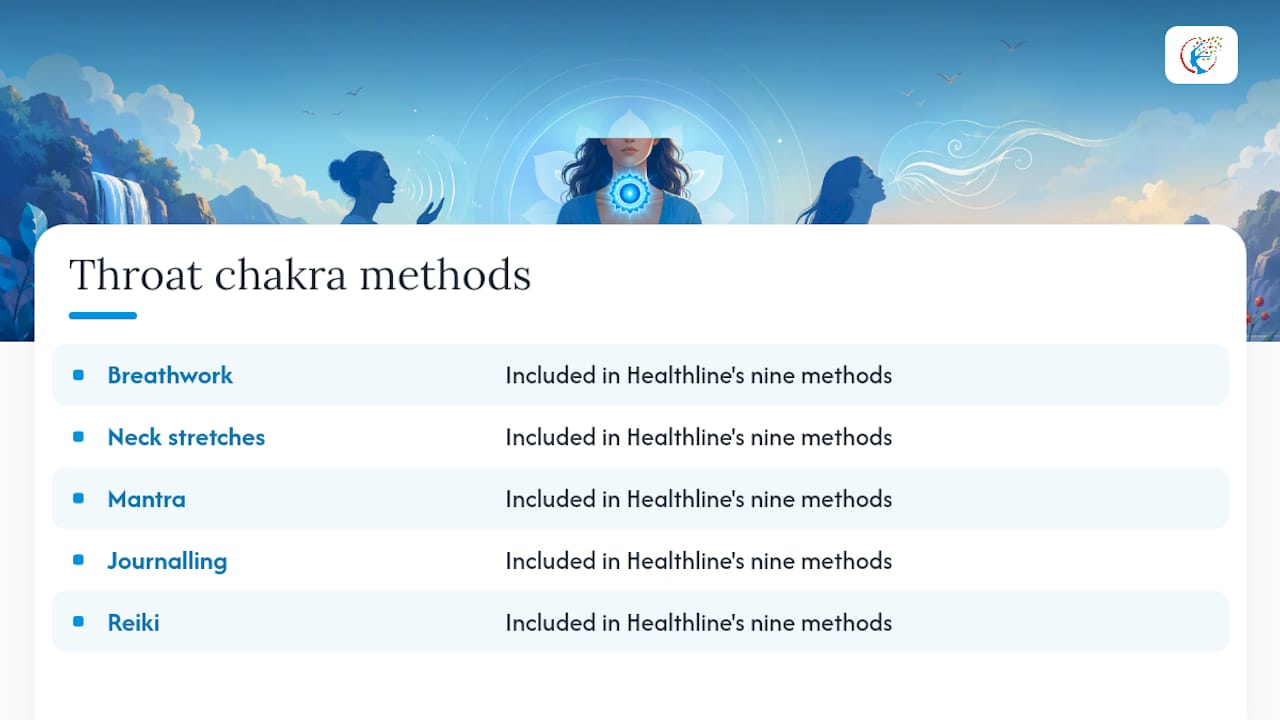
Healthline outlines nine practical methods for healing an unbalanced throat chakra, including breathwork, neck stretches, mantra, journalling, and Reiki. Here is how to use the most accessible ones, from a 60-second fix to a daily practice.
Immediate micro-practices (60–120 seconds)
Lion’s Breath (Simhasana Pranayama): Kneel or sit comfortably. Inhale through your nose, then exhale sharply through your mouth with your tongue extended downward and your eyes wide. Make a “HA” sound on the exhale. Three rounds is enough to feel a shift in throat tension.
Chanting ‘HAM’: Sit quietly, close your eyes, and on each exhale, chant “HAM” (pronounced “hum”) at a comfortable pitch. Feel the vibration in your throat and chest. Even two minutes of this can interrupt a pattern of held tension.
Humming: Simply hum any note for 30 seconds. The vibration directly stimulates the vagus nerve and the tissues of the throat. It sounds almost too simple, but the physical effect is real.
Daily practices
Neck and shoulder stretches: Ear-to-shoulder stretches, slow neck rolls, and shoulder shrugs held for five breaths each. Do these before any speaking-intensive activity.

Truth journalling: Set a timer for ten minutes and write without editing. The rule is simple: write what you actually think, not what you think you should think. Burn or delete it afterwards if that makes honesty easier.
Mindful speaking: Once a day, say one true thing you would normally swallow. Start small. “I’d prefer not to” to a colleague. “I’m struggling with this” to a friend. The practice is the repetition, not the size of the truth.
Movement and creative expression
Singing, even badly and alone in your kitchen, is one of the most direct ways to open the throat chakra. The combination of breath, vibration, and emotional expression does what no stretch can replicate. Group singing, choir, or even a drama class adds the social dimension that many blockages specifically need.
Arhant Yoga’s guidance on throat-chakra balance also highlights yoga poses such as Fish Pose (Matsyasana), Camel Pose (Ustrasana), and Cat-Cow (Marjaryasana-Bitilasana) as particularly useful for opening the throat and chest.
Safety caveats: If you have a diagnosed cervical spine condition, avoid deep neck rolls and check with your GP or physiotherapist before attempting any neck-intensive yoga poses. If you have a vocal cord condition, avoid forceful chanting and opt for gentle humming instead. Anyone with a respiratory condition should approach breathwork gradually and stop if they feel dizzy or short of breath.
On crystals: Blue lace agate, aquamarine, and lapis lazuli are commonly used as supportive adjuncts in throat-chakra work. They are not treatments, but many people find holding or wearing them during meditation or journalling helps maintain focus on the intention. Use them as a prompt, not a cure.
Pro Tip: The most underrated throat-chakra practice is listening. Genuinely listening to someone else, without planning your response, exercises the receptive side of Vishuddha just as much as speaking does.
How does an overactive throat chakra differ from a blocked one?
An overactive throat chakra is not the opposite of a blocked one in the way you might expect. Siddhi Yoga notes that overactivity can function as a compensation for earlier suppression: excessive talking is sometimes a cover for a deep fear of vulnerability, not evidence that expression is healthy.
Signs of an overactive throat chakra:
Talking compulsively, even when you have nothing meaningful to add
Interrupting others mid-sentence
Harsh or critical speech that you later regret
Difficulty sitting in silence without discomfort
Sharing more than the situation calls for
The remedy is not enforced silence. It is selective, heartfelt expression. Three practices that help:
Listening meditation: Sit quietly for five minutes and focus entirely on the sounds around you. No commentary, no labelling. Just receive.
The 3-second rule: Before speaking in conversation, pause for three seconds. Ask yourself: is this true, is it kind, and does it need to be said now? You will not always wait, but the habit gradually shifts the pattern.
Core-truth journalling: When you notice you have been talking a lot, write down what you were actually trying to say underneath all of it. Often it is something much simpler and more vulnerable than what came out.
When should you see a GP, a therapist, or an energy healer?
Medical red flags: see your GP promptly
Persistent difficulty swallowing or a feeling that food is sticking
Unexplained voice loss or hoarseness lasting more than three weeks
A lump in your throat or neck that does not resolve
Breathing difficulties or stridor (a high-pitched sound when breathing)
Pain in the throat or ear that does not improve
These symptoms need medical evaluation before any energetic work. The NHS offers clear guidance on throat and voice symptoms at Nhs, and your GP can refer you to an ENT specialist if needed.
Mental-health support
If anxiety, trauma, or chronic stress are driving your communication difficulties, a mental-health professional is the right first port of call. NHS Talking Therapies (formerly IAPT) offers free access to CBT and other therapies via self-referral in England. SAMHSA and UK mental-health organisations both emphasise trauma-informed care: when expression difficulties are rooted in earlier trauma, specialist support should run alongside, not instead of, any energetic or somatic work.
Choosing an energy-healing practitioner
When you are ready to work with a practitioner, ask these questions before booking:
What training and qualifications do you hold, and are they verifiable?
How do you handle clients who have trauma histories or active medical conditions?
Do you work alongside, not instead of, conventional medical care?
What does a typical session involve, and what integration support do you offer afterwards?
For UK readers, you can use Qualitycheck as a starting point to check practitioner credentials and complaints history. Paul Stebles’ guide on how to choose the right energy healing practitioner is also a practical resource for anyone navigating this decision in the South East.
A 7-day starter routine to open your throat chakra
This routine is designed to be low-risk, time-efficient, and genuinely progressive. Each day builds on the last without overwhelming you.
Practitioner tips for pacing this well:
Do not skip Day 3. Journalling is where most people meet the actual blockage, not the symptom.
If Day 5 feels impossible, start with two minutes of humming in the shower. The goal is vibration, not performance.
Combine body-based and vocal practices where you can; the physical and energetic layers reinforce each other.
Pro Tip: After completing the 7-day routine, most people find one or two practices that resonated far more than the others. Those are your practices. Build your ongoing routine around them rather than maintaining all seven.
Realistic expectations: within one week, many people notice a small but clear shift, a conversation they handled differently, a moment of speaking up that surprised them, or simply less physical tension in the neck and jaw. Deeper patterns, particularly those rooted in childhood or trauma, take longer and often benefit from professional support alongside self-practice.
What working with throat-chakra blockages has taught me
Most people who come to me with communication difficulties are not struggling because they lack courage. They are struggling because somewhere along the way, speaking their truth produced a consequence that felt too costly: rejection, ridicule, conflict, or simply being ignored. The body remembers that cost and starts protecting against it automatically.
What I find in QHHT and energy-healing sessions is that the throat-chakra blockage is rarely the whole story. It is usually the surface expression of something held deeper, a belief about worthiness, a pattern inherited from family dynamics, or an unresolved moment that the subconscious is still managing. When we access those deeper layers, the throat tends to release on its own. Clients often describe feeling a physical warmth or loosening in the throat area during or after a session, without any direct work on the throat itself.
Sessions are structured to feel safe. There is no pressure to speak, perform, or produce insights on demand. Integration suggestions are offered afterwards, and I always recommend that clients with active physical symptoms maintain concurrent GP care. Energy healing works best as a complement to, not a replacement for, conventional medicine.
If any of this resonates, you are welcome to read more on the Paulstebles blog or get in touch to discuss whether a session might be a useful next step for you.
How Paulstebles can support your throat-chakra healing

Paulstebles offers in-person and remote energy healing sessions that include chakra balancing, Reiki, cord cutting, and emotional release work, alongside QHHT sessions that access the subconscious to address the deeper patterns behind communication blocks. Where self-practice reaches its limit, professional session work can reach further.
A typical session begins with a conversation about what you are experiencing, followed by the healing or hypnosis work itself in a calm, structured environment. Afterwards, integration suggestions are provided so the work continues beyond the session. For those who want to understand QHHT in more detail before committing, the QHHT FAQ page covers the most common questions clearly.
If you are ready to go deeper, you can book a QHHT or energy healing session directly online. As always, if you have persistent physical symptoms, please consult your GP alongside any energetic work you undertake.
Sources
Recommended
Comments