3 Moves for Fast Health Anxiety Relief: NHS Aligned UK Body First Plan
- Paul Stebles

- 2 days ago
- 9 min read
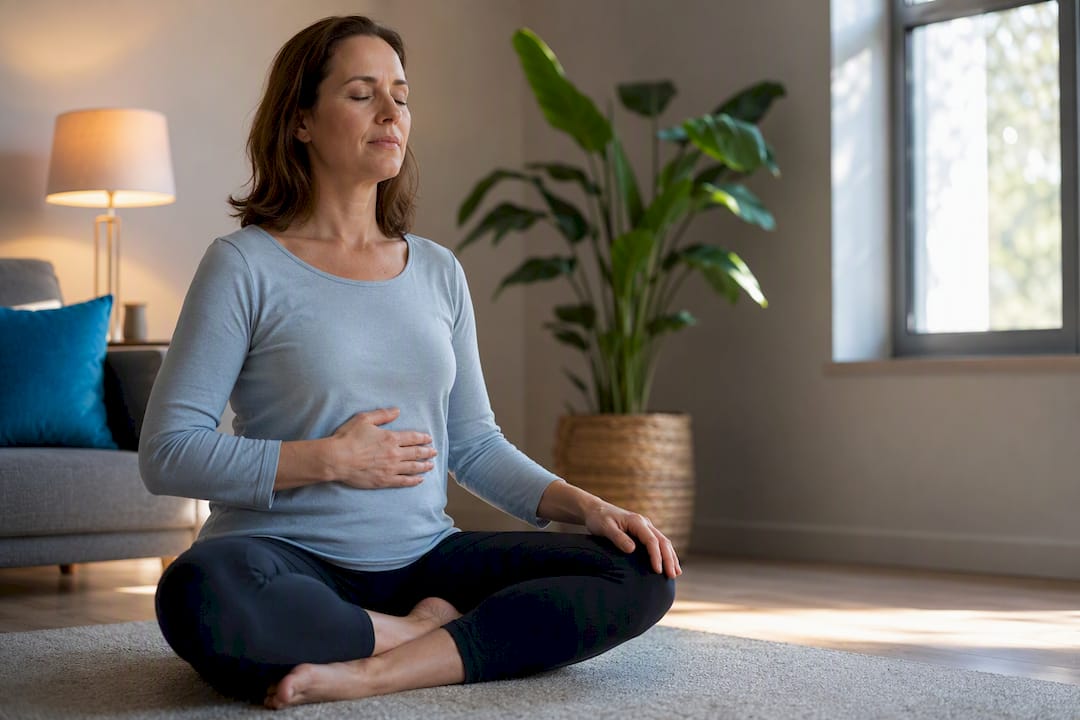
The fastest relief comes from three moves done together: slow your breathing and ground your body for two minutes, stop checking or Googling symptoms for the rest of the day, and book a short daily “worry time” instead of ruminating all day. If health anxiety is disrupting your work, sleep, or relationships most days, talk to your GP about CBT or self-refer to NHS talking therapies rather than waiting it out alone.
TL;DR:
Relying on breathing, grounding, and distraction techniques offers quick relief but should be used to calm before engaging in longer-term exposure and response prevention strategies.
Building awareness through a symptom diary and thought records helps identify patterns, showing relief from checking often lasts less than an hour.
Limiting search behaviors, setting a fixed worry time, and gradually returning to avoided activities can weaken the cycle of health anxiety over time.
Consulting a GP for diagnosis and evidence-based treatments like cognitive behavioral therapy is crucial when anxiety severely impacts daily life.
Maintaining progress involves periodic reviews of triggers, tools, and exposure work, with relapse viewed as part of the process rather than failure.
Table of Contents
Signs of health anxiety: how to tell if this guide applies to you
Practical self-help toolkit: step-by-step techniques to reduce checking and calm your body
How to access support (NHS self-referral, charities and private therapy costs)
Coping with health anxiety during pandemics or widespread health scares
Editorial take: what most health anxiety advice gets backwards
Signs of health anxiety: how to tell if this guide applies to you
Health anxiety rarely announces itself as anxiety. It shows up as certainty that something is physically wrong, dressed up as caution rather than fear.
The behaviours are fairly consistent from person to person, even when the feared illness changes:
Repeated body-checking: pressing on lumps, monitoring your heartbeat, scanning your skin for new marks
Reassurance-seeking: asking a partner, friend, or GP the same question in slightly different ways
Searching symptoms online, often late at night, until a rare but frightening explanation feels like the likely one
Avoiding health-related triggers altogether, such as hospital dramas, health news, or medical appointments
Needing repeated tests or scans even after a clinician has said everything is normal
Here’s the complication almost nobody explains well: anxiety itself produces real physical sensations. A racing heart, tight chest, dizziness, and headaches are all standard products of a stressed nervous system, not proof that something sinister is happening. The Mayo Clinic notes that people with health anxiety commonly misread these anxiety symptoms as evidence of serious illness, which then drives more checking, more adrenaline, and more symptoms. It is a loop that feeds itself.
You’re looking at a clinical-level problem, not just a bad week, when the worry persists despite medical reassurance, when it eats an hour or more of your day, or when it is shrinking your work, sleep, or social life. If that description fits, the techniques below are the right starting point, and a conversation with your GP is worth having sooner rather than later.
Practical self-help toolkit: step-by-step techniques to reduce checking and calm your body
This is the working toolkit. None of it requires special equipment, and most of it can start today.
Start a symptom diary. Each time you notice a worry spike, write down the trigger, the sensation, what you did next (checked, searched, asked someone), and how long the relief lasted. Patterns emerge within a week, usually showing that relief from checking rarely lasts more than an hour.
Run a two-column thought record. On one side, write the catastrophic thought (“this headache means something is seriously wrong”). On the other, write the balanced alternative based on evidence (“I’ve had headaches before after poor sleep, and they’ve always resolved”). This is a technique the NHS specifically recommends for health anxiety.
Set a fixed worry time. Pick 15 minutes, same time each day, and postpone all health worries to that slot. When a worry hits at 11am, note it down and tell yourself you’ll deal with it at 6pm. Most people find the worry has lost most of its charge by the time the slot arrives.
Challenge catastrophic interpretations directly. Ask yourself: what’s the most likely explanation, not just the scariest one? How many times has this exact sensation turned out to be nothing? What would I tell a friend who described this to me?
Use paced breathing for acute spikes. Breathe in for four counts, hold for four, out for six. Ninety seconds of this changes your physiological state enough to think clearly again.
Ground yourself in the room. Name five things you can see, four you can hear, three you can touch. It interrupts the spiral by forcing your attention outward.
Delay and distract rather than suppress. A ten-minute walk, a phone call, or a task that needs your hands often does more than trying to force the thought away.
Return to avoided activities gradually. If you’ve stopped going to the gym because exercise makes your heart race, go back in small, planned steps rather than waiting until the fear disappears completely, which it won’t do on its own.
Cap your searching. Set a hard rule: no symptom searches after a set time, and one search maximum before switching to a distraction task.
Protect sleep, movement, and moderate caffeine and alcohol. Poor sleep amplifies bodily sensations and makes catastrophic thinking easier; regular movement does the opposite.
Pro Tip: Breathing exercises and grounding are brilliant for the moment, but clinicians warn that leaning on them every single time a sensation appears can turn them into safety behaviours, the same trap as checking or reassurance-seeking. Use them to get calm enough to think, then deliberately sit with some uncertainty rather than reaching for a ritual every time. The goal is tolerance of uncertainty, not permanent avoidance of discomfort.
The mechanism behind all of this is worth understanding, because it explains why checking never actually helps long term. Health anxiety runs on a specific cycle: you perceive a threat, you check or seek reassurance, you get temporary relief, and then your sensitivity to the next sensation goes up rather than down. Breaking that cycle, according to NHS-aligned self-help guidance, means exposing yourself to the trigger and deliberately not performing the checking response, so your brain relearns that uncertainty is survivable without a ritual attached to it.
When to see a GP and evidence-based treatments to expect
A GP visit isn’t an admission that you’re “just anxious”. It’s a genuine diagnostic step. Your GP will do a physical examination, ask about your symptom history, and rule out organic causes before anything else, because anxiety-driven sensations can genuinely mimic illness. Once physical causes are excluded, the conversation shifts to psychological treatment.
Cognitive behavioural therapy is the first-line treatment for health anxiety, and it works by directly targeting the checking cycle described above. A core component is exposure and response prevention: you’re gradually exposed to the trigger (a bodily sensation, a hospital waiting room, a health news story) while resisting the urge to check or seek reassurance, so the anxious response weakens over repeated exposure.
Medication has a place too, though it’s rarely the whole answer:
SSRIs are the most commonly prescribed medication for persistent health anxiety, often used alongside therapy rather than instead of it
Short-term benzodiazepines are sometimes used for acute crisis periods, but carry dependency risks and aren’t a long-term strategy
Any medication decision should weigh benefits against side effects with your GP, not be self-managed
CBT for health anxiety typically runs for around 12 to 20 sessions, and progress tends to look like fewer checking episodes and shorter recovery time after a worry spike, not the total disappearance of anxious thoughts. If you or someone you know is experiencing thoughts of self-harm, or health anxiety has become severely impairing, that’s an urgent situation. Contact your GP immediately, call 111, or go to A&E if there’s immediate risk.
How to access support (NHS self-referral, charities and private therapy costs)
You can self-refer directly to many NHS talking therapies services in England without seeing your GP first, which cuts out a step and often speeds things up. Seeing your GP first still makes sense if you want a physical check alongside the referral, or if your symptoms are complex.
If you’d rather go private, or the NHS waiting list feels too long, costs vary but follow a fairly predictable pattern:
Private therapy for anxiety in the UK typically starts from around £35 per session
Some charitable or low-cost services offer sessions from roughly £15, which matters if cost is the barrier rather than availability
Local guides such as this mental health support directory list community and low-cost options worth checking before committing to a private practice
Before booking anyone privately, ask three things: do they have specific experience treating health anxiety with CBT, do they use exposure and response prevention rather than just talking therapy, and what’s the cancellation and fee structure. While you wait for a first appointment, structured self-help workbooks and worksheet-based modules give you something concrete to work through immediately.
Expert perspective: nervous-system regulation, grounding and how hypnotherapy can be a complementary option
Cognitive techniques like thought records work far better once your body isn’t in a state of alarm. That’s the practical case for somatic regulation: short grounding exercises create a physiological window where rational thinking is actually possible again, rather than trying to out-argue a racing heart.
A few practitioner-level points worth knowing:
Paced breathing and grounding lower physiological arousal quickly, which is what makes the subsequent thought-challenging step effective rather than futile
Regulation practice done daily, not just during a crisis, tends to build broader tolerance for uncertainty over weeks
Nervous-system regulation work sits comfortably alongside CBT; it isn’t a replacement for it
Some people explore hypnotherapy, including Quantum Healing Hypnosis Technique, as a complementary route for deeper relaxation and exploring the emotional roots of persistent worry, though it should sit alongside, not instead of, medical assessment and evidence-based therapy
Pro Tip: If you notice the same sensation triggering panic every time, try mindfulness-based breathing practice as a daily habit rather than only reaching for it mid-crisis. Prevention tends to outperform rescue.
Discuss any complementary approach, including hypnotherapy, with your GP or therapist first, particularly if you’re also taking medication or actively working through CBT.
Coping with health anxiety during pandemics or widespread health scares
Widespread health scares are the stress test for everything above, because the environment itself starts behaving like your anxious brain normally does: constant updates, worst-case headlines, and other people visibly worried too. That combination validates catastrophic thinking in a way ordinary health anxiety never gets.
The core strategy doesn’t change, but the discipline needs to tighten. Limit news and social media checking to fixed times, ideally once or twice a day rather than continuously, and choose one or two reliable sources rather than scrolling widely. Apply the same worry-time principle to pandemic-specific fears as you would to a health symptom: note the worry, schedule it, move on.
Distinguish precautions that genuinely reduce risk from rituals that only reduce anxiety temporarily. Handwashing before meals is proportionate; repeatedly re-washing until it “feels right” is a safety behaviour dressed up as hygiene. The same checking-and-relief cycle that drives ordinary health anxiety applies here, just with a socially reinforced trigger.

If a health scare is dominating your thinking for weeks rather than days, that’s a signal to lean harder on the structured tools already covered, the diary, the thought record, the worry time, rather than assuming the anxiety is simply “appropriate” because everyone else is anxious too. Collective anxiety is still anxiety, and it responds to the same techniques.
Long-term maintenance and relapse prevention techniques
Health anxiety has a tendency to resurface during periods of stress, illness in the family, or after a genuine health scare, even once you’ve made real progress. That’s not a sign the earlier work failed.
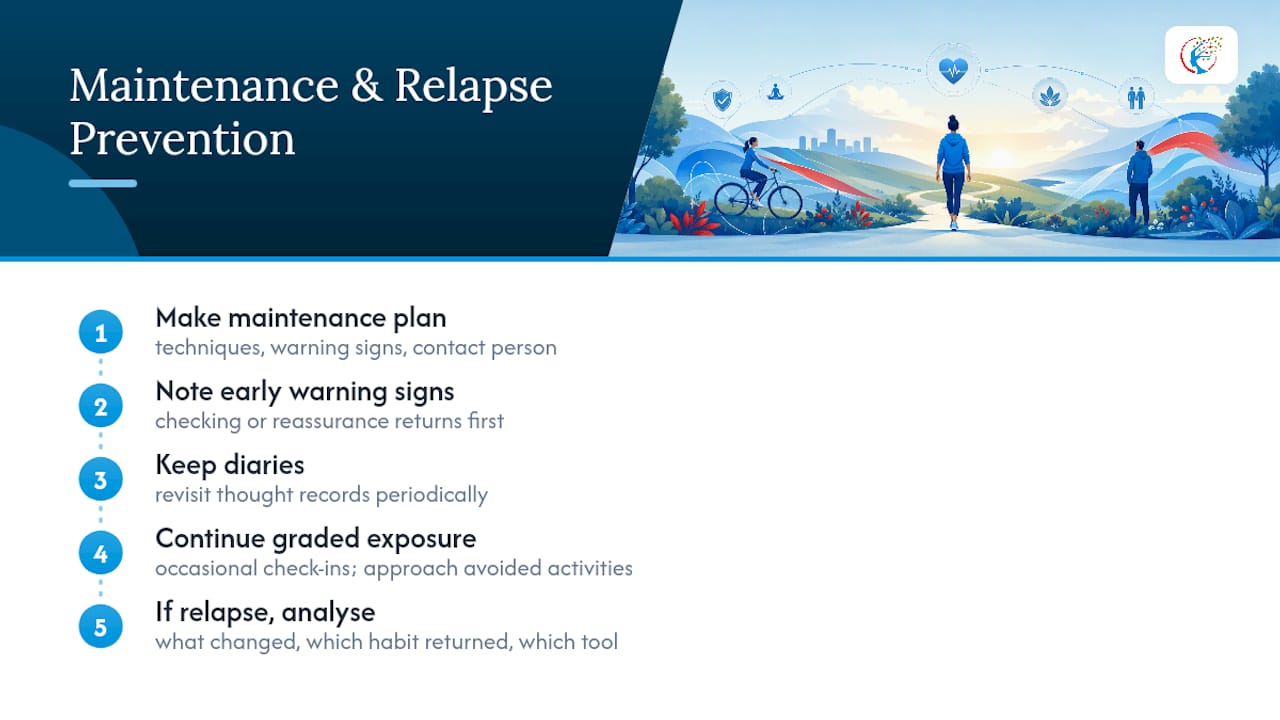
Build a short personal maintenance plan once the acute phase has settled: which techniques worked best for you specifically, what your early warning signs look like (usually a return of checking or reassurance-seeking before the worry itself returns), and who you’ll contact if things escalate again. Revisit your diary and thought records periodically rather than discarding them once you feel better; they’re a record of what your specific triggers and balanced counter-thoughts actually are.
Keep light contact with the graded exposure work even after avoided activities feel manageable again. Anxiety has a habit of quietly re-establishing avoidance once the pressure to fight it eases, so an occasional deliberate check-in, going to that appointment you’d normally dodge, sitting with a sensation without checking it, keeps the gains in place. If a relapse does happen, treat it as data rather than failure: what changed, what old habit crept back in, and which tool from your toolkit needs picking back up first.
Editorial take: what most health anxiety advice gets backwards
Most guidance treats health anxiety as a knowledge problem, as if the right fact about your symptoms will finally make the fear stop. It won’t, and the diary evidence backs this up: relief from checking rarely survives the hour. The real lever is tolerance of uncertainty, built through exposure and response prevention, not through better reassurance.
Where I think the conventional advice underperforms is in treating breathing and grounding as the whole solution. They’re a bridge to clearer thinking, not a cure, and overusing them just swaps one safety behaviour for another. Prioritise the structural work first: diary, thought records, worry time, and a GP conversation about CBT if daily functioning is affected. Nervous-system regulation and complementary approaches like hypnotherapy earn their place afterwards, supporting that structural work rather than substituting for it.
— Paul
This article is general information, not a substitute for advice from a qualified doctor. Consult a qualified healthcare professional about your own circumstances before acting on anything here.
Sources
Recommended
Comments