Interrupt rumination in 90 seconds with a body reset and worry slot


The fastest way to stop rumination is a two-step move: a short physiological reset (such as slow breathing or a brief walk), followed immediately by naming your looping thought and placing it into a fixed worry slot later that day. Do that now, before reading on. The sections below explain why this pairing works and how to build it into a lasting habit.
TL;DR:
Brief physiological resets combined with naming and scheduling worries are among the fastest ways to interrupt rumination.
Cognitive restructuring takes longer but changes underlying thought patterns, while body resets provide immediate relief.
Persistent rumination that interferes with daily life or involves suicidal thoughts requires professional therapy beyond self-help methods.
Tracking progress over a structured week with specific tools increases chances of breaking loops rather than relying on vague intentions.
Guided somatic and hypnosis sessions can enhance traditional techniques by calming the nervous system and addressing root patterns.
Table of Contents
What is rumination and why it matters
Rumination is the habit of replaying the same negative thought, mistake or worry over and over without ever reaching a resolution. It runs like a treadmill: plenty of mental effort, no forward movement. The American Psychiatric Association frames it exactly this way, and notes it raises the risk of both depression and anxiety the longer it continues unchecked.
Reflection, by contrast, moves towards an answer. Rumination just circles.
Common content includes:
Replaying an awkward conversation and searching for what you “should have said”
Rehearsing a mistake at work long after it’s been fixed
Worrying about a decision that’s already been made and can’t be changed
Lying awake reworking an argument that finished hours earlier
Recognising the pattern is the first real skill. Most people don’t notice they’re ruminating until they’re twenty minutes deep into it.
Common causes and triggers
Rumination rarely strikes at random. It tends to cluster around specific moments in the day and specific mental states.
Everyday triggers include:
Uncertainty about an outcome you can’t control (a job result, a health test, a relationship conversation)
Social stress, particularly after a perceived slight or awkward exchange
Bedtime, when there’s nothing left to distract the mind
The commute home, when the day’s stresses finally have room to surface
Automatic negative thoughts (quick, distorted judgements like “I always mess this up”) feed the cycle by supplying fresh material every few minutes. Cognitive distortions, such as catastrophising or all-or-nothing thinking, make each replay feel more urgent than the last.
Physical state matters just as much as mental state. Fatigue lowers your capacity to challenge a thought, and poor sleep both causes and worsens rumination, creating a loop where overthinking disrupts sleep and disrupted sleep fuels more overthinking. Tension in the body, especially a tight jaw, shoulders or chest, often shows up before you consciously register the thought spiral at all.
An evidence-based map of what actually works
Four technique families cover almost everything that reliably interrupts rumination, and each suits a different moment or type of person.
Cognitive tools (CBT): catch the thought, examine the evidence, choose a more balanced version. Best for people who like structure and are willing to write things down.
Mindfulness and acceptance: observe the thought without engaging it, then return attention to the present. Best for people whose rumination has a strong emotional charge.
Behavioural containment: scheduled worry time, activity planning, deliberate distraction. Best as a first-line habit for almost everyone.
Physiological resets: breathing, grounding, brief movement. Best when you need to interrupt a spiral in under two minutes.
A peer-reviewed comparison of brief interventions found that distraction, problem-solving, and mindfulness all reduced rumination in the young people studied, which is worth sitting with: there is no single correct method, only the right tool for the moment you’re in.
The trade-off comes down to speed versus durability. A breathing exercise works in ninety seconds but the relief tends to fade quickly if nothing else changes. Learning to restructure a thought takes longer to master but changes the pattern at its root over weeks.
Pro Tip: If you’re not sure where to start, pick based on what your body is doing right now. Racing heart or tight chest means start physiological. Calm body but a thought on repeat means start cognitive or mindfulness.
How to use CBT to catch, check and change a thought
Cognitive restructuring is a core CBT technique, and the NHS Every Mind Matters guidance sets out a version of it that works well against rumination specifically:
Catch it. Notice the thought and write it down word for word, e.g. “I ruined that meeting by saying the wrong thing.”
Check it. Ask what evidence actually supports it, and what evidence contradicts it. Did anyone say the meeting was ruined, or is that your interpretation?
Change it. Write a more balanced version: “I said one thing I’d phrase differently, but the meeting covered everything it needed to.”
Doing this in the moment is hard when a thought has real emotional pull. That’s where a scheduled 10 to 15 minute daily “worry slot” earns its place. The Cleveland Clinic describes fixed worry time as an effective way to contain intrusive rumination, because you’re not suppressing the thought, just deferring it to a slot where you can actually work through it properly.
Cognitive restructuring doesn’t produce instant relief. It works cumulatively, softening the automatic pull of a distorted thought over repeated practice.
Mindfulness and acceptance based approaches
Trying to force a thought out of your head usually backfires. Suppression tends to make an unwanted thought louder, and Harvard Health points to mindfulness as the better route because it changes your relationship with the thought instead of fighting it directly.
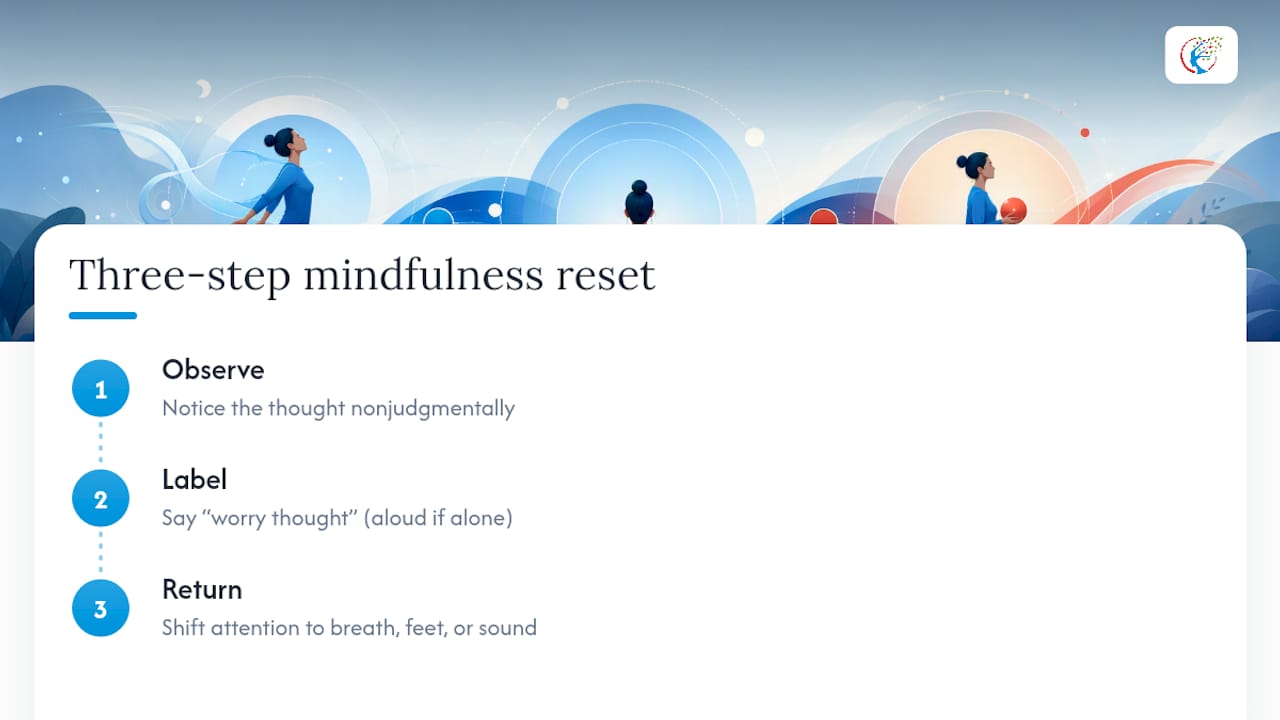
A simple three-minute practice: observe the thought without judging it, label it (“that’s a worry thought”), then return attention to something sensory, your breath, the feeling of your feet on the floor, a sound nearby.
Acceptance-based methods suit thoughts about things you genuinely can’t change right now. If there’s a concrete action available, take it instead. That’s the difference between accepting and problem-solving, and it’s worth learning to tell the two apart.
Pro Tip: Label the thought out loud if you’re alone. Saying “worry thought” instead of just thinking it adds a small but real layer of distance.
Breathing, grounding and movement to reset the body first
Short bursts of deep breathing and brief movement lower physiological arousal quickly, and Psychology Today links this to activation of vagal pathways that calm the stress response.
Three fast options:
60-second grounding: name five things you can see, four you can hear, three you can feel, then two you can smell.
Two-minute breath protocol: inhale for four counts, hold for four, exhale for six. Repeat for eight rounds.
Movement micro-break: two minutes of stairs, a short walk, or star jumps if you’re at a desk.
Pairing a body reset with a cognitive step, like the catch and check routine above, tends to work better than either alone, because a calmer nervous system makes a reframed thought easier to accept. For a fuller routine, the somatic grounding steps and the grounding for anxiety techniques both build on this same principle.
Are you problem solving or just ruminating?
Ask yourself one question: can you name a single concrete action you could take in the next 24 hours? If the answer is yes, you’re planning. If the answer is no, you’re almost certainly ruminating.
Notice you’ve been circling the same worry for more than a few minutes.
Ask the 24 hour action question.
If there’s an action, take the smallest version of it now. If there isn’t, write the worry down and move it into your scheduled worry slot.
Example: worrying about a friendship going quiet has no 24 hour action beyond “wait and see”, so it belongs in worry time. Worrying about an unpaid invoice does have an action: send a follow up email today. Take it and the loop usually stops on its own.
When to seek professional help
Most rumination responds to self-help tools within weeks. Some doesn’t, and that’s worth taking seriously rather than pushing through alone.
Watch for these signs:
Rumination is interfering with work, relationships or basic daily tasks
You feel unable to disengage from the thoughts even briefly
You’re withdrawing from people or activities you’d normally enjoy
Any thoughts of suicide or self-harm, which need immediate attention
Harvard Health lists persistent impairment and suicidal ideation as clear signals that self-help alone isn’t enough. CBT has the strongest evidence base for rumination-related difficulties, and a therapist can build a structured plan around triggers specific to you rather than generic advice. A first session usually involves mapping when rumination happens and what it tends to be about, then agreeing which techniques to trial first.
If you’re in crisis, contact your GP, NHS 111, or the Samaritans on 116 123 straight away.
A simple 7 day plan to reduce rumination
A short structured week beats an open-ended intention every time, because it forces you to actually try each tool rather than just read about it.
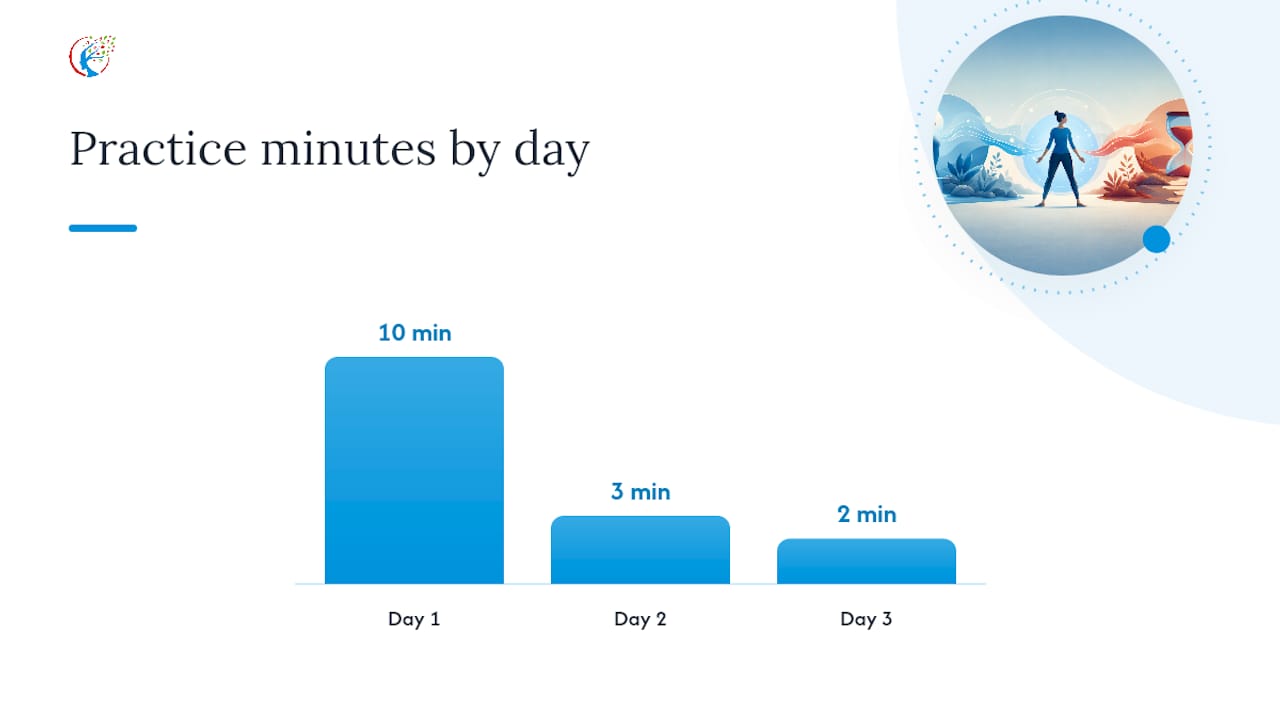
Day 1: Set a 10 minute worry slot at the same time each day, and use it once.
Day 2: Add a 3 minute mindfulness practice each morning.
Day 3: Insert a 2 minute movement break whenever you notice looping thoughts.
Day 4: Write one full thought record using catch, check, change.
Day 5: Repeat your favourite tool from days 1 to 4, whichever felt most useful.
Day 6: Combine a body reset with a thought record the moment rumination starts.
Day 7: Review your notes and keep only what actually helped.
Track progress with one line each night: “Today rumination was [better/same/worse] because ___.” Adapt freely, someone with a rigid nine to five can lock the worry slot to lunchtime, while shift workers might anchor it to their first break instead. A regular routine around sleep and daily structure makes every other tool here work better.
Pro Tip: Don’t judge day one by day seven’s results. The worry slot especially takes three or four uses before it starts feeling natural instead of forced.
How guided somatic work fits alongside these techniques
Everything above works on its own, but many people find the cognitive steps land more easily once the body has settled first. That’s the logic behind pairing breathing or grounding with a thought record, and it’s also the reasoning behind guided somatic and hypnotherapy sessions: calming the nervous system tends to make the mind more receptive to the reframing work that follows.
A practitioner has experience helping clients work through this kind of stuck pattern, using Quantum Healing Hypnosis Technique and energy healing to support deeper release alongside the practical tools above. These sessions aren’t a replacement for CBT or mindfulness, they’re a complementary route for people who want guided support getting there. If persistent rumination feels bigger than daily self-help can shift alone, booking a session is a sensible next step.
— Paul
Ready for guided support beyond self-help?
If you’ve tried the worry slot, the breathing resets, and the thought records and rumination still has its grip on you, a guided route can get you further, faster than working through it alone. A trained practitioner can offer a calm, structured space to work directly with subconscious patterns rather than leaving you to interpret them solo.

Sessions cover Quantum Healing Hypnosis Technique for exploring the roots of a recurring pattern, energy healing for emotional release, and a structured online course for anxiety and depression for those who prefer working through material at their own pace. All three suit people who’ve already tried the practical steps above and want deeper, guided support to finish the job. Visit Paulstebles to check available session times and book what fits.
Sources
This article is general information, not a substitute for advice from a qualified doctor. Consult a qualified healthcare professional about your own circumstances before acting on anything here.
Recommended
Comments