Sleep paralysis spiritual meaning: a calm, practical guide


Yes, sleep paralysis can carry real spiritual meaning for the person experiencing it, and it also has a clear physiological explanation. Both things are true at once. If you’re mid episode right now: try to stay calm, take slow exhales, and gently wiggle a toe or finger. Most episodes last under two minutes and are not medically dangerous.
Right now: breathe slowly, focus on a small movement, wait it out.
Longer term: read on for what different traditions believe it means, why your brain does this, and when it’s worth seeing a doctor.
Key Takeaways
Sleep paralysis combines a genuine physiological event, REM atonia paired with hallucination, with meanings that different traditions and individuals interpret differently, and both layers deserve attention.
Point | Details |
It’s common, not rare | Roughly 7.6% of people experience it once, rising to 28.3% among students. |
Spiritual readings vary widely | Interpretations range from spiritual attack to visitation to Jungian shadow work. |
Triggers are largely manageable | Irregular sleep, stress, and alcohol are among the biggest levers you can control. |
Simple actions help mid episode | Slow breathing and small movements like wiggling a toe can shorten the fear. |
Frequent episodes need medical review | Daytime sleepiness or very frequent episodes warrant a GP or sleep clinic referral. |
Table of Contents
What actually happens during sleep paralysis
Sleep paralysis happens when your mind wakes up before your body does. You surface into consciousness while REM related muscle atonia, the temporary paralysis that stops you acting out dreams, is still switched on, and the brain often layers vivid hypnagogic or hypnopompic hallucinations on top, according to a clinical synthesis on NCBI Bookshelf. You’re awake, aware, and unable to move, sometimes for the most unsettling minute of your year.
It’s more common than most people assume. A systematic review found that A minority of the general population report at least one episode in their lifetime, with notably higher rates among students likely due to irregular sleep schedules., likely because of irregular sleep schedules.
Typical features include:
A crushing sense of pressure on the chest
A vivid feeling that someone or something is in the room
Inability to speak or move despite full awareness
Duration of a few seconds up to roughly two minutes
The next sections cover the meanings people give this experience, what triggers it, and how to respond.
Common spiritual and religious interpretations
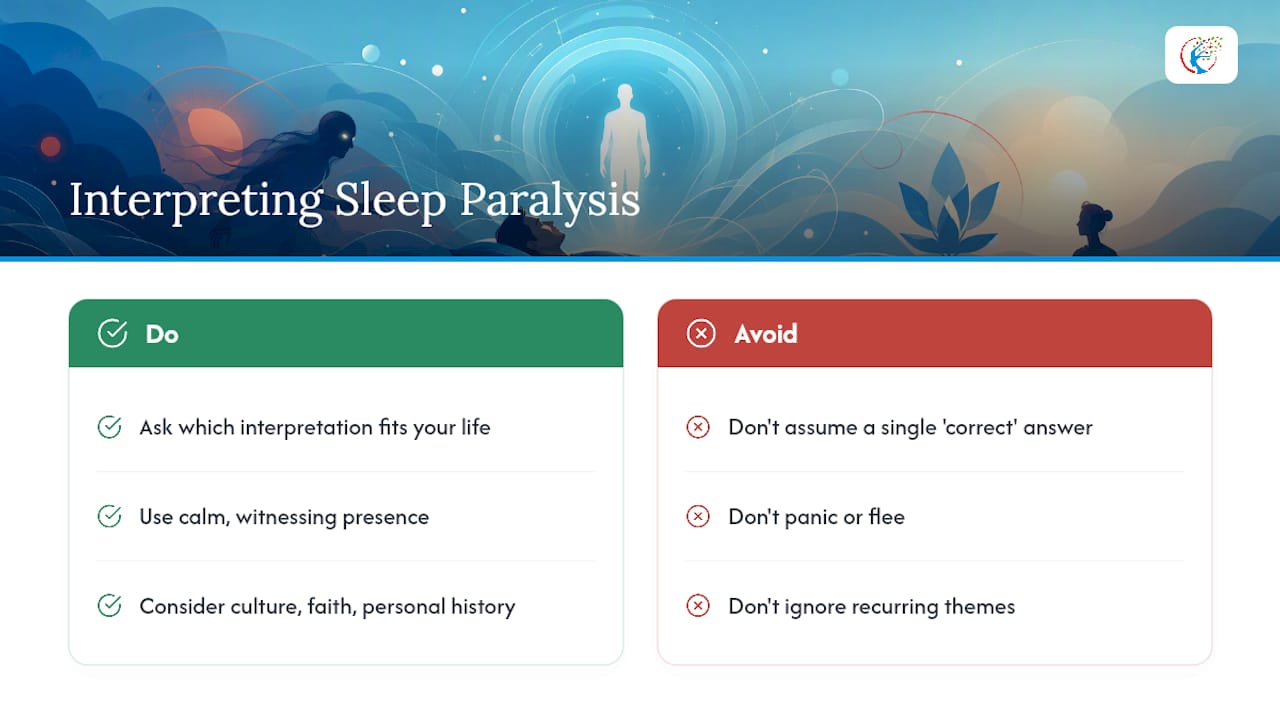
Multiple spiritual meanings attach to sleep paralysis, and which one resonates tends to depend on your culture, faith, and personal history rather than any single “correct” answer.
Spiritual attack or demonic presence. Many people describe a malevolent force pinning them down, sometimes reported as witch riding or an incubus sitting on the chest. This reading is old and remarkably consistent across unconnected cultures.

Visitation from the deceased or ancestors. Some interpret the presence not as hostile but as a departed relative trying to make contact, especially when the episode follows a bereavement.
Astral projection or out of body experience. Practitioners of astral travel sometimes treat the paralysis itself as the doorway, the moment the body locks down so consciousness can, in their framework, step outside it. Academic work on abduction narratives and sleep paralysis explores how this same physiology may underpin some alien abduction reports.
Jungian archetype and shadow work. In this reading, the “intruder” figure is a rejected or unintegrated part of the self surfacing at the threshold between waking and dreaming, an invitation to face rather than flee.
Spirit guides or higher self contact. Some spiritual teachers frame the state as an opportunity to receive guidance, recommending calm, witnessing presence rather than panic.
Pro Tip: Ask yourself which interpretation fits the rest of your life, not just the episode. A recurring shadow figure that appears alongside unresolved grief or anger points towards Jungian integration work; a presence that feels externally hostile and unfamiliar may sit better within a protective or devotional framework.
Why the mind reaches for spiritual explanations
The sheer intensity of the imagery pushes most people toward transcendent explanations rather than mundane ones. Nobody wakes from a paralysed, hallucinating state and immediately thinks “REM atonia.”
The hallucinations are unusually vivid and multisensory, unlike an ordinary dream
The “threatening presence” theme recurs across cultures with no shared folklore
Existing religious or cultural frameworks give the fear somewhere to go
The threat response amplifies whatever the mind is already primed to see
Research on sleep paralysis across cultures found that a majority of subjects interpret the episode as a spiritual or supernatural event, and the sense of a threatening presence shows up whether or not the person had any prior exposure to relevant folklore.
What triggers an episode
Disrupted sleep and REM dysregulation cause most cases, and several factors make that disruption more likely, which is why understanding Delta Sleep Inducing Peptide science can be helpful for managing sleep quality.
Irregular sleep schedules or sleep deprivation
Shift work that fights your natural circadian rhythm
Narcolepsy and other REM sleep disorders
Stress, anxiety, or PTSD
Alcohol or recreational drug use
Certain medications affecting REM sleep
Sleeping flat on your back
Harvard Health links several of these to REM transition disruption directly, which means the fix is often unglamorous: a fixed sleep and wake time, cutting evening alcohol, and managing stress through whatever actually works for you. If episodes keep recurring despite these changes, that’s worth raising with a doctor, covered further below.
How to respond during and after an episode
Simple, deliberate actions can shorten an episode and take real fear out of it, even though they won’t stop the paralysis instantly.
During the episode:
Remind yourself, even mid panic, that this is sleep paralysis and it will pass.
Breathe slowly and deliberately, focusing on long exhales rather than gasping.
Try to move one small thing first, a finger or a toe, rather than fighting the whole body at once.
If it fits your beliefs, silently repeat a prayer, mantra, or protective phrase, which some Christian communities use through deliverance prayer and invocation.
Ground yourself in a sense, listening for a real sound in the room or feeling the mattress beneath you.
After the episode:
Sit up, switch on a light, and let your nervous system settle before trying to sleep again.
Write down what you saw or felt while it’s fresh, useful whether you’re processing it spiritually or just tracking patterns.
If the same figure or theme recurs, treat that as data worth exploring rather than random noise.
Pro Tip: Wiggling toes works because it’s a small, achievable motor task that reconnects you to voluntary movement, unlike trying to sit bolt upright, which usually fails and increases panic.
If episodes bring daytime sleepiness or other worrying symptoms, medical advice matters more than any coping technique, which the next section covers.
When to see a doctor about sleep paralysis
Seek medical review when episodes are frequent, disabling, or accompanied by other sleep disorder symptoms, rather than relying on coping strategies alone.
Excessive daytime sleepiness most days
Cataplexy, sudden muscle weakness triggered by emotion
Very frequent episodes, several times a week
Pauses in breathing during sleep, reported by a partner
Symptoms suggesting a mood or psychotic disorder
Concerns about alcohol or substance use affecting sleep
A GP or sleep clinic will typically take a sleep history, screen for narcolepsy, review any medications, and may refer you for a sleep study. The NHS notes that sleep paralysis is usually harmless on its own, but recurrent cases deserve proper assessment rather than guesswork.
How spiritual therapy and hypnotherapy help you integrate the experience
For some people, understanding the biology isn’t enough to settle the fear, and that’s where integration focused spiritual work earns its place alongside medical advice. Sessions combining regression hypnotherapy with energy healing give you a structured, guided space to explore what the presence or figure means to you personally, rather than leaving it as an unprocessed fright.
A typical QHHT session involves an initial intake conversation, a guided relaxation into a light trance state, exploration of relevant memories or subconscious material, and time afterwards to talk through what surfaced.
Before booking with any practitioner, it’s worth asking:
What does a typical session actually involve, step by step?
How do they handle fear based or frightening material if it comes up?
What kind of aftercare or follow up do they offer?
If you’d like guided support making sense of a recurring sleep paralysis experience, Paulstebles offers QHHT and energy healing sessions designed around exactly this kind of exploration.
What the evidence actually supports
Most articles on this topic pick a side, either dismissing spiritual readings as ignorance or ignoring the physiology entirely. Neither position holds up. The research on cross-cultural interpretation is fairly unambiguous: people with no shared folklore independently describe the same threatening presence, which suggests the biology creates fertile ground for spiritual meaning rather than spiritual meaning being pure invention layered on afterwards.
Where conventional advice falls short is stopping at “it’s just REM atonia, don’t worry.” That’s medically accurate and emotionally useless to someone who just felt something sit on their chest. The more useful move is treating the spiritual interpretation as real data about your inner life, worth exploring through whatever framework fits you, prayer, Jungian reflection, or guided hypnotherapy, while still keeping an eye on the practical triggers that make episodes more frequent.
Prioritise the coping mechanics first. Fear response, more than the paralysis itself, is what most people find unbearable, and calming that down changes the whole experience.
Frequently asked questions
Can sleep paralysis really be a spiritual experience? For many people, yes, in the sense that it feels profoundly meaningful and often gets interpreted through a spiritual or religious lens, even though the underlying mechanism is REM related muscle atonia combined with hallucination.
Why do so many cultures describe the same “presence” during sleep paralysis? Cross-cultural research suggests the vivid, threat-shaped nature of the hallucination itself pushes people toward similar interpretations, independent of shared folklore or religious background.
Is sleep paralysis dangerous? No, it’s generally not dangerous on its own and typically lasts under two minutes, though frequent episodes alongside daytime sleepiness warrant a medical check.
What’s the difference between sleep paralysis and astral projection? Sleep paralysis is a documented physiological state; astral projection is a spiritual framework some people apply to the same experience, treating the paralysis as a threshold rather than purely a neurological event.
Can hypnotherapy help with recurring sleep paralysis fear? Some clients find that regression hypnotherapy and energy healing sessions help them process and reframe recurring episodes, particularly when a specific figure or theme keeps appearing.
This article is general information, not a substitute for advice from a qualified doctor. Consult a qualified healthcare professional about your own circumstances before acting on anything here.
Sources
Recommended
Comments