Anhedonia recovery: a practical plan to feel pleasure again


Anhedonia can improve, and for many people it improves faster once they stop treating it as ordinary low mood and start treating it as a reward-circuit problem. That distinction changes what you do next. Standard advice for sadness (talk about your feelings, wait it out) rarely touches the flatness that anhedonia brings. What does help: brief behavioural activation tasks started this week, a medication review with a clinician if you’re already on an antidepressant, and tracking your symptoms on a validated scale so you and your prescriber can monitor any changes.
Start here, in the next 48 to 72 hours:
Pick one small, concrete activity you used to enjoy (even 10 minutes) and schedule it at a fixed time, not “when you feel like it.”
If you take an SSRI or SNRI and pleasure hasn’t returned, book an appointment to discuss whether it’s contributing to the problem.
Fill in the Snaith–Hamilton Pleasure Scale (SHAPS) once this week as a baseline, so future changes are measurable rather than guessed at.
If you have any thoughts of self-harm, can’t eat or manage basic care, or feel your situation is getting rapidly worse, contact a GP, crisis line, or emergency service today rather than waiting on self-help steps.
Pro Tip: Don’t wait for motivation before you act. With anhedonia, motivation often returns after the activity, not before it. Do the small task first and let the feeling catch up.
Key Takeaways
Anhedonia recovery works best when behavioural activation, targeted medication or neuromodulation, and validated measurement tools like SHAPS are combined rather than used in isolation.
Point | Details |
Act before you feel like it | Start small behavioural activation tasks now; motivation typically follows action, not the other way round. |
Measure, don’t guess | Use SHAPS or TEPS at baseline and every few weeks to track whether treatment is actually working. |
Look beyond SSRIs if stuck | Ask a prescriber about bupropion, vortioxetine, agomelatine, brexpiprazole, or ketamine if flatness persists on standard antidepressants. |
Consider neuromodulation for persistent cases | TMS shows growing evidence for reward-specific improvement, often via specialist referral. |
Support recovery with complementary care | Paulstebles offers QHHT and energy healing sessions as an adjunct to conventional treatment, alongside a self-guided online course. |
Table of Contents
What is anhedonia and how does it affect the brain’s reward system?
How do you tell anhedonia apart from feeling numb or just low?
What daily habits actually help rebuild the capacity for pleasure?
Which therapies are best suited to restoring pleasure and motivation?
Which medications and clinic treatments target reward deficits directly?
Do TMS, tDCS and other brain stimulation treatments actually work for anhedonia?
What does the research actually say about targeted anhedonia treatment?
Where complementary approaches like hypnotherapy and energy healing fit in
What is anhedonia and how does it affect the brain’s reward system?
Anhedonia is the reduced ability to feel pleasure or interest in things that used to matter to you, whether that’s food, hobbies, sex, or company. It’s not unique to depression. Anhedonia shows up in substance use recovery, schizophrenia, Parkinson’s disease, and even in some physical illnesses, which is why clinicians call it transdiagnostic rather than a single-condition symptom.
The mechanism is different from sadness. Sadness is an emotional response; anhedonia is closer to a wiring fault in how your brain processes reward. Dopamine pathways running from the ventral tegmental area to the nucleus accumbens normally light up in anticipation of something good, then again when you get it. In anhedonia, that anticipatory signal often goes quiet first. Researchers have also flagged the lateral habenula, a small structure that acts almost like a brake on reward circuits, as overactive in some people with persistent anhedonia, along with disrupted connectivity between the brain’s reward and executive control networks.
This is exactly why treating anhedonia as “just” low mood can leave people stuck. A narrative review of anhedonia treatments notes that anhedonia is often transdiagnostic and that conventional serotonergic antidepressants frequently leave residual anhedonia even when overall mood scores improve. You can feel “less depressed” on paper while still feeling almost nothing when good things happen.
That gap is measurable, not just anecdotal. Clinicians increasingly use structured tools rather than relying on how a person describes their mood in a ten-minute appointment:
SHAPS (Snaith–Hamilton Pleasure Scale): a self-report questionnaire measuring current ability to experience pleasure.
TEPS (Temporal Experience of Pleasure Scale): separates anticipatory pleasure (wanting) from consummatory pleasure (liking), which matters because they can be affected differently.
MADRS anhedonia items: a subset of the Montgomery-Åsberg Depression Rating Scale clinicians use to isolate anhedonia within a broader depression assessment.
A simple way to picture this: imagine two dials on a control panel, one for “wanting” and one for “liking.” Depression and addiction can turn either dial down independently, which is why some people crave nothing (low wanting) while others go through the motions of pleasurable activities but feel nothing when they arrive (low liking). Knowing which dial is affected shapes which treatment is likely to help.
How do you tell anhedonia apart from feeling numb or just low?
Anhedonia has a specific shape, and recognising it helps you describe it accurately to a clinician instead of defaulting to “I’m just depressed.”
Watch for this pattern:
Anticipatory loss: you no longer look forward to things, even ones you know you used to enjoy.
Consummatory loss: you do the activity anyway and it produces little or no pleasure once you’re there.
Social withdrawal that isn’t about anxiety: you’re not avoiding people out of fear, you simply don’t feel pulled towards contact.
Selective flatness: your capacity for other emotions, like irritation, guilt, or worry, may still be intact even while pleasure specifically is gone.
That last point is the clearest differentiator from general low mood, where most emotional experience feels muted together. Emotional numbness, often described after trauma or dissociation, tends to flatten the whole emotional range rather than pleasure alone. Anhedonia can sit inside a broader low mood, but it can also appear on its own, which is part of why it gets missed.
Some signs need immediate attention rather than a wait-and-see approach:
Thoughts of suicide or self-harm.
Inability to eat, wash, or manage basic daily care.
Rapid worsening over days rather than weeks.
Using alcohol or drugs to fill the emotional gap.
If any of those apply, contact a GP, mental health crisis service, or emergency department the same day. For everyone else, it’s worth writing a short symptom log; something as simple as “things I used to enjoy,” “how much I wanted to do them this week (0 to 10),” and “how much I enjoyed them when I did (0 to 10)” gives a clinician far more to work with than “I feel flat.”
What causes anhedonia and what makes it worse?
Anhedonia rarely has a single cause. The most common driver is major depressive disorder, but it’s also one of the defining features of prolonged substance use and early recovery from addiction, where repeated exposure to drugs or alcohol has effectively hijacked the dopamine reward system, leaving natural rewards like food, connection, or achievement feeling flat by comparison.
A few other contributors worth checking before assuming it’s “just depression”:
Medication effects: some antidepressants, particularly certain SSRIs, are associated with blunted emotional response in a subset of patients, sometimes called emotional blunting rather than classic anhedonia, but the experience overlaps considerably.
ADHD and other neurodevelopmental conditions: chronic under-stimulation of dopamine pathways in ADHD can look similar to anhedonia, and untreated ADHD can worsen it.
Inflammation and physical illness: conditions involving chronic inflammation, thyroid dysfunction, and some neurological disorders have documented links to reduced reward sensitivity.
Sleep deprivation and chronic stress: both directly dampen dopamine signalling over time.
Substance withdrawal deserves particular attention here. During active addiction, the brain adapts to a flood of dopamine by scaling back its own natural production and receptor sensitivity. When the substance is removed, that recalibration doesn’t happen overnight. Some clinical literature and patient guidance point out that misdiagnosing this post-dependence anhedonia as simple depression can lead to treatment that doesn’t address the actual reward deficit, which is one reason recovery can stall even when someone is doing “everything right.”
Before assuming the cause is straightforward, it’s worth ruling out or flagging: disrupted sleep, ongoing alcohol or drug use (including cannabis), thyroid problems, and any new medication started around the time symptoms began. A GP can order basic bloodwork to screen for the medical contributors in a single appointment.
What daily habits actually help rebuild the capacity for pleasure?
The single most evidence-backed principle here is deceptively simple: act first, feel later. This is the foundation of behavioural activation, and it works because waiting to “feel like it” before doing anything keeps the reward circuit starved of the small wins it needs to recalibrate. As WebMD’s coverage of reward-processing treatments puts it, structured, purposeful tasks can retrain reward associations even before motivation naturally returns.
Start with activities graded by effort, not by how appealing they sound, because appeal is exactly what anhedonia switches off first:
Step outside for five minutes, no destination required.
Make one phone call or send one message to someone you trust.
Cook one meal from scratch, even something basic.
Do ten minutes of light movement, a walk, stretching, or a short cycle.
Complete one small task you’ve been avoiding (a load of washing, one email).
Spend fifteen minutes on a hobby you used to enjoy, without pressure to “enjoy” it.
Sit in daylight for ten minutes, ideally within an hour of waking.
Say yes to one low-stakes social invitation, even briefly.
Sleep, light, movement, and diet aren’t separate wellness advice bolted onto this. They directly affect the same dopamine and serotonin systems anhedonia disrupts. Morning light exposure helps reset circadian rhythm, which in turn supports more stable dopamine release throughout the day. Regular exercise, even modest amounts, increases dopamine receptor sensitivity over time. Practical self-care measures such as exercise, sleep, diet, sunlight, and social contact are consistently recommended as baseline supports that work alongside, not instead of, targeted clinical treatment.
A simple day might look like: wake at a consistent time, ten minutes outside before breakfast, one scheduled activity mid-morning, a short walk after lunch, one social contact in the afternoon, and a wind-down routine with no screens for the last half hour before bed. Log each activity with two numbers: how much you expected to enjoy it (0 to 10) and how much you actually did. The gap between those numbers, tracked over a few weeks, tells you far more than your mood alone.

Pro Tip: Expect flat results at first. The point of early behavioural activation isn’t to enjoy the activity, it’s to prove to your brain that action still leads somewhere. Enjoyment tends to lag behind engagement by two to three weeks.
Manage your own expectations here as carefully as you manage the schedule. Social reconnection especially tends to feel effortful before it feels rewarding, and one flat interaction doesn’t mean the approach isn’t working. Discouragement after a single bad day is the most common reason people abandon behavioural activation right before it starts paying off.
Which therapies are best suited to restoring pleasure and motivation?
Behavioural activation (BA) is often considered a first-line psychotherapy specifically for anhedonia because it directly targets the cycle of low engagement and reduced reward, rather than working indirectly through mood or thought patterns.
Other approaches serve different roles:
Behavioural activation: structured activity scheduling with graded tasks, ideally tracked against a baseline like SHAPS. Strongest evidence base for anhedonia specifically.
CBT adaptations focused on reward: traditional cognitive behavioural therapy addresses negative thought patterns; anhedonia-adapted versions add explicit focus on pleasure and reward prediction rather than just cognitive distortion.
Mindfulness-based approaches: useful for reducing avoidance and rumination that can compound anhedonia, though evidence for anhedonia specifically is less robust than for BA.
Savoring techniques: deliberately slowing down and attending to positive experiences as they happen, useful once some baseline engagement has returned.
Positive Affect Treatment (PAT): a newer, more targeted intervention explicitly designed to boost positive emotion and reward sensitivity rather than only reducing negative symptoms.
If you’re choosing a therapist, ask directly whether they use activity scheduling, whether they track outcomes with a scale like SHAPS or TEPS, and how they’ll adjust the plan if early tasks produce no change in pleasure ratings after several weeks. A therapist who treats anhedonia as identical to general depression, rather than as its own target, is more likely to default to talk-focused work that doesn’t move the reward needle quickly.
Which medications and clinic treatments target reward deficits directly?
If you’ve been on an SSRI or SNRI for months and the sadness has lifted but the flatness hasn’t, that’s not you failing to recover, it’s a known limitation of these drugs. Research summarising targeted treatments for anhedonia points specifically to bupropion, vortioxetine, and ketamine as promising alternatives because they act on different systems than standard serotonergic antidepressants.
Here’s how the main options differ:
Bupropion: works primarily on dopamine and norepinephrine rather than serotonin, and is often specifically chosen when anhedonia or emotional blunting persists on an SSRI.
Vortioxetine: a multimodal antidepressant with effects across several serotonin receptor subtypes, studied for improved outcomes on measures of pleasure and cognition, not just mood.
Agomelatine: acts on melatonin and serotonin receptors, notable for a side-effect profile that avoids the sexual dysfunction and emotional blunting sometimes associated with SSRIs.
Brexpiprazole: typically used as an add-on to an existing antidepressant, working partly through dopamine receptor modulation.
Ketamine and esketamine: glutamate-modulating agents that can produce rapid effects, sometimes within hours to days rather than the weeks typical of standard antidepressants, and are usually reserved for treatment-resistant depression under specialist supervision.
Recent literature on anhedonia treatment specifically singles out dopamine-focused agents like bupropion and brexpiprazole, alongside glutamate-modulating drugs like ketamine, as more directly addressing motivational deficits than conventional SSRIs.
None of this is a shopping list to bring to a pharmacy. These are prescription-only medications, several used off-label for anhedonia specifically, and all require a prescriber’s assessment of your history, other medications, and risk factors. Ketamine and esketamine in particular carry monitoring requirements around blood pressure and dissociative side effects, and are typically only available through specialist mental health services or approved clinics rather than a general practice. In the UK, esketamine nasal spray is licensed for specific treatment-resistant depression indications under specialist supervision; ketamine used more broadly for depression remains largely in specialist or research settings. If you think medication is contributing to your anhedonia, or that a different medication might help more, raise it directly with your prescriber rather than adjusting doses yourself.
Do TMS, tDCS and other brain stimulation treatments actually work for anhedonia?
Repetitive transcranial magnetic stimulation (TMS) has a growing evidence base for anhedonia specifically, and interestingly, some data suggests it can improve reward-related symptoms faster than it improves depressive symptoms more broadly. Clinical commentary on reward-processing treatments describes standard TMS protocols as daily sessions over several weeks, typically delivered in a clinic setting, targeting brain regions involved in mood and motivation regulation.
Where the other neuromodulation options stand:
tDCS (transcranial direct current stimulation): a milder, non-invasive technique using weak electrical currents; evidence for anhedonia specifically is still preliminary compared to TMS.
VNS (vagus nerve stimulation): generally reserved for treatment-resistant cases and requires a surgical implant, making it a later-line option.
ECT (electroconvulsive therapy): effective for severe, treatment-resistant depression, though its specific effect on anhedonia versus overall mood is less well characterised than TMS.
Psilocybin and aticaprant: investigational only. These remain in clinical trial stages and are not routinely available treatments; anyone interested in them should look at registered trials rather than unregulated sources.
In the UK, TMS is available through some NHS specialist mental health services (typically for treatment-resistant depression) and through private clinics, usually requiring psychiatric referral and assessment first. Investigational treatments are generally accessible only through registered clinical trials, which your GP or psychiatrist can help you locate if standard approaches haven’t worked. Expect any of these routes to involve an assessment period, a defined treatment course rather than a single session, and follow-up monitoring, not a one-off fix.
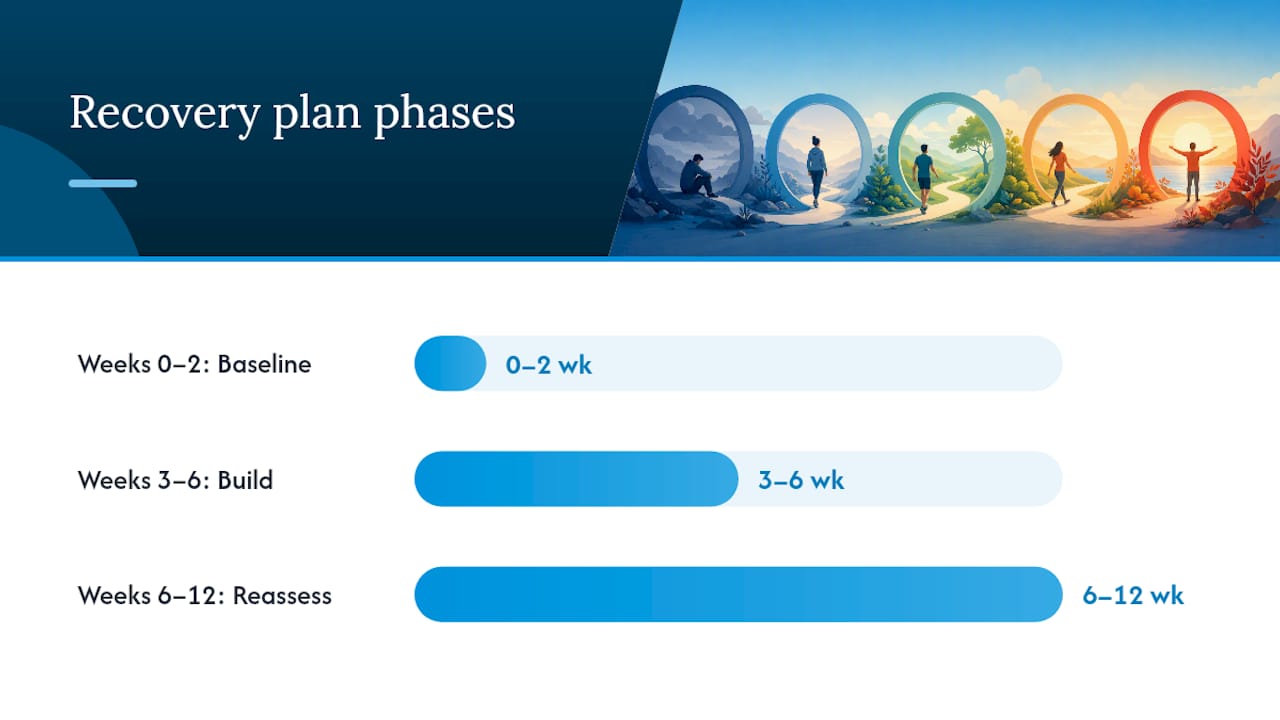
What does a realistic 6 to 12 week recovery plan look like?
Recovery from anhedonia isn’t linear, but it does tend to follow a rough shape, and having a plan stops you from either giving up too early or expecting too much too fast.
Weeks 0 to 2: baseline and stabilisation
Complete a SHAPS or TEPS assessment to establish where you’re starting from.
Begin two or three behavioural activation micro-tasks daily, chosen for low effort over high appeal.
Fix your sleep and wake times, even if sleep quality itself hasn’t improved yet.
Weeks 3 to 6: build and review
Add slightly more demanding activities, graded exposure rather than a sudden jump.
If you’re not already seeing a therapist, get a referral for behavioural activation or CBT with a reward-focused adaptation.
Review your medication with your prescriber if there’s been no change in SHAPS scores.
Weeks 6 to 12: reassess and escalate if needed
Repeat the SHAPS or TEPS measurement and compare it against your baseline.
If there’s minimal change and symptoms remain significant, discuss a medication switch, augmentation, or referral for neuromodulation such as TMS.
Build a relapse prevention plan: identify early warning signs (skipping activities, withdrawing again) and decide in advance what you’ll do about them.
Keep an activity log throughout: date, activity, expected pleasure (0 to 10), actual pleasure (0 to 10), and a short note on mood. This becomes genuinely useful data by week four or five, not just a diary exercise.
Escalate to urgent care immediately, regardless of where you are in the plan, if you develop suicidal thoughts, stop eating or caring for yourself, or feel your symptoms sharply worsening rather than plateauing. Otherwise, if week 12 arrives with no measurable movement on your scores at all, that’s the point to push for a specialist psychiatric review rather than continuing to adjust the plan alone.
How long does anhedonia recovery usually take?
Early gains often show up faster than full recovery. Behavioural activation can produce small, measurable shifts in engagement within a few weeks, and rapid-acting agents like ketamine can shift symptoms within days for some patients. Fuller, more stable recovery, where pleasure feels consistent rather than occasional, more commonly takes several months, and the timeline varies considerably depending on the underlying cause and any comorbid conditions.
Track it properly rather than relying on memory. Routine use of validated scales like SHAPS and TEPS in clinical practice gives both you and your clinician an objective way to see whether treatment is working, rather than relying on how you happen to feel on the day of an appointment. A simple weekly rating, plotted on even a basic chart, will often show an upward trend well before it feels obvious day to day.
Setbacks are normal and don’t erase progress. A bad week after three good ones isn’t a relapse, it’s part of how recovery in reward circuits typically progresses, in fits and starts rather than a straight line. Adjust the plan (scale back task difficulty, revisit the medication conversation) rather than abandoning it.
What does the research actually say about targeted anhedonia treatment?
The clearest shift in recent research is a move away from treating anhedonia as a side effect of depression and towards treating it as its own target. A comprehensive review of current and future anhedonia treatments concludes that anhedonia is transdiagnostic and responds better to interventions chosen specifically for their effect on reward circuits than to standard antidepressant treatment alone.
The strongest evidence currently sits with:
Vortioxetine and bupropion: pharmacological options with documented effects on reward and motivation beyond general mood improvement.
Ketamine: the fastest-acting option studied, though generally reserved for treatment-resistant cases under specialist supervision.
TMS: growing evidence for reward-specific improvement, sometimes ahead of broader mood gains.
Behavioural activation: the psychotherapy with the most direct mechanistic link to reward re-engagement.
Researchers increasingly argue for what’s sometimes called a “dimension-targeted” approach, treating the specific symptom domain (reward deficit) rather than the diagnostic label attached to it. Studies in this space still carry real limitations: sample sizes are often modest, and long-term outcome data beyond a year or two remains limited for several of these interventions. What’s consistent across the literature is the recommendation to measure with SHAPS or TEPS rather than relying on general mood scales, and to personalise the treatment combination to the individual rather than applying one protocol to everyone.
A short story about getting the spark back
I think about recovery from anhedonia less as a light switching back on and more as a dimmer being turned up, degree by degree, often so slowly you only notice it in retrospect. Someone I’ve heard describe this well put it as going through the motions of a Saturday morning coffee for three weeks feeling nothing, then on the fourth week, noticing the smell of it before they’d even thought about drinking it. That’s not a cure. That’s one signal, in one moment, that something is moving again.
What tends to make the difference isn’t a single treatment working alone, it’s routine holding steady while therapy and, where needed, medication do their slower work underneath it. The people who seem to do best are rarely the ones who find one perfect fix. They’re the ones who kept showing up to small scheduled tasks even when those tasks felt pointless, who stayed in contact with a clinician who was willing to adjust the plan rather than repeat the same advice for months, and who didn’t mistake a flat week for proof that nothing was working.
Progress here is genuinely gradual, and anyone promising otherwise is oversimplifying a process that involves real biology recalibrating over real time.
Where complementary approaches like hypnotherapy and energy healing fit in
Behavioural activation, medication reviews, and neuromodulation are the evidence-based backbone of anhedonia recovery, and nothing here replaces that. But many people rebuilding their capacity for pleasure are also looking for something that addresses the emotional and energetic weight sitting underneath the numbness, particularly when depression or addiction has left unresolved emotional blockages that talk therapy alone hasn’t fully touched.
That’s where Paulstebles offers something different as a complementary layer, not a substitute. Paul Stebles works with clients through in-person Quantum Healing Hypnosis Technique (QHHT) sessions, which access the subconscious mind to explore emotional patterns and gain insight into what might be holding recovery back, alongside energy healing sessions combining Reiki, chakra balancing, and cord cutting, available both in-person and remotely. For those wanting a structured self-guided option, Paul’s online course on overcoming anxiety and depression offers video content and exercises that can run alongside your existing treatment plan.
These sessions are designed to sit comfortably next to conventional care, not instead of it. If your anhedonia is severe, persistent, or accompanied by any safety concerns, please continue working with a GP, psychiatrist, or specialist mental health service first, and think of energy work as additional support for the emotional side of recovery, not a replacement for it. If that sounds like the kind of support you’re looking for, you can read more about what a QHHT session involves or book a session directly to take the next step.
Frequently asked questions
Can anhedonia go away completely? For many people, yes, particularly when the underlying cause (depression, medication, substance withdrawal) is directly addressed alongside targeted treatments like behavioural activation or reward-focused medication. Full recovery timelines vary, and some people manage residual symptoms for longer, which is why ongoing measurement with tools like SHAPS matters.
Is anhedonia the same as depression? No. Anhedonia is one specific symptom domain that can occur within depression, but it also appears in addiction recovery, ADHD, and several physical conditions. You can have depression without severe anhedonia, and you can have persistent anhedonia after your mood has otherwise lifted.
What is the fastest way to start anhedonia recovery? Begin behavioural activation immediately with small, scheduled tasks rather than waiting for motivation, and book an assessment with a GP or mental health professional to rule out medication effects and establish a SHAPS baseline. These two steps can start in the same week.
Do antidepressants help with anhedonia? Some do, but not all equally. Standard SSRIs often leave residual anhedonia even when mood improves, whereas bupropion, vortioxetine, and other dopamine or multimodal agents are more specifically studied for reward-related symptoms. This is worth discussing directly with a prescriber rather than assuming any antidepressant will address it.
When should I see a specialist rather than just my GP? If symptoms persist past 12 weeks of consistent behavioural activation and medication review, if you’re considering ketamine, esketamine, or TMS, or if you have any safety concerns at all, a referral to a psychiatrist or specialist mental health service is the appropriate next step.
Sources
Recommended
Comments